RecipeDB2: A Structured Data Framework That Makes Recipes Computable

RecipeDB2 turns 128,942 global recipes into a structured, computable dataset spanning ingredients, nutrition, and culture.
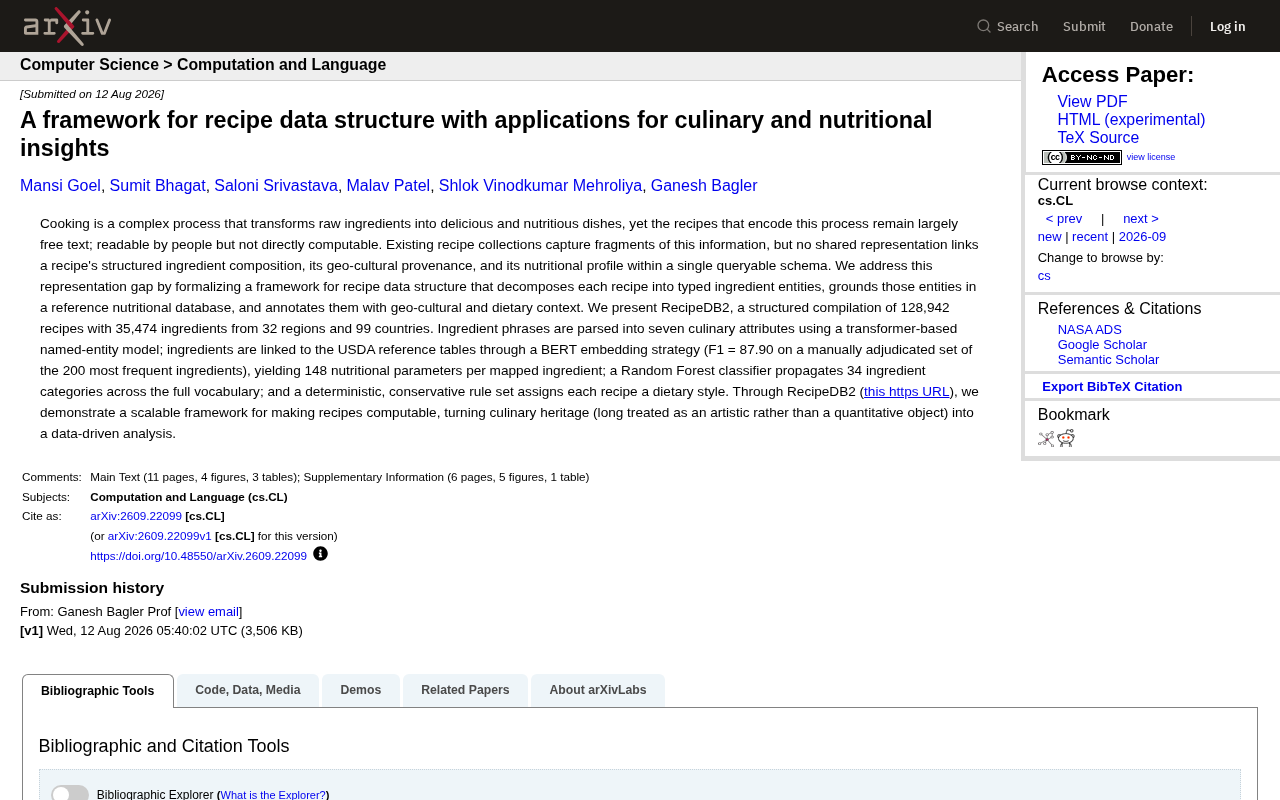
IIIT-Delhi researchers released RecipeDB2, a structured dataset of 128,942 recipes and 35,474 ingredients covering 99 countries, bridging the gap between human-readable and machine-computable recipe data. The pipeline uses Transformer-based NER to parse ingredient phrases into seven culinary attributes, BERT embeddings to link ingredients to the USDA nutrition database (F1 of 87.90 on high-frequency items, 148 nutritional parameters each), a random forest to propagate 34 ingredient categories across the full vocabulary, and rule sets to assign dietary style labels — making recipes queryable across ingredient, nutritional, and cultural dimensions for downstream research.
From Free Text to Computable Data: The Recipe Representation Problem
Cooking is a complex process that transforms raw ingredients into flavorful, nutritious dishes. Yet the recipes that encode this process have long existed as free text — readable by humans, but not directly computable by machines. Existing recipe datasets tend to capture only fragments of the full picture, lacking a unified representation that integrates structured ingredient composition, geographic-cultural provenance, and nutritional characteristics into a single queryable schema.
A new study from IIIT-Delhi (arXiv preprint) addresses precisely this "representation gap." The research team built a recipe data structure framework that decomposes each recipe into typed ingredient entities, anchors those entities to a reference nutrition database, and annotates them with geographic-cultural and dietary context.
The Core Components of RecipeDB2
The centerpiece of this work is RecipeDB2, a structured dataset compiling 128,942 recipes spanning 35,474 ingredients from 32 regions across 99 countries. At this scale, it is far more than a recipe collection — it is a computable map of global culinary culture.
Building the dataset required a combination of machine learning techniques. Ingredient phrases are parsed by a Transformer-based named entity recognition (NER) model that splits them into seven culinary attributes. Ingredients are then linked to the U.S. Department of Agriculture (USDA) reference nutrition tables using a BERT embedding strategy — achieving an F1 score of 87.90 on a human-adjudicated set of the 200 most frequent ingredients — providing 148 nutritional parameters for each mapped ingredient.
In addition, a random forest classifier extends 34 ingredient categories across the full ingredient vocabulary, while a deterministic, conservative rule set assigns dietary styles (e.g., vegetarian, vegan) to each recipe. This multi-model pipeline ensures completeness across ingredient, nutritional, and cultural dimensions.
Named entity recognition (NER) carries a more complex burden here than the typical "identify person/place names" task. In the recipe domain, an ingredient phrase like "two tablespoons of cold-pressed extra virgin olive oil" simultaneously encodes quantity, unit, preparation method, source modifier, and core ingredient — five distinct types of information. Rule-based parsers break down readily on long-tail descriptions. A Transformer-based NER model (typically built on BERT or a variant) uses bidirectional contextual attention to classify individual tokens within the same phrase into predefined culinary attribute slots, converting an unstructured phrase into seven typed fields. This step is the pipeline's critical quality gate: parsing errors cascade and amplify in the downstream nutrition-linking and category-propagation stages, making the choice of a strong pretrained sequence labeling model over simple regex rules a key engineering decision.
The Value and Design Philosophy of the Technical Approach
The significance of this work lies not just in the volume of data, but in the rigor with which it handles linking. The biggest pain point in recipe data has never been the ingredients themselves — it's how to transform a freely written ingredient phrase (e.g., "two cloves of minced garlic") into a structured entity that can be queried for nutrition, categorized, and compared across cultures.
RecipeDB2's approach is cleanly layered: the NER model handles linguistic parsing, BERT embeddings handle semantic entity linking, the random forest handles category propagation at scale, and the rule set handles dietary style assignment. Each layer applies the right method to a specific subproblem rather than relying on a single large model to "do it all." This kind of engineered specialization tends to be more robust when dealing with long-tail ingredient vocabulary.
Also worth noting is the nutrition-linking F1 score of 87.90 — established on a human-adjudicated set of high-frequency ingredients. This signals that the team had a well-defined evaluation boundary for result quality, rather than making sweeping accuracy claims without qualification.
The core logic of BERT embeddings for entity linking is as follows: an ingredient name (the core term extracted by NER) is encoded as a high-dimensional semantic vector, which is then compared against vectors for every standard entry in the USDA reference database; the nearest neighbor becomes the candidate match. The advantage is the ability to bridge spelling variants, synonyms, and abbreviations (e.g., "capsicum" mapping to "bell pepper") — cases where pure string matching fails at high rates. The evaluation set being limited to the "200 most frequent ingredients" is a design choice worth noting: high-frequency ingredients appear more often in training corpora and yield more stable embeddings, so this metric reflects the model's performance ceiling in its most confident domain. The team does not provide a separate accuracy figure for long-tail, low-frequency ingredients, and users should exercise caution regarding that portion of the mappings.
From Culinary Heritage to Data-Driven Analysis
The researchers note that cooking has long been regarded as an art rather than a quantifiable object of study. RecipeDB2 aims to change that: by making recipes computable, it transforms culinary cultural heritage into a resource amenable to data-driven analysis.
This framework opens up a range of potential applications. At the nutritional epidemiology level, it enables large-scale comparative studies of nutrient distributions across regional cuisines and dietary styles. At the cultural level, it supports quantitative analysis of geographic variation and transmission pathways in ingredient use. At the application level, it can power intelligent recipe recommendation systems and personalized meal planning tools.
The dataset has been publicly released through IIIT-Delhi's CoSyLab laboratory (cosylab.iiitd.edu.in/recipedb2), providing reusable infrastructure for the cross-disciplinary field of food computing. For research teams working at the intersection of diet, health, and culture, this is a structured resource well worth attention.
Food computing is a cross-disciplinary research field centered on food as its core object, integrating computer vision, natural language processing, nutritional science, and cultural geography. It has grown rapidly in recent years alongside the increasing availability of large-scale dietary data. Typical tasks include automatically recognizing dishes from images and estimating their nutritional content, mining cultural patterns in ingredient pairings from text, and generating personalized menus that satisfy individual health constraints. Structured datasets like RecipeDB2 serve an infrastructural role in this field — they do not directly solve any single application problem, but provide downstream models with a unified, reusable three-dimensional anchor across ingredients, nutrition, and culture. This reduces the cost of data cleaning from scratch for each new research project and makes results across different studies more comparable.
Related articles

Chain of Thought Isn't Just for AI: How Humans Can Use CoT to Improve Thinking Quality
Chain of Thought isn't just a prompt trick for large models. Starting from a Hacker News discussion, this article analyzes why CoT works for human thinking too, breaks down actionable ways to transfer it, and highlights the key differences between human CoT and machine CoT.
Cloudflare Teams Up with OpenAI: Closi…
Cloudflare Teams Up with OpenAI: Closing the Loop from Vulnerability Discovery to Defense with AI
Cloudflare uses OpenAI Daybreak to investigate security vulnerabilities and generate reviewable remediation plans, while developers use Codex to boost coding efficiency and quality.

Orca Multi-Agent Orchestration in Practice: A Guide to Parallel Collaboration with Claude and Codex
Orca is Stable AI's free open-source agent workbench supporting 34 agents like Claude Code and Codex in parallel. Learn its Git worktree isolation, multi-model orchestration, and mobile management.