Recommended Free AI Certification Courses: Authoritative Platforms and Resume-Boosting Strategies

A curated guide to free AI certification courses from top platforms and how to leverage them for career growth.
This article reviews the best free AI certification courses from platforms like Coursera, Google, Microsoft, IBM, Hugging Face, and Kaggle. It covers how to choose courses based on your background, analyzes the real value of AI certificates in hiring, and shares strategies for making certifications count — including building portfolios and optimizing LinkedIn profiles with verifiable digital badges.
Introduction: The Barrier to AI Learning Is Dropping
As artificial intelligence permeates every industry, more and more professionals and students want to systematically learn AI. Recently on Reddit, a user posted this request: "Looking for a free AI course with a certificate, preferably from a well-known university, company, or platform — something I can actually add to my resume and LinkedIn."
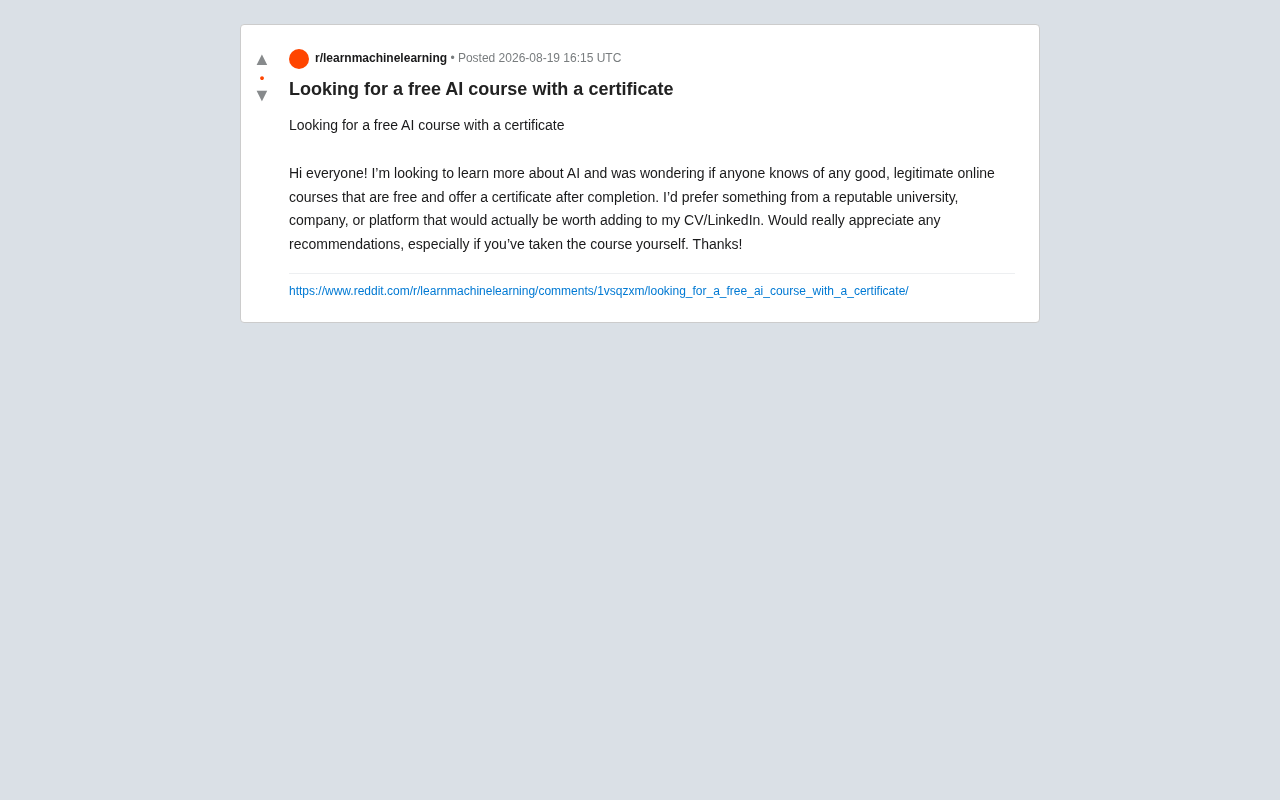
This question represents the genuine needs of countless AI beginners: they want something authoritative and credible, completely free, and able to back up their career development. This article systematically reviews the best free AI certification courses currently available and analyzes how to make these certificates truly valuable in your job search.
Overview of Major Free AI Course Platforms
Free Courses from Top Universities and Tech Giants
For learners seeking authoritative credentials, the following sources deserve the most attention:
Coursera (Audit Mode + Financial Aid): Coursera hosts numerous courses from Stanford, DeepLearning.AI, and other institutions. While obtaining an official certificate typically requires payment, the platform offers a Financial Aid mechanism that allows qualifying learners to earn certified credentials for free. Andrew Ng's Machine Learning and AI for Everyone are universally recognized entry-level classics.
Coursera was founded in 2012 by Stanford professors Andrew Ng and Daphne Koller and is one of the pioneers of the MOOC (Massive Open Online Course) movement. Its financial aid mechanism allows economically disadvantaged learners to access paid certificates for free — applicants fill out a brief explanation form and typically receive approval within 15 days. Notably, after Coursera's NYSE IPO in 2021, its commercialization deepened, and some previously free content shifted to paid subscription models (Coursera Plus). However, the financial aid channel has always remained available, making it a vital pathway for learners in developing countries to access world-class educational resources.
Google AI / Google Cloud Skills Boost: Google offers a series of free foundational AI courses, including the Generative AI Learning Path. Upon completion, learners earn digital badges that can be shared directly on LinkedIn.
Google's Generative AI Learning Path launched in 2023, aligning with the industry explosion of large language models (LLMs). The path covers multiple modules from fundamental concepts to hands-on practice with the Vertex AI platform, including topics like Transformer model principles, Prompt Engineering, and Responsible AI. The Google Cloud Skills Boost platform uses the Qwiklabs lab environment, allowing learners to practice in real Google Cloud environments — this sandbox-style learning experience offers greater skill transfer value than purely video-based courses. The digital badges earned are issued through the Credly platform and support online verification.
Microsoft Learn: Microsoft's learning platform is entirely free, offering learning paths in AI engineering, data science, and other domains, and issuing verifiable achievement certificates.
Free AI Resources from Enterprises and Open-Source Communities
IBM SkillsBuild / Cognitive Class: IBM's Cognitive Class provides completely free courses in AI, machine learning, and data science, issuing certificates directly upon completion with no payment required.
Hugging Face Courses: For learners looking to dive deep into NLP and large language models, Hugging Face's free courses are exceptionally high-quality, focusing on Transformer architecture and hands-on applications — a benchmark in the open-source community.
Hugging Face was founded in 2016, originally as a chatbot company, and later pivoted to become an open-source machine learning platform now valued at over $4.5 billion. Its core product, the Transformers library, has become the de facto standard in NLP, hosting over 500,000 pre-trained models. The Transformer architecture was introduced by Google in the 2017 paper Attention Is All You Need, revolutionizing sequence modeling through self-attention mechanisms and serving as the foundation for all modern large language models including GPT, BERT, and LLaMA. Hugging Face's free courses directly teach how to use these models for fine-tuning, inference deployment, and RLHF (Reinforcement Learning from Human Feedback), offering tremendous practical value for learners aiming to enter the LLM development space.
Kaggle Learn: Kaggle offers short, efficient "Micro-courses" covering Python, machine learning, deep learning, and more. Certificates are issued upon completion, and the content is highly practice-oriented.
Kaggle was founded in 2010 and acquired by Google in 2017. It now has over 15 million registered users and is the world's largest data science competition platform. Its competition format simulates real business scenarios where participants build optimal predictive models on given datasets, ranked by objective evaluation metrics (such as AUC, RMSE, etc.). Kaggle's ranking system (Novice→Contributor→Expert→Master→Grandmaster) is widely recognized in data science hiring, and some top tech companies even consider Kaggle rankings as a bonus factor in resume screening. Its Micro-courses are well-designed, taking approximately 4-6 hours each to complete, using a browser-based Jupyter Notebook environment that requires zero configuration to start coding.
How to Choose the Right Free AI Course for You
Clarify Your Learning Goals Based on Your Background
The key to choosing among the many options is to first identify your position:
- Non-technical background, managerial perspective: Andrew Ng's AI for Everyone is recommended — no programming involved, focused on building a holistic understanding of AI.
- Looking to transition into a technical role: Choose courses that include Python programming and hands-on machine learning, such as Kaggle Learn or DeepLearning.AI's specialization courses.
- Already have programming skills, seeking deeper knowledge: Hugging Face and fast.ai's free courses are more suitable, enabling you to quickly get hands-on with cutting-edge models.
Understanding the Real Value of AI Certificates
It's important to be clear-eyed about this: certificates from free courses are more a demonstration of learning attitude and knowledge breadth than hard proof of professional expertise. Hiring managers typically place more weight on:
- The reputation of the issuing institution behind the certificate (Stanford, Google, and IBM clearly outweigh unknown platforms);
- Whether you can translate what you learned into actual projects;
- Whether the certificate is verifiable online (verifiable digital credentials are far more credible than a PDF).
Modern digital credentials are typically built on the Open Badges 2.0 standard or W3C Verifiable Credentials specification. Credly (now under Pearson) is currently the most mainstream digital badge issuance platform — Google, Microsoft, IBM, and other tech giants all issue verifiable certificates through it. Unlike traditional PDF certificates, digital badges contain metadata (such as issuing organization, earning criteria, skill mapping, etc.), and third parties can verify authenticity in real-time via a unique URL. Some platforms have begun exploring blockchain-based verification to make certificates tamper-proof. This verifiability is the core reason hiring managers increasingly value digital credentials.
Strategies to Make AI Certificates Truly Boost Your Resume
A Portfolio Speaks Louder Than Certificates
Simply listing a pile of certificates has limited impact when competing for AI positions. More effective approaches include:
- After completing a course, independently reproduce a project and publish it on GitHub;
- Participate in Kaggle competitions — even without a high ranking, the participation experience itself demonstrates capability;
- Write learning notes or technical blog posts to showcase your depth of thinking.
Tips for Displaying Digital Badges on LinkedIn
Directly linking digital badges from Google, Microsoft, and other platforms to your LinkedIn profile is more credible than manually entering them. Additionally, adding corresponding AI skill tags in the "Skills" section helps you get picked up by recruiters' search algorithms.
Conclusion: Free AI Courses Can Build a Solid Knowledge Foundation
For the Reddit user's request, the answer is clear: high-quality free AI certification courses do exist, and they come from quite authoritative sources. From Andrew Ng's classic courses to official learning paths from Google, Microsoft, and IBM, learners can absolutely build a solid AI knowledge foundation at zero cost.
But the real key is this — certificates are just the starting point of your learning journey. Converting knowledge into demonstrable projects, consistently producing output, and accumulating hands-on experience is what truly transforms these free resources into career competitiveness. In today's market where AI talent demand is booming, the attitude of proactive learning is itself the best calling card.
Related articles

Felix Rieseberg Personal Homepage
Felix Rieseberg's personal homepage sparks attention on Hacker News. This article covers the Slack engineer's technical background, the rise and fall of nativefier, and the value of a developer homepage as a tech calling card.

@ai-sdk/vue 3.0.306 Patch Release Syncs with [email protected] Update
@ai-sdk/vue 3.0.306 released, synced with [email protected]. A routine patch release for the Vercel AI SDK ecosystem with no public API changes; the Vue adapter layer stays version-aligned with the core package.

Gemini 4 Argon API Launches: The Era of Million-Token Output Begins
Google launches Gemini 4 Argon with sparse MoE architecture, up to 1M output tokens, and a 68.90% Vals Index score, available across API, AI Studio, and the Gemini app.