Recommended Visual Learning Resources for Transformers: From Encoders to Decoders

Build intuitive Transformer understanding through visualizations covering attention, encoders, decoders, and training vs. inference.
This article addresses a beginner's need for Transformer visualization resources, systematically covering interactive tools for understanding self-attention and multi-head attention, the collaboration between Encoder and Decoder structures (including masked self-attention and cross-attention), and the key difference between Teacher Forcing during training and autoregressive generation during inference. A progressive learning path — interactive tools → animated walkthroughs → code practice — is recommended to truly internalize Transformer mechanics.
Why Visualization Matters for Understanding Transformers
Understanding the training and inference processes of Transformers is often an uphill battle when you rely solely on papers and formulas. Concepts like attention mechanisms, multi-head attention, and positional encoding are abstract matrix operations on paper — but once you use visualization tools to dynamically illustrate how data flows through the network, the learning curve becomes noticeably gentler.
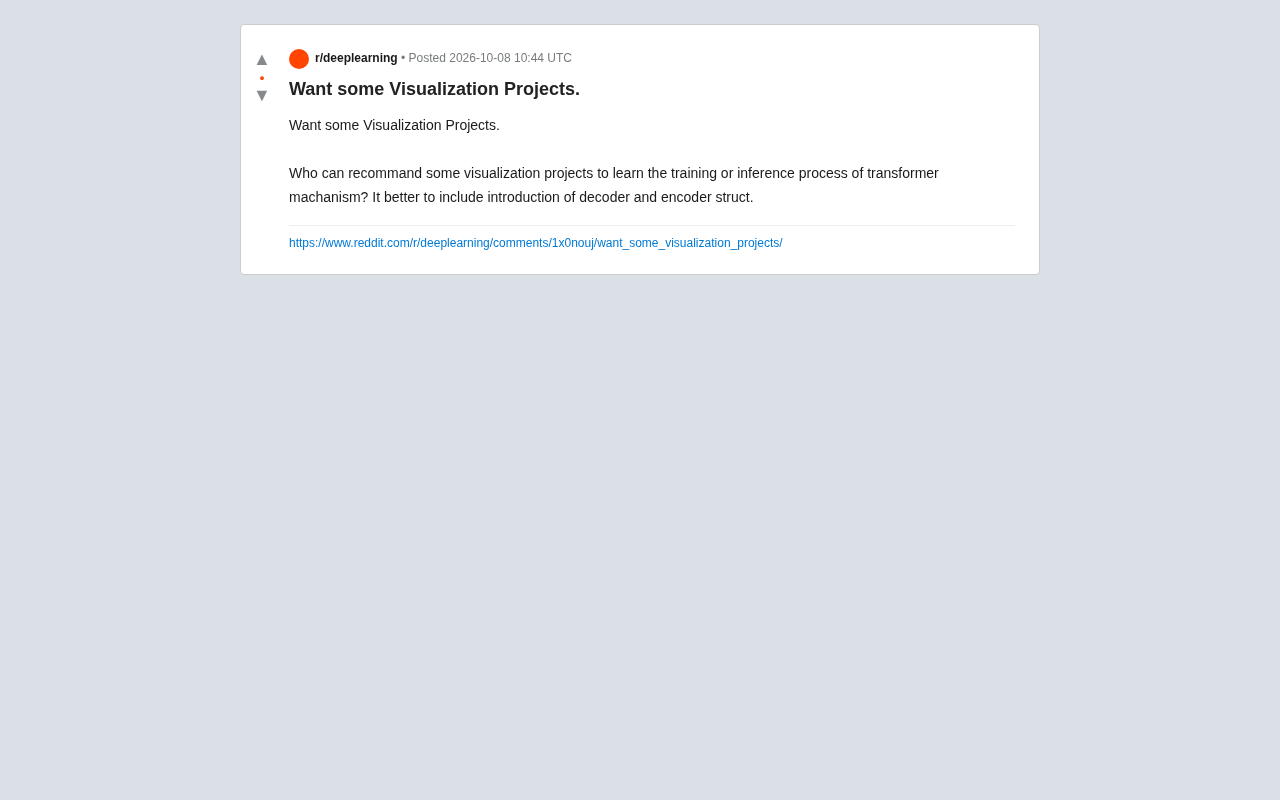
A Reddit user posted asking the community for help finding visualization projects that demonstrate Transformer mechanics, specifically hoping the resources would cover both the Encoder and Decoder architectures. This is a fairly typical learning need — many beginners, even after reading the original paper Attention Is All You Need, still struggle to build an intuitive mental model of how data flows through the network.
This article organizes several categories of visual learning resources worth exploring, to help you build an intuitive understanding of the Transformer architecture from the ground up.
Interactive Visualization Tools for Beginners
For learners who want to understand attention mechanisms intuitively, interactive visualizations are the best entry point. These tools typically allow users to input text and observe in real time how the model distributes attention weights across different words.
Several widely circulated open-source projects break down the Self-Attention computation step by step, showing how the Query, Key, and Value matrices interact to produce attention scores. By representing attention strength through color intensity or line thickness, learners can clearly see which other parts of a sentence the model is "attending to" when processing a particular word.
This kind of visualization is especially valuable for understanding Multi-Head Attention. Different attention heads tend to capture different types of semantic relationships — some focus on syntactic dependencies, others on coreference relations. Visualization makes this division of labor immediately apparent.
Some of the most well-known visualization tools include: Jay Alammar's The Illustrated Transformer blog series, which uses static diagrams to break down each step of the attention calculation and is widely cited as essential introductory reading; BertViz, an interactive attention visualization library designed for BERT and other Transformer models that supports loading HuggingFace models directly in Jupyter Notebook to explore attention distributions across layers and heads; and 3Blue1Brown's "Neural Networks" series on YouTube, which features animated explanations of attention mechanisms — ideal for building geometric intuition before diving into code. These resources each have their own strengths and work best when used together.
Breaking Down Encoder and Decoder Structures
The original poster specifically emphasized wanting resources that cover Encoder and Decoder structures — and understanding this is key to grasping the complete Transformer architecture.
The Encoder is responsible for transforming the input sequence into context-rich representations. It consists of multiple stacked self-attention layers and feed-forward networks. The Decoder builds on this by adding two additional mechanisms: Masked Self-Attention and Cross-Attention. The former ensures that during generation, the model can only attend to previously produced tokens; the latter allows the Decoder to "query" the Encoder's output.
Understanding how these two components collaborate is foundational to comprehending how tasks like machine translation and text generation work. Some tutorial projects with layer-by-layer animated walkthroughs trace an input sentence all the way from word embeddings and positional encoding through to the final output — this kind of end-to-end tracing is extremely helpful for building a holistic understanding.
It's worth noting that not all Transformer variants include both an Encoder and a Decoder. The full Encoder-Decoder architecture from the original paper is primarily used for sequence-to-sequence tasks (like translation); BERT-family models use only the Encoder and excel at understanding tasks (classification, extraction); while GPT-family models use only the Decoder and focus on text generation. While mastering the full dual-tower structure is important, when studying different pretrained models you should first confirm which sub-architecture they use — otherwise it's easy to conflate the limitations of a specific structure with the properties of Transformers in general.
The Difference Between Training and Inference
Visualization isn't limited to static architecture diagrams — what's even more valuable is dynamically illustrating the differences between the training and inference phases.
During training, the Decoder can use "Teacher Forcing" to process the entire target sequence in parallel. During inference, however, the model can only generate output autoregressively, one token at a time, feeding each generated token back as the input for the next step. This difference is a common source of confusion for beginners, and visualizing both workflows side by side can effectively clear up misunderstandings.
Some projects use animation to show the step-by-step generation process during inference: how the model starts from a beginning token, predicts one word at a time, and continues until it produces an end token. Combined with real-time changes in attention weights, learners can observe the model's "thought process" as it generates each word.
Teacher Forcing is a key source of training efficiency, but it also introduces a problem known as "Exposure Bias": during training, each decoding step receives the true target token as input, whereas during inference the input is the model's own prediction from the previous step. If the model makes an error at some intermediate step, that error can accumulate and amplify in subsequent steps, causing a distributional shift between training and inference. To address this, researchers have proposed training strategies like Scheduled Sampling, which gradually mixes in the model's own predictions during training to narrow the gap between the two phases. Understanding this background helps you develop a deeper appreciation for the limitations of autoregressive generative models.
Learning Path Recommendations
For those who want to learn systematically, a progression from shallow to deep is recommended. Start with interactive attention visualization tools to build intuition for the core mechanisms; then use layer-by-layer animated tutorials to understand the complete architecture; and finally, combine this with code implementations to connect what you've seen visually to the actual tensor operations.
Implementing a small Transformer yourself and printing the shapes and values of intermediate tensors is itself an effective form of "visualization." When you can map every change in matrix dimensions to a specific module in the architecture diagram, you've truly understood the mechanism.
Visualization is a means, not an end — it helps you bridge the gap between abstract formulas and intuitive understanding, but real mastery still requires hands-on coding practice and repeated reflection to solidify.
Related articles

Chain of Thought Isn't Just for AI: How Humans Can Use CoT to Improve Thinking Quality
Chain of Thought isn't just a prompt trick for large models. Starting from a Hacker News discussion, this article analyzes why CoT works for human thinking too, breaks down actionable ways to transfer it, and highlights the key differences between human CoT and machine CoT.
Cloudflare Teams Up with OpenAI: Closi…
Cloudflare Teams Up with OpenAI: Closing the Loop from Vulnerability Discovery to Defense with AI
Cloudflare uses OpenAI Daybreak to investigate security vulnerabilities and generate reviewable remediation plans, while developers use Codex to boost coding efficiency and quality.

Orca Multi-Agent Orchestration in Practice: A Guide to Parallel Collaboration with Claude and Codex
Orca is Stable AI's free open-source agent workbench supporting 34 agents like Claude Code and Codex in parallel. Learn its Git worktree isolation, multi-model orchestration, and mobile management.