RecPo: Reconstructing Procedural Knowledge for More Flexible Robot Skill Composition
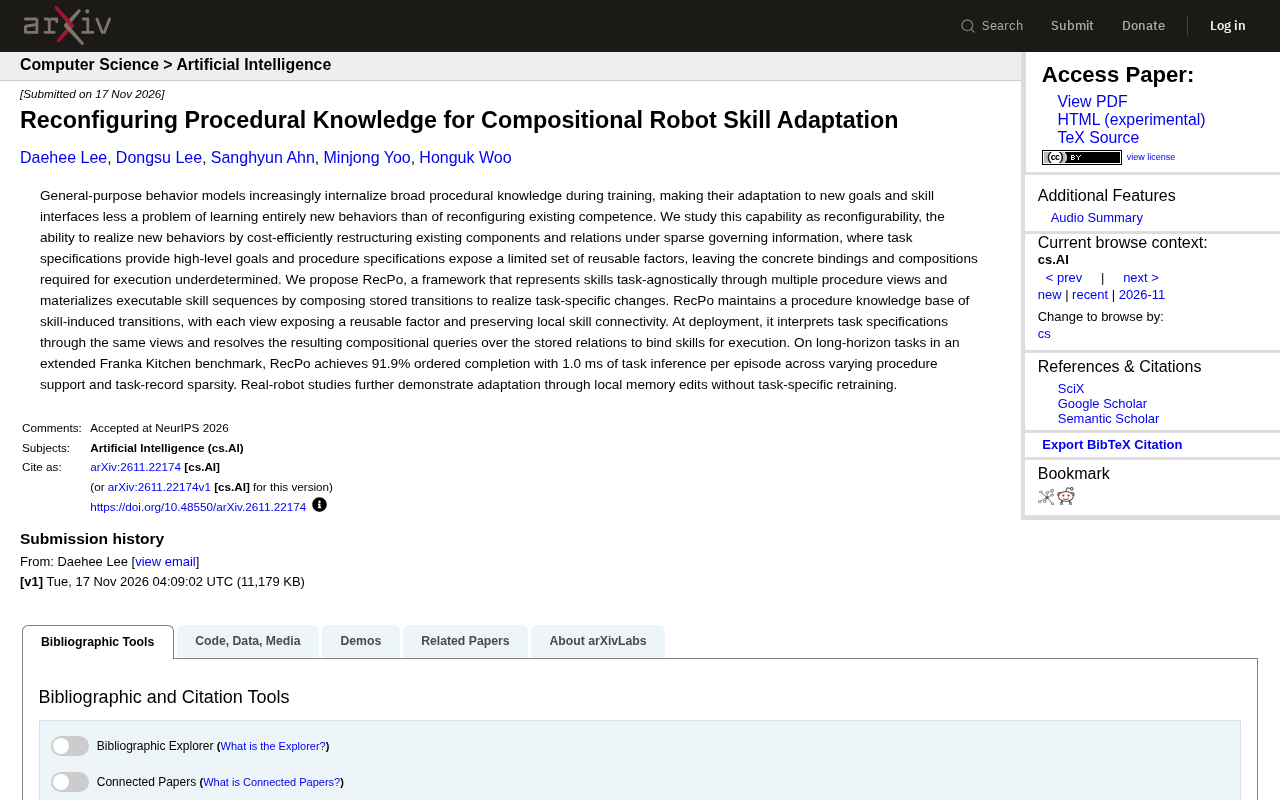
RecPo enables flexible robot skill composition by reconstructing procedural knowledge, hitting 91.9% long-horizon completion with 1 ms inference.
Researchers from RSS propose RecPo, a framework that treats robot skill adaptation as reconfiguring existing procedural knowledge rather than learning from scratch. It represents skills task-agnostically via multiple program views and a transition knowledge base, binding skills through compositional queries at deployment. RecPo reaches 91.9% ordered completion on long-horizon Franka Kitchen tasks with just 1.0 ms inference per episode, and real-robot experiments show adaptation via local memory editing without task-specific retraining.
Can robots, like humans, flexibly recombine mastered skills to tackle new tasks? A recent study from RSS proposes the RecPo framework, which achieves compositional skill adaptation by reconstructing procedural knowledge, reaching a 91.9% ordered completion rate on long-horizon tasks with only 1.0 ms of task inference per episode.
When Behavior Models Learn "Procedural Knowledge"
General-purpose behavior models increasingly internalize broad procedural knowledge during training. This means that when they need to adapt to new goals or new skill interfaces, the challenge is often not learning entirely new behaviors from scratch, but rather reconfiguring existing capabilities. The researchers call this capability "reconfigurability"—the ability to reorganize existing components and relationships at low cost under sparse guidance to produce new behaviors.
Here, "sparse guidance" operates on two levels: task specifications provide high-level goals, while procedural specifications expose a limited set of reusable factors. The specific bindings and compositions needed for execution are left for the system to determine on its own. This setting is closer to real-world scenarios—human instructions are often rough, and the robot must fill in the execution details itself.
Procedural Knowledge in cognitive science refers to knowledge about "how to do" something, as opposed to declarative knowledge (knowledge about "what is"). In robotics, it typically manifests as the execution logic of skills, such as the sequences and conditions of actions like grasping, placing, and opening doors. Behavior models are trained on large-scale demonstration data and can encode these skills as implicit policies or state transition relationships. Reconfigurability emphasizes the ability to explicitly reorganize this implicit knowledge, rather than simply adding more training data. RecPo stores this knowledge as transitions—(state, action, next state) triples—so that skills can be treated as composable modules. This representation draws on the operator model from classical planning but adds adaptability to sparse guidance through a multi-view mechanism. Understanding the distinction between procedural and declarative knowledge helps clarify why RecPo does not rely on task-specific fine-tuning but instead adapts to new tasks by querying existing transitions.
RecPo: Representing Skills with Multiple Views
To address the above challenges, the researchers propose the RecPo framework. Its core idea is to represent skills in a task-agnostic manner and to expose reusable factors through multiple "program views" while preserving local connectivity between skills. RecPo maintains a procedural knowledge base that stores state transitions induced by skills, with each view corresponding to a reusable factor.
During deployment, RecPo interprets task specifications through the same views and resolves the resulting compositional queries against the stored relations, thereby binding skills for execution. In other words, the system does not need to retrain for each new task but instead achieves task-specific variation by composing existing transitions.
Multi-View Representation here refers to describing the same skill from different "program views," each corresponding to a reusable factor such as the skill's preconditions, effects, or execution parameters. This design draws on the idea of multi-view learning, which leverages different feature subsets of the same object to enhance generalization. In RecPo, views are task-agnostic, allowing the same skill to be indexed and composed by different views under different task specifications. A compositional query refers to parsing a task specification into queries over transitions in the knowledge base—for example, "open the cabinet door then put in the cup" is decomposed into compositional queries over the "open door" and "place" transitions. This query resolution mechanism is analogous to relational queries in databases but operates over skill transitions. The benefit of multiple views is that they expose the reusability of skills while preserving local connectivity between skills, enabling flexible skill binding under sparse guidance.
Performance Validation: Long-Horizon Tasks and Real Robots
On an extended Franka Kitchen benchmark, RecPo achieves a 91.9% ordered completion rate on long-horizon tasks, with task inference time of only 1.0 ms per episode. This result remains stable across varying degrees of procedural support and task-record sparsity. More importantly, real-robot studies further show that RecPo can achieve adaptation through local memory editing without task-specific retraining.
This "local memory editing" capability means that when a task changes, the system only needs to modify a small number of entries in the knowledge base rather than touching the entire model. This opens up new possibilities for rapid adaptation of robots in dynamic environments.
The Franka Kitchen benchmark is a commonly used long-horizon task evaluation environment in robot manipulation, based on the Franka Emika Panda arm and including multiple kitchen manipulation tasks (such as opening the microwave, moving the kettle, and opening the cabinet). The standard version typically evaluates multi-task learning, while the "extended" version may increase the complexity of task compositions and long-horizon dependencies. Ordered completion rate refers to the proportion of long-horizon tasks in which subtasks must be completed in a specific order, emphasizing order correctness rather than just the number completed. Local memory editing refers to modifying only a small number of transition entries in the knowledge base relevant to the current task, rather than retraining the entire model, similar to parameter isolation or memory editing techniques in continual learning. The 1.0 ms inference time indicates that compositional query resolution is highly efficient and suitable for real-time robot control. Together, these metrics show that RecPo achieves high order correctness while remaining lightweight.
Implications and Outlook
The value of RecPo lies in redefining the paradigm of robot skill adaptation: from "learning new behaviors" to "reorganizing existing capabilities." This line of thinking resonates with the emphasis on in-context learning and compositional generalization in the current large-model field. However, the study has so far been validated mainly on the Franka Kitchen benchmark, and its generalization to more complex, more open environments remains to be further explored. In addition, how to automatically discover and define appropriate "program views" is also a direction worth attention.
For researchers and engineers in AI and robotics, RecPo offers a lightweight, interpretable approach to skill composition, particularly suited to scenarios that require rapid adaptation to new tasks but have limited labeled data. As behavior models internalize increasingly rich procedural knowledge, how to efficiently reconstruct this knowledge may become the key challenge of the next stage.
One-line Summary
RecPo achieves robot skill composition adaptation by reconstructing procedural knowledge, with a 91.9% long-horizon task completion rate and only 1 ms inference.
Paragraph Summary
A study from RSS proposes the RecPo framework, which treats robot skill adaptation as reconstructing existing procedural knowledge rather than learning from scratch. The framework represents skills in a task-agnostic manner, exposes reusable factors through multiple program views, and maintains a knowledge base of state transitions. At deployment, the system parses task specifications into compositional queries and binds existing skills for execution. On the extended Franka Kitchen benchmark, RecPo achieves a 91.9% ordered completion rate on long-horizon tasks with only 1.0 ms inference per episode, remaining stable across different sparsity levels. Real-robot experiments show that adaptation can be achieved through local memory editing without task-specific retraining. This work provides a lightweight, interpretable solution for rapid skill composition in data-limited scenarios.
Related articles

MIT PhD Takes You from Scratch to Build DeepSeek: A 25-Hour Hardcore Course
MIT PhD Raj Dandekar launches a 25+ hour Bilibili course building DeepSeek from scratch—MoE, MLA, GRPO, hand-written code plus math derivations, aiming to reproduce mini R1.

DeepSeek Harness in Practice: From Installation to Plugin Ecosystem, Building a Fully Automated AI Workflow
Based on a hardcore Bilibili tutorial, this guide systematically covers DeepSeek Harness installation, three plugin installation methods, and real-world use cases to help developers quickly build customizable AI Agent workflows.
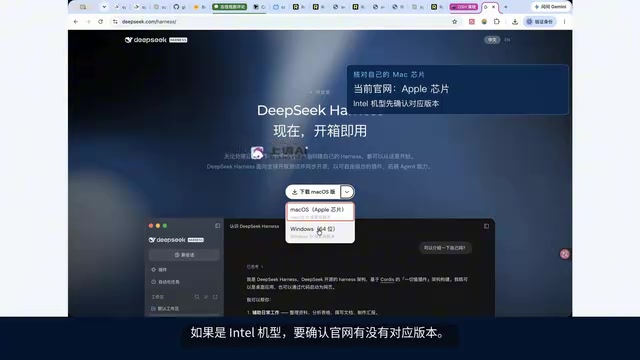
DeepSeek Harness in Practice: From Installation to Automated Workflows
Hands-on DeepSeek Harness tutorial covering Mac/Windows installation, login, workspace binding, model & permission setup, and minimal closed-loop verification for AI automation workflows.