Recursive Self-Improvement: How DiscoveryRSI Teaches AI to Formulate Good Hypotheses

DiscoveryRSI uses a three-layer recursive mechanism to teach large models to propose testable hypotheses, with DFM-Bench evaluation.
The article introduces DiscoveryRSI, a research assistance framework that shifts large models from "answering questions" to "discovering questions." It defines valuable testable hypotheses operationally with four elements and builds three recursive mechanisms: hypothesis credit optimization, workflow replay, and rediscovery. DFM-Bench evaluates hypothesis quality across four levels. Experiments show scores rising from 4.86 to 5.39, with falsifiability and data resolvability improving most; correspondence rate with post-cutoff papers reaches 6.3%, beating GPT-6 and Claude Opus 5. Limitations include low absolute scores, possible hotspot capture, and amplification of evaluation bias.
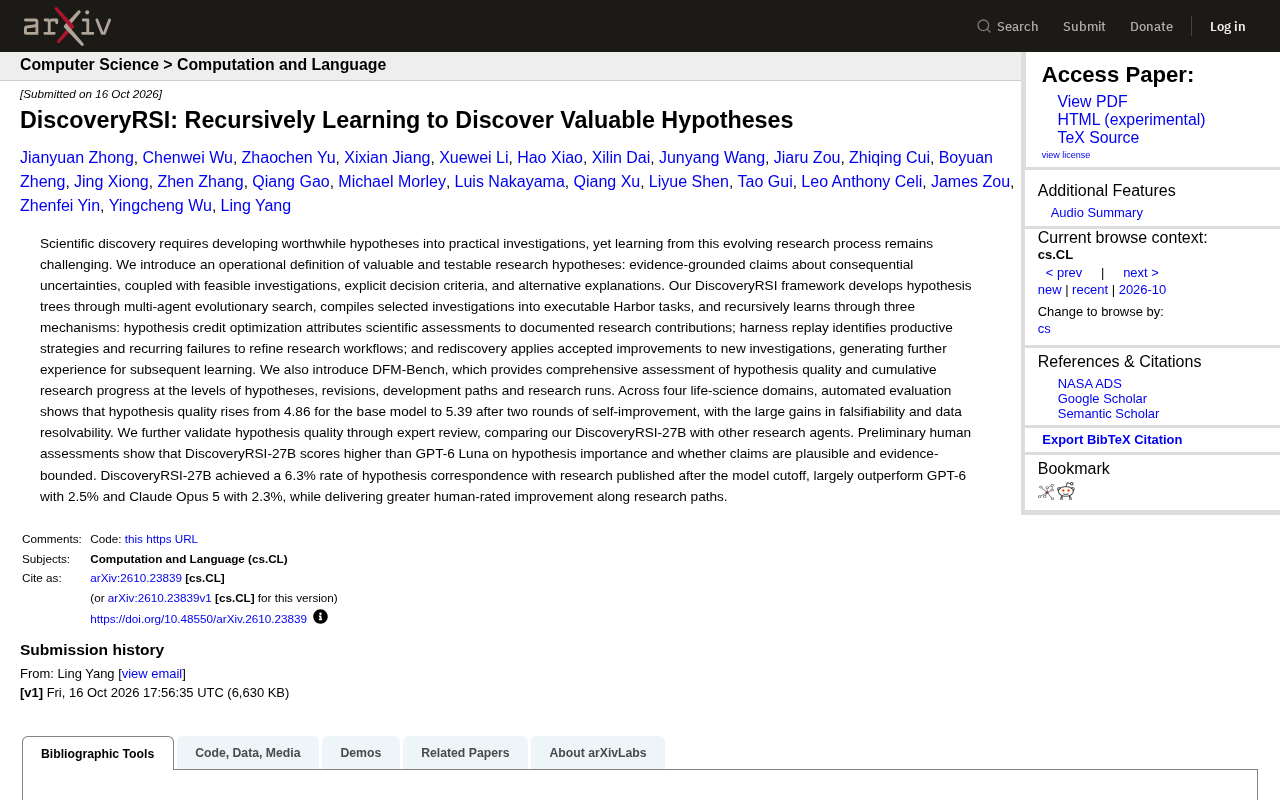
One of the core challenges of scientific discovery is not verifying hypotheses, but proposing hypotheses worth verifying. Current large models' performance in research assistance often stays at the level of literature review or code generation; when it comes to "distilling actionable research questions from uncertainty," their capabilities are clearly insufficient. The DiscoveryRSI work attempts to fill this gap: it is not content with having models "answer" questions, but rather teaches models to "discover" questions, and continuously improves this ability through a recursive mechanism.
What Counts as a "Valuable" Hypothesis
The research team first did something foundational but crucial: they provided an operational definition of a "valuable testable hypothesis." This definition contains four elements—evidence-based claims, pointing to consequential uncertainty, accompanying feasible research plans, and clear criteria for judgment with alternative explanations.
The significance of this definition lies in transforming "good hypotheses" from vague intuitive judgments into an evaluable structure. If a hypothesis merely sounds interesting but cannot articulate "what results would refute it," it does not qualify under this framework. This also explains why "falsifiability" and "data resolvability" became the two dimensions with the most obvious improvements in subsequent evaluations—they happen to be the parts of this definition most easily overlooked and most amenable to mechanistic improvement.
DiscoveryRSI's Three-Layer Recursive Mechanism
The DiscoveryRSI framework consists of three interlocking mechanisms that form a closed loop.
Hypothesis Credit Optimization: Turning Review Feedback into Training Signals
Multi-agent evolutionary search is responsible for generating hypothesis trees, while "hypothesis credit optimization" attributes scientific evaluation results to specific research contribution records. Simply put, the system not only knows whether a hypothesis scores high or low, but also knows which reasoning step or which piece of evidence led to that score. This gives improvement a clear focus rather than vaguely "getting better overall."
Credit Assignment is a classic problem in reinforcement learning and multi-step reasoning: when a multi-step process ultimately yields a good or bad result, how do you determine which decision actually caused that result? In sparse-reward scenarios, this problem is especially difficult because the system only knows the final score but not which intermediate reasoning path or evidence citation played a key role. Hypothesis credit optimization transfers this idea to scientific hypothesis generation—attributing scores given by experts or automated reviewers back to specific contribution records in the hypothesis tree (a particular reasoning step, a particular piece of evidence), so the model knows "what to keep and what to revise." Without credit assignment, recursive improvement can only degenerate into vague preference tuning over overall outputs, making it difficult to pinpoint problems.
Workflow Replay: Identifying Effective Strategies and Repeated Failures
The "Harness replay" mechanism replays the research process, identifying high-yield strategies and recurring failure patterns, and refining the research workflow accordingly. This is quite valuable from an engineering perspective—failures in research are often repetitive, and being able to systematically identify and avoid them is itself a form of capability accumulation.
Harness in AI agent research refers to the external runtime environment wrapping the model, responsible for orchestrating tool calls, multi-turn interactions, state management, and result recording. Harness replay means replaying and reviewing this execution trajectory, breaking down a complete research process into an inspectable sequence of steps. This approach draws on record-and-replay debugging in software engineering and trajectory analysis in agent research: by comparing differences between successful and failed trajectories, it identifies which strategies repeatedly yield high output and which failure patterns recur. Its value lies in making implicit "research experience" explicit as reusable workflow rules, enabling the system to improve research behavior without retraining model parameters.
Rediscovery: Transferring Improvements to New Problems
"Rediscovery" applies accepted improvements to new research tasks while generating new experience for subsequent learning. The three mechanisms stack together to give the system a structure for recursive self-improvement rather than one-time fine-tuning.
DFM-Bench and Experimental Results
The accompanying DFM-Bench evaluates hypothesis quality and cumulative research progress across four levels—hypotheses, revisions, development paths, and research execution—covering four life science domains.
Automated evaluation shows that hypothesis quality improved from the base model's 4.86 to 5.39 after two rounds of self-improvement, with gains concentrated in falsifiability and data resolvability. This absolute increase may not look large, but on a task requiring structured reasoning, two iterations producing stable improvement indicates the recursive mechanism is indeed working.
More noteworthy is external validation. In expert reviews, DiscoveryRSI-27B scored higher than GPT-6 Luna on hypothesis importance and "whether claims are credible with evidence boundaries." On the correspondence rate with papers published after the model's cutoff date, DiscoveryRSI-27B reached 6.3%, compared to 2.5% for GPT-6 and 2.3% for Claude Opus 5. This metric measures whether the model can "anticipate" the direction of subsequent real research; although the absolute values are not high, the relative gap is significant.
Correspondence rate with post-cutoff papers is a proxy metric for measuring a model's "foresight": selecting real papers published after the model's training data cutoff and examining whether hypotheses independently proposed by the model align with the core claims or research directions of these papers. The logic is that if a model can hit subsequent research it has never seen, it suggests its output may reflect a genuine grasp of the structure of scientific problems rather than paraphrasing training corpora. However, this metric has inherent limitations: a high correspondence rate may also come from pattern capture of research hotspots, popular paradigms, and common method combinations rather than genuine causal insight. Therefore, interpretation should be combined with qualitative evidence such as expert reviews; looking at the number alone can easily overestimate the model's scientific discovery capability.
A Sober View: Where Are the Boundaries of Recursive Evolution?
This framework is ambitious, but several questions deserve scrutiny. First, the hypothesis quality score going from 4.86 to 5.39 is still far from a "reliable research partner," and the expert review sample size is only described as "preliminary." Second, whether the 6.3% correspondence rate improvement partly comes from pattern capture of research hotspots rather than genuine scientific insight is currently difficult to distinguish. Third, recursive learning depends on high-quality scientific evaluation signals; if the evaluation itself is biased, recursion may amplify the bias.
Nevertheless, the direction this work proposes is clear: treat "asking good questions" as a capability that can be trained, evaluated, and recursively improved. Compared to pursuing accuracy of single responses, this approach of modeling the research process may be closer to the true form of scientific discovery.
One-line Summary
DiscoveryRSI uses a three-layer recursive mechanism to teach large models to propose testable hypotheses, accompanied by DFM-Bench evaluation.
Paragraph Summary
The article introduces DiscoveryRSI, a research assistance framework whose core proposition is to shift large models from "answering questions" to "discovering questions." The research team first provides an operational definition of a "valuable testable hypothesis," containing four elements: evidence support, consequential uncertainty, feasible research plans, and judgment criteria, transforming vague intuition into an evaluable structure. The framework consists of three recursive mechanisms: hypothesis credit optimization attributes review results to specific contribution records, workflow replay identifies high-yield strategies and recurring failure patterns, and rediscovery transfers improvements to new tasks. The accompanying DFM-Bench evaluates hypothesis quality across four levels. In experiments, hypothesis quality rose from the base model's 4.86 to 5.39 after two rounds of improvement, with falsifiability and data resolvability showing the most obvious gains; correspondence rate with post-cutoff papers reached 6.3%, higher than GPT-6 and Claude Opus 5. The article also notes limitations: absolute scores remain low, correspondence rates may stem from hotspot capture, and evaluation bias may be amplified by recursion.
Related articles

JobRunner MCP Server: AI Agents Can Now Fix Failed Java Jobs
JobRunner launches an open-source MCP server enabling AI agents to view cluster status, diagnose failures, and recover Java jobs—incident response from any cloud coding environment or existing agent.

MLAI Digital Launches 9 Security Agents: MCP Server Safeguards the Full Lifecycle of Agentic AI
MLAI Digital launches Security MCP Server with nine built-in specialized security agents covering vulnerability discovery, attack simulation, prompt injection detection, API and infrastructure assessment, and accelerated remediation—embedding security validation across the full Agentic AI lifecycle from development to production.

Running Isaac Lab on H100 GPUs: Exploring Better Approaches
Exploring optimization methods for running Isaac Lab on NVIDIA H100 GPUs, including MIG configuration, mixed precision, TensorRT acceleration, and community experience to improve robotics simulation and reinforcement learning efficiency.