Reddit Hot Post: Why Does a 'Dangerous' GPU Photo Spark AI Compute Anxiety?

A GPU photo on Reddit sparks collective anxiety over AI compute scarcity, resource allocation, and technology governance.
A Reddit user posted a GPU photo labeled "dangerous," unexpectedly igniting community discussion. Top comments joked the card should be donated to a data center, reflecting extreme GPU compute scarcity amid the AI boom; running open-source models locally was derided as "wasting compute" or even "immoral," highlighting tension between individual AI exploration and enterprise deployment. The discussion extended to the social credit system, with some comparing tech companies' control over compute and data to an American-style credit score, while Chinese users rebutted stereotypes with personal experience. The article argues AI hardware has become a symbol of resource anxiety, tech ethics, and geopolitics—the real "danger" being the compute divide.
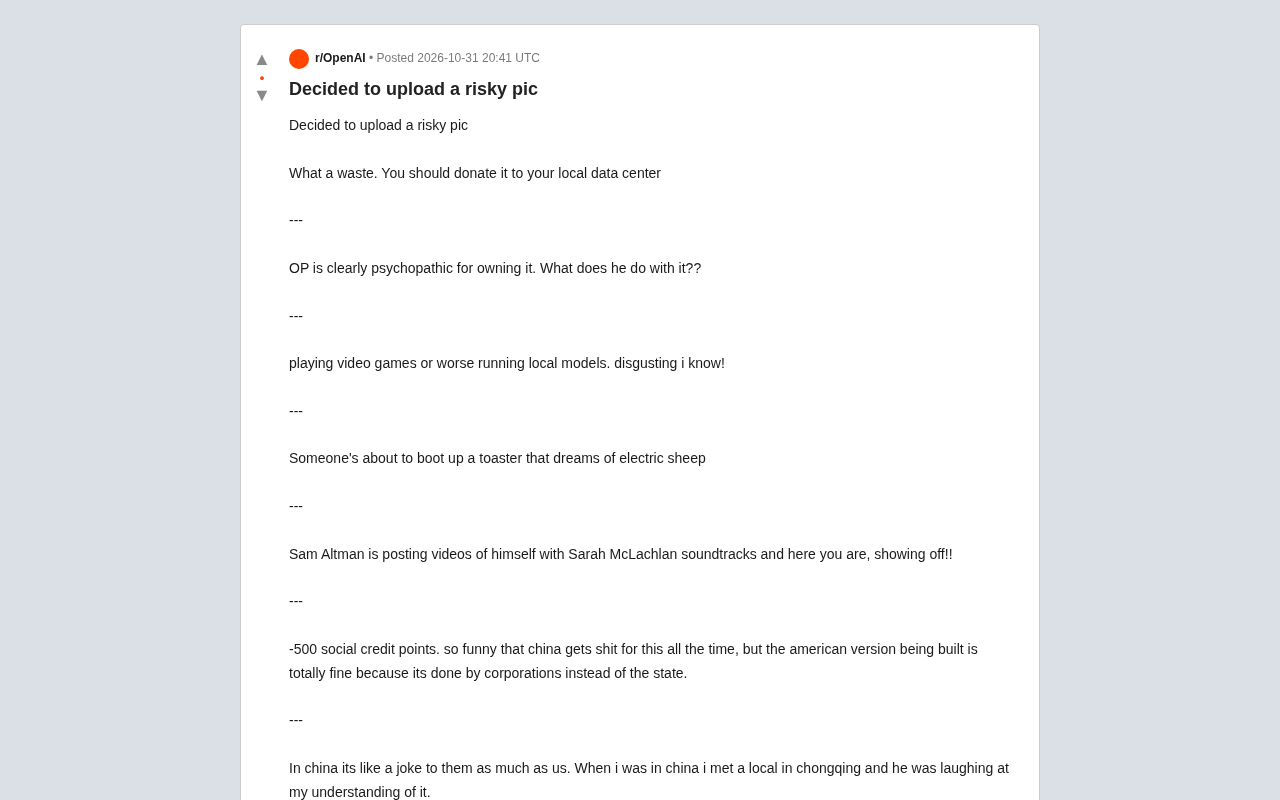
A seemingly nonsensical post recently appeared on Reddit: a user posted only a "dangerous" image with the caption "Decided to upload a dangerous photo." Upon clicking, it turned out the "danger" was nothing more than a photo of a graphics card—but in the current AI boom, this photo unexpectedly struck a sensitive nerve in the community.
Why Does a GPU Photo Become a "Dangerous Item"?
The top comment under the post gets straight to the point: "What a waste, you should donate it to your local data center." Behind this joke lies the extreme scarcity of AI compute resources. With demand for model training and inference skyrocketing, consumer-grade GPUs are seen as scarce resources, and an individual holding a high-end GPU without putting it to "proper" use has become a kind of "sin."
Another user plays detective: "OP clearly has mental issues owning this thing, what does he even use it for?" A reply immediately chimes in: "Gaming, or worse—running local models. Disgusting, I know!" This exchange portrays "local LLM deployment" as a shady hobby, forming an absurd contrast with the current frenzy of enterprise-level AI deployment.
Why GPUs Became a Scarce Resource in the AI Era: Large language model training and inference rely heavily on parallel matrix operations, and GPUs—with their thousands of compute cores and high-bandwidth memory (HBM)—have become the hardware of choice. Since the generative AI explosion in 2022, demand for high-end GPUs has far exceeded TSMC's production capacity, with NVIDIA's data-center product delivery cycles stretching to months at times, as cloud providers and startups race to stockpile cards. The rigid constraints on compute supply have driven up rental prices and turned "having a good card" from an ordinary consumer behavior into a symbol of resource occupation. Understanding this supply-demand context is essential to grasping why a single GPU photo triggers such sensitive reactions about waste and allocation in the community.
Where Does the "Guilt" of Local Model Enthusiasts Come From?
"Running local models" is, in AI enthusiast circles, a form of technical exploration, but in this post it's mockingly labeled as "wasting compute." This contrast precisely reflects the current contradiction in AI resource allocation: on one side, tech giants are fighting over GPUs and data centers are consuming ever more power; on the other, individual enthusiasts using the same hardware to run open-source models are seen as "inefficient" or even "immoral."
Some users even bring out sci-fi references: "Someone is about to boot up a toaster that dreams of electric sheep." This comment, riffing on Do Androids Dream of Electric Sheep?, hints that local models, though small, carry AGI ambitions—though to outsiders, it looks more like performance art.
Running Local LLMs refers to users deploying open-source weight models (such as the Llama and Mistral series) on their own consumer-grade hardware (e.g., a single or a few high-end GPUs) through techniques like quantization and compression, rather than calling cloud APIs. Its appeal lies in keeping data off the local machine, offline usability, no pay-per-use billing, and the freedom to fine-tune. But the trade-off is: consumer-grade GPU memory (typically 8–24GB) is far smaller than data-center GPUs (e.g., the H100's 80GB), so only smaller-parameter or 4-bit-quantized models can run, with limited inference speed and context length. Precisely because of this, in the context of compute scarcity, individuals using high-end GPUs to run local models are easily teased as "using strategic resources for toys"—which is the technical root of the "guilt" in the post.
The Social Credit Metaphor Behind Compute Anxiety
The discussion didn't stop at the tech circle. One widely discussed comment steers the topic in a more sensitive direction: "-500 social credit. Funny how China always gets flak for this, but the American version being built is totally fine because it's corporations, not the state." This comment juxtaposes compute monopoly with data surveillance, suggesting that tech companies' control over AI infrastructure could form another kind of "credit system."
A user then responds with personal experience: "In China this is more like a joke. I met a local in Chongqing who laughed heartily at my understanding of the social credit system." This collision of multiple perspectives elevates what started as GPU banter into a public discussion about technology governance.
The Social Credit System is a credit information recording and disciplinary mechanism covering government affairs, commerce, society, and the judiciary that China has been advancing since 2014. It primarily targets corporate compliance and judgment defaulters, not the unified, nationwide scoring and surveillance system often depicted in Western media. International discussion around it has long involved exaggeration and misreading, and the "-500 social credit" in the post is exactly this kind of internet-meme expression. Commenters juxtapose it with the scores, risk controls, and behavioral profiling that American tech companies build from user data, aiming to point out that even without a unified national scoring system, corporations' private control over data and infrastructure can likewise constitute implicit behavioral constraints. Though the analogy is imprecise, it reveals widespread public unease about the concentration of compute and data power.
From Banter to Reflection: The Symbolization of AI Hardware
That a single GPU photo can spark such multidimensional discussion shows that AI hardware has transcended its tool nature to become a symbol of resource anxiety, technology ethics, and geopolitics. According to cross-discussion on Reddit and community users, the core consensus is: compute is becoming the scarce resource of the new era, and how individuals hold and use it is being placed under public scrutiny.
As for the OP, he never explained what he actually did with the GPU. Perhaps, as one user summed up: "Someone out there is using AI to generate videos set to Sarah McLachlan music, and you're here showing off—the world is just that absurd."
Conclusion: What's Dangerous Isn't the Photo, It's the Compute Divide
The post's "dangerous" label ultimately points to a reality: when AI compute becomes a strategic resource, any display of hardware can trigger debates about fairness, surveillance, and waste. From data centers to personal desktops, from corporate monopoly to state governance, what a single GPU photo reflects is the collective anxiety of an entire industry racing forward.
One-line Summary
A GPU photo on Reddit sparks collective anxiety over AI compute scarcity, resource allocation, and technology governance.
Paragraph Summary
A Reddit user posted a GPU photo labeled "dangerous," unexpectedly igniting community discussion. Top comments joked that the card should be donated to a data center, reflecting the extreme scarcity of GPU compute amid the AI boom; running open-source models locally was derided as "wasting compute" or even "immoral," highlighting the tension between individual AI exploration and enterprise-level deployment. The discussion further extended to the social credit system: some comments compared tech companies' control over compute and data to an American-style credit score, while Chinese users rebutted related stereotypes with personal experience. The article argues that AI hardware has transcended its tool nature to become a symbol of resource anxiety, technology ethics, and geopolitics—and the post's real "danger" lies in the compute divide.
Related articles

AI Tools Quietly Altering Settings: Postman Silently Installs Plugin, Codex Sharing Option Auto-Resets
AI Daily reports: Postman silently installs a Mac plugin and self-approves startup hooks, logged as auto-existing upgrade; Hacker News developers say Codex data-sharing opt-out flips back. Plus Simon Willison's raw float weight experiment with QEN 3.8-27B.

AI Learns to Rewrite AI: MIT's "Weightspace Programming" Redraws the Path to Recursive Self-Improvement
MIT team proposes weightspace programming: GPT-6 Astra reads and edits AI model weights directly. Math scores jump several-fold, hand-written networks beat trained models. Eight experiments analyzed, plus Anthropic's same-day warning and the real boundaries of recursive self-improvement.

Running Qwen 3.8 on a Laptop to Read Raw Weights: 46 Minutes Per Answer
Simon Willison reproduced weight space programming with Qwen 3.8 27B on a laptop: a 17GB model file, 46 minutes per answer, 43,506 reasoning tokens, Pong over an hour, Freeway failed. Suited for interpretability researchers.