Reddit Roasts AI Giants: 'Got Cooked So Hard'—Why Does Superintelligence Still Need 'Pacing'?

A Reddit post mocks AI firms touting superintelligence while relying on pacing to ship products, exposing the narrative-delivery gap.
A sarcastic Reddit post points out that while AI companies tout their march toward 'superintelligence,' product iteration increasingly relies on 'pacing'—staggered releases, throttling, waitlists. The article analyzes the multiple reasons behind this tension: high inference compute costs, regulatory and safety buffers, and competitive games when companies are at similar levels—real-world constraints that make 'pacing' an industry standard. But the community sentiment also reveals a deeper issue: users are growing fatigued with 'narrative inflation,' as grand terms like 'superintelligence' lose persuasiveness through repeated use. The article argues the industry is shifting from concept-driven to product-driven, and what truly answers skepticism isn't more concepts but more substantial capability releases.
When 'Superintelligence' Starts Caring About 'Pacing'
A Reddit post recently sparked quite a discussion: "Got cooked so hard that they back to cooking. Can't be out of ideas with 'Super' Intelligence that needed pacing."
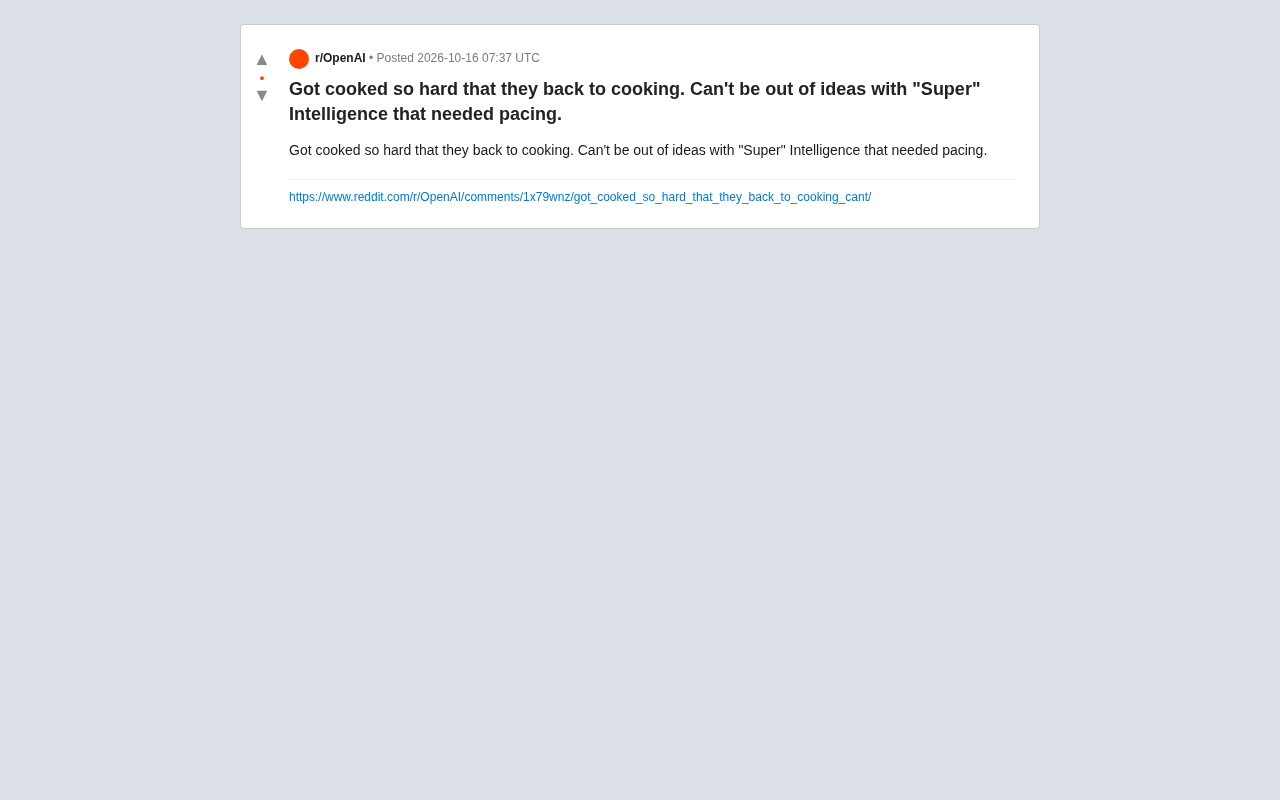
The gist of it: "They got crushed so badly they went back to the kitchen. For something called 'Super' Intelligence, it still needs 'pacing' to hold things together—how could they possibly be out of ideas?"
Short as it is, this post points to a brewing industry phenomenon: as major AI companies rush to brand themselves as marching toward "superintelligence," the cadence of product iteration increasingly resembles a carefully choreographed "show"—when to launch, when to cool things down, when to drop a teaser, all carefully timed.
The Gap Between 'Superintelligence' Narratives and the 'Squeeze-the-Toothpaste' Reality
Over the past few years, leading AI labs have frequently invoked terms like "superintelligence" and "AGI" in public statements. This is itself a narrative strategy: anchoring valuations, attracting talent, and locking in user expectations with a sufficiently grand vision.
But what Reddit users have keenly noticed is the tension between narrative and actual delivery. If a model were truly approaching "superintelligence," its capabilities should be unleashed in a torrent—not require "pacing," i.e., deliberately controlling release timing, doling out features in batches, and even actively throttling certain capabilities.
To the community, this toothpaste-squeezing approach to pacing actually exposes something else: the marginal pace of capability improvement may not be as fast as advertised, or companies need to find a sustainable balance between monetization and technical showcase.
Superintelligence is a concept rooted in philosophy and futurology, first systematically articulated by Oxford philosopher Nick Bostrom in his 2014 book of the same name. It refers to an intelligence that vastly surpasses the smartest humans in nearly all cognitive domains. It differs from AGI (Artificial General Intelligence): AGI emphasizes "being able to perform any intellectual task a human can," while superintelligence emphasizes "doing it better than all humans combined." In the past two years, companies like OpenAI, Anthropic, and DeepMind have frequently used these terms—partly in internal mission statements, partly as "vision anchoring" for capital markets, using a sufficiently distant endgame to support current high valuations. But for ordinary users, these terms are far removed from daily experience, so when product updates look like mere incremental steps, the chasm between "narrative and perception" becomes especially glaring.
Why 'Pacing' Became an Industry Standard
From a product operations perspective, "pacing" isn't necessarily bad, but its very existence is worth analyzing.
Hard Constraints of Compute and Cost
The cost of large-scale inference remains high. Even if model capabilities allowed it, unlimited access to certain features would send inference costs spiraling. Staggered releases, usage limits, and waitlists are essentially products of engineering and financial constraints, not capability gaps.
"Inference cost" refers to the compute overhead consumed each time a model responds to a user request. It differs from training cost: training is a one-time massive investment, while inference cost grows linearly—or even superlinearly—with user volume. A single complex inference on a frontier model may invoke tens of billions or even hundreds of billions of parameters, involving substantial GPU memory bandwidth and electricity. If a new feature (say, longer context, stronger multimodal understanding, deeper chain-of-thought) were opened up without limits, unit costs would quickly crush gross margins. This is why many companies opt for "limited releases," "waitlists," and "tiered subscriptions"—essentially using product design to keep the compute bill within tolerable limits, not because the model "can't do it."
Buffer Needs for Safety and Regulation
With regulatory frameworks not yet fully clear, gradually releasing capabilities is a risk management strategy. Unleashing everything at once could trigger uncontrollable abuse scenarios, while staggered releases give companies a window to observe and adjust.
The Game of Competitive Timing
When multiple companies are at similar levels, the choice of release timing is itself a competitive tool. Releasing too early risks being quickly matched by rivals; too late risks losing buzz. At this level, "pacing" is a market strategy whose relationship to technical capability is actually less direct.
Release-timing games are nothing new in the tech industry. The software era's "version number marketing" and the phone industry's "annual flagship" follow similar logic. But in AI, this game is amplified further, because model capabilities are hard to independently verify externally—users can only judge who's "stronger" by release timing, benchmark scores, and word of mouth. Hence a phenomenon: one company releases a capability, competitors follow or even overtake within weeks, and the buzz keeps shifting. To avoid "getting buried upon release," companies deliberately slice capabilities into chunks and release them in stages, each creating its own independent news cycle. This is both an adaptation to the attention economy and a defensive strategy.
Behind the Community Sentiment: Users' Fatigue with 'Narrative Inflation'
The Reddit post's wording carries obvious sarcasm, and the reason it resonates is that it touches a broader sentiment: users' fatigue with the AI industry's 'narrative inflation' is accumulating.
When every new version is labeled "revolutionary" or "disruptive" while the actual experience improves only gradually, user expectation management breaks down. The more the word "superintelligence" is used, the more its persuasiveness is diluted.
That line in the post—"Can't be out of ideas"—mocks precisely this contradiction: If there really were superintelligence, how could there be no ideas? Why would it still need pacing to hold things together?
What This Means for the AI Industry
From a calmer perspective, this Reddit post reflects not technical stagnation, but a calibration period between narrative and delivery.
The industry is shifting from "concept-driven" to "product-driven." Users are increasingly unwilling to buy into grand terms like "superintelligence"—what they care about is: Does this feature actually work? Is it good to use? Is it worth the price?
For companies still packaging incremental updates in grand narratives, such complaints on Reddit are a signal: the community's patience is limited. "Pacing" can fool a launch event, but it can't fool daily use.
The real answer to such skepticism isn't more concepts—it's more substantial capability releases.
Related articles

Chain of Thought Isn't Just for AI: How Humans Can Use CoT to Improve Thinking Quality
Chain of Thought isn't just a prompt trick for large models. Starting from a Hacker News discussion, this article analyzes why CoT works for human thinking too, breaks down actionable ways to transfer it, and highlights the key differences between human CoT and machine CoT.
Cloudflare Teams Up with OpenAI: Closi…
Cloudflare Teams Up with OpenAI: Closing the Loop from Vulnerability Discovery to Defense with AI
Cloudflare uses OpenAI Daybreak to investigate security vulnerabilities and generate reviewable remediation plans, while developers use Codex to boost coding efficiency and quality.

Orca Multi-Agent Orchestration in Practice: A Guide to Parallel Collaboration with Claude and Codex
Orca is Stable AI's free open-source agent workbench supporting 34 agents like Claude Code and Codex in parallel. Learn its Git worktree isolation, multi-model orchestration, and mobile management.