Redefining Sparse Attention: MASA Replaces "Pick the Big Values" with Matrix Approximation

MASA redefines sparse attention as matrix approximation, using closed-form error scoring to improve accuracy without extra compute.
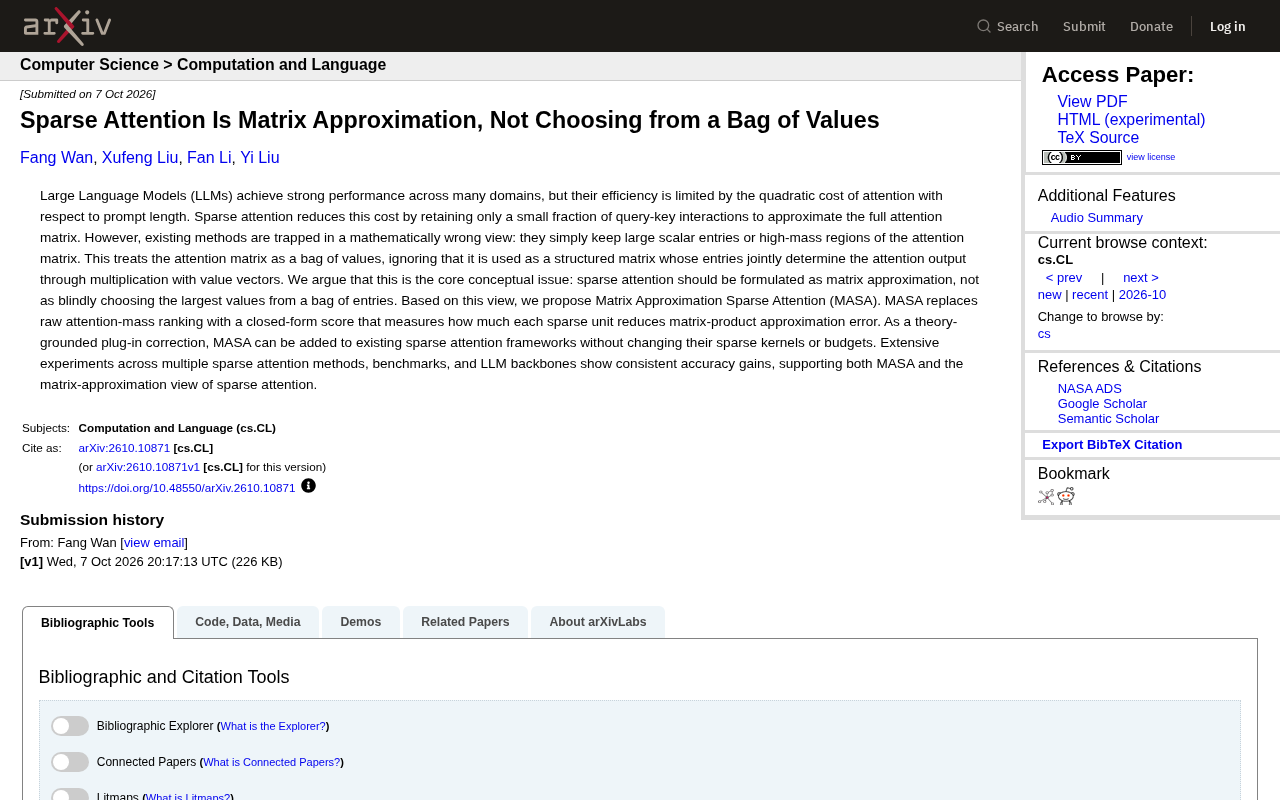
Existing sparse attention methods retain entries with large values in the attention matrix, but the paper (arXiv:2610.10871) argues this is mathematically flawed: the attention matrix is a structured operator in a matrix product, not a bag of isolated numbers. MASA (Matrix Approximation Sparse Attention) addresses this by scoring each sparse unit based on its actual contribution to reducing matrix product approximation error via a closed-form expression. It plugs into existing frameworks without modifying sparse kernels or compute budgets, achieving consistent accuracy gains across multiple methods, benchmarks, and LLM backbones.
The Efficiency Bottleneck in Sparse Attention
Large language models (LLMs) have demonstrated remarkable performance across countless tasks, but their core attention mechanism carries an unavoidable bottleneck: computational cost scales quadratically with prompt length. As context windows expand to tens or even hundreds of thousands of tokens, this overhead quickly becomes unsustainable.
Sparse Attention was designed precisely to address this problem. The basic idea is that in a full attention matrix, most query-key interactions contribute negligibly to the final output — so retaining only a small subset of critical interactions can approximate the effect of full attention while dramatically reducing both compute and memory requirements.
This direction has spawned a large body of work, but a newly published arXiv paper (arXiv:2610.10871) argues that existing approaches suffer from a fundamental mathematical flaw.
The quadratic complexity of attention stems from its core computation: for each token (query) in the sequence, similarity scores must be computed against all other tokens (keys), and all value vectors are then aggregated with these weights. For a sequence of length $n$, this requires computing an $n \times n$ attention matrix, with both time and memory complexity of $O(n^2)$. As $n$ grows from 2K to 128K, the computation balloons by roughly 4,000×. The core strategy of sparse attention is to limit each query to interacting with only $k \ll n$ keys, reducing complexity to $O(nk)$ — but the critical challenge lies in selecting those $k$ most "worthwhile" interactions. This is precisely the blind spot that MASA targets.
The Core Critique: The Attention Matrix Is Not "a Bag of Values"
The paper's authors put forward a striking claim: mainstream sparse attention methods have fallen into a "mathematically incorrect intuition."
The Problem with Existing Methods
Most sparse attention methods take a straightforward approach — retain entries with large scalar values in the attention matrix, or preserve "high-mass regions," discarding the rest. In other words, they implicitly assume that large-valued interactions are important interactions.
The paper argues that this treats the attention matrix as "a bag of values" from which the largest entries are simply picked out. But this overlooks a critical fact: the attention matrix is not a collection of isolated numbers — it is a structured matrix whose true role is to multiply against value vectors, with all entries jointly determining the final attention output.
Why "Pick the Big Values" Is Wrong
A large entry in the attention matrix does not necessarily mean it contributes most to the output after the matrix multiplication. Conversely, an entry with a modest value might have a significant impact on the final result once multiplied by the corresponding value vector. Ranking purely by magnitude severs the attention matrix from its essential nature as a "multiplicative operator."
The paper frames this as the core conceptual problem in the sparse attention field: sparse attention should be formulated as a matrix approximation problem, not as blindly selecting the largest entries from a bag of scalars.
A concrete example makes this intuitive. Suppose a row of the attention matrix contains two entries: entry A has weight 0.8 but its corresponding value vector is nearly zero; entry B has weight 0.2 but its corresponding value vector has large magnitude and a distinctive direction. Traditional methods would prioritize keeping entry A (since 0.8 > 0.2), yet entry B actually contributes more to the final output vector (weight × value norm is larger). This illustrates that attention weights (attention scores) and actual contribution to the output are two distinct quantities — and existing sparse methods conflate them. From a linear algebra perspective, this is equivalent to using the element-wise magnitude of a matrix as a proxy for the operator norm of the matrix product: a categorical error.
MASA: A Matrix Approximation-Based Solution
Building on this perspective, the paper proposes Matrix Approximation Sparse Attention (MASA).
From "Mass Ranking" to "Error Contribution Ranking"
MASA's key innovation is replacing the scoring criterion. Traditional methods rank and filter by raw attention mass, while MASA uses a closed-form score that measures how much each sparse unit can reduce the approximation error of the matrix product.
The significance of this shift: the scoring criterion is no longer "how large is this entry's value," but rather "how much closer to the true attention output does retaining this entry bring us?" This directly aligns with the ultimate objective of sparse attention — approximating the result of full attention computation, not approximating the numerical distribution of the attention matrix itself.
The meaning of "closed-form scoring" in MASA is worth unpacking. A closed-form score means it can be computed directly through an explicit mathematical expression, without iterative optimization or additional network inference — keeping computational overhead manageable. Specifically, MASA's score quantifies: given the already-selected sparse set, how much can the Frobenius error between $\hat{A}V$ and the full attention output $AV$ be reduced by adding a particular unit? This quantity jointly considers the attention weight magnitude and the corresponding value vector's norm — effectively introducing value-awareness on top of the traditional attention-mass score. This aligns the selection decision directly with the true optimization objective: minimizing output error.
A Theoretically Grounded Plug-in Correction
Another practical highlight of MASA is its engineering friendliness. The paper positions it as a theoretically grounded plug-in correction: it can be added on top of existing sparse attention frameworks without modifying the underlying sparse kernels or computational budgets.
This means practitioners don't need to overhaul existing sparse attention implementations — they only need to introduce MASA's scoring correction at the selection stage to achieve accuracy gains. This low-invasiveness dramatically lowers the barrier to adoption.
Experimental Validation and Significance
The paper reports that MASA was evaluated across multiple sparse attention methods, various benchmarks, and different LLM backbone models, demonstrating consistent accuracy improvements throughout.
This consistency across methods, benchmarks, and models serves as strong evidence supporting the paper's central claim — validating not only MASA's effectiveness but also the theoretical correctness of framing sparse attention as matrix approximation.
Potential Impact on Long-Context Models
As LLMs' demand for ultra-long contexts continues to grow, sparse attention is nearly an indispensable engineering tool. The value of MASA's perspective lies in its implication: many existing methods may have been off-target at the most fundamental decision — what to select — and by adopting a mathematically more rigorous scoring criterion, additional accuracy can be recovered without increasing the computational budget.
For researchers, perhaps the paper's deeper contribution is how it reframes the problem — reminding the entire field that sparse attention is fundamentally an approximation of matrix multiplication, and any selection strategy should aim to minimize the approximation error in the final output, rather than operating at the surface level of entry magnitudes.
Summary
MASA challenges mainstream sparse attention practice with a clear theoretical insight: the attention matrix should not be treated as a bag of values to be freely cherry-picked, but rather as a structured operator participating in matrix multiplication. By replacing mass-based ranking with closed-form error scoring and integrating as a plug-in correction on top of existing frameworks, MASA achieves consistent accuracy gains without changing the computational budget. This is not merely a concrete method — it represents an important correction to the design philosophy of sparse attention.
Related articles

Chain of Thought Isn't Just for AI: How Humans Can Use CoT to Improve Thinking Quality
Chain of Thought isn't just a prompt trick for large models. Starting from a Hacker News discussion, this article analyzes why CoT works for human thinking too, breaks down actionable ways to transfer it, and highlights the key differences between human CoT and machine CoT.
Cloudflare Teams Up with OpenAI: Closi…
Cloudflare Teams Up with OpenAI: Closing the Loop from Vulnerability Discovery to Defense with AI
Cloudflare uses OpenAI Daybreak to investigate security vulnerabilities and generate reviewable remediation plans, while developers use Codex to boost coding efficiency and quality.

Orca Multi-Agent Orchestration in Practice: A Guide to Parallel Collaboration with Claude and Codex
Orca is Stable AI's free open-source agent workbench supporting 34 agents like Claude Code and Codex in parallel. Learn its Git worktree isolation, multi-model orchestration, and mobile management.