Redis Creator's New Project ds4: A Fresh Take on Running LLMs Locally

Redis creator antirez's new project ds4 aims to run large language models locally, drawing early developer interest.
Salvatore Sanfilippo (antirez), creator of Redis, has launched ds4, a local large language model runner that surfaced on Hacker News in its early stages. The article explores the core drivers behind local LLM deployment — privacy, cost, offline access, and customizability — and infers that ds4 may lean toward a lightweight, engineering-optimized design aimed at developers rather than consumers, consistent with antirez's signature style. The article also cautions that public information on ds4 remains very limited, and recommends a careful, experimental approach until the project matures.
Redis Author Strikes Again: Local LLM Runner ds4
Salvatore Sanfilippo (antirez), the creator of Redis, has long been an iconic figure in the open-source community. Redis — the in-memory database he built — remains one of the most widely used of its kind worldwide. Recently, the community noticed a new project called ds4, described as a tool for running large language models (LLMs) locally, created by the same author behind Redis. The project surfaced on Hacker News and sparked another round of discussion around local LLM deployment tools.
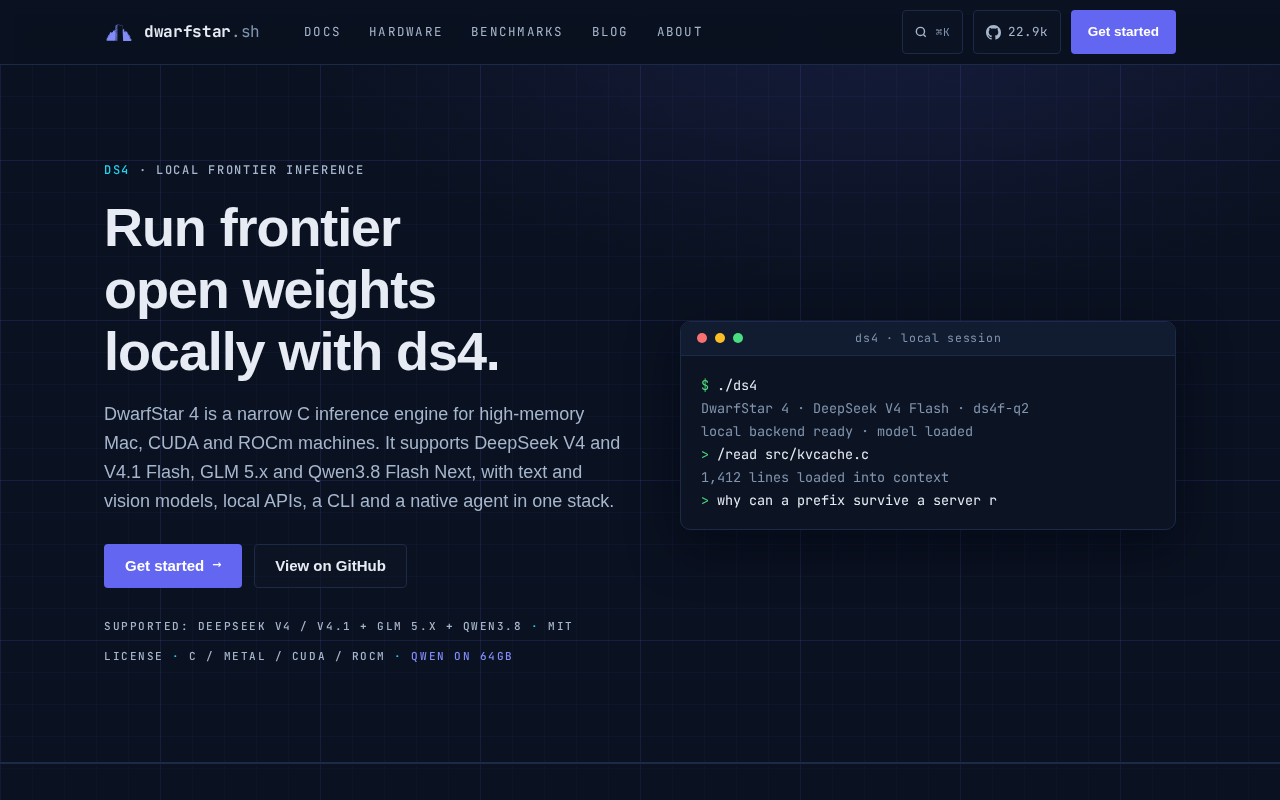
To be upfront: the publicly available information about this project is quite limited. The original Hacker News post has only 6 upvotes and 1 comment, placing it firmly in early-exposure territory. This article therefore focuses more on the broader technical trend of running LLMs locally and the context surrounding the project, rather than offering a detailed feature review of ds4 itself.
Why Running LLMs Locally Is Getting More Attention
Over the past two years, local deployment of large language models has gradually shifted from a niche hobby to a mainstream interest. Tools like llama.cpp, Ollama, and LM Studio have enabled everyday developers — and even individual users — to run quantized open-source models on their own laptops or desktops.
Several clear drivers are behind this trend:
- Privacy and data sovereignty: Local inference means data never leaves your machine — hugely appealing for sensitive use cases like healthcare, legal work, and internal enterprise documents.
- Cost control: No per-token charges for cloud API calls; the marginal cost of long-term use approaches zero.
- Offline availability: Model capabilities remain accessible even without an internet connection or in restricted-network environments.
- Customizability and experimentation: Developers can freely swap models, adjust parameters, and integrate everything into local workflows.
The fact that an author of Redis's caliber is entering this space is itself a signal worth noting. antirez is known for his commitment to simplicity, high performance, and engineering elegance. If ds4 carries forward his signature design philosophy, it could very well offer differentiated value in usability or performance.
The technical foundation of local LLM inference is model quantization. Raw large language model weights are stored as 32-bit or 16-bit floating-point numbers, often requiring tens of gigabytes of VRAM — far beyond what typical consumer hardware can handle. Quantization compresses parameter precision down to 8-bit, 4-bit, or even lower, making it possible to run a 7-billion-parameter model on a laptop with 8GB of RAM, or a 13-billion-parameter model on a 16GB device — usually with acceptable accuracy trade-offs. llama.cpp's GGUF format has become the most widely used standard for distributing quantized models, while tools like Ollama wrap it with a friendlier management layer that standardizes model downloading, switching, and API access. The maturity of this stack is what made the current explosion of local LLM tooling possible.
Inferring ds4's Positioning from the Redis Author's Engineering Style
antirez's code is famously "small but mighty." Redis's core logic is clean, has minimal dependencies, and delivers extreme performance. In the context of developer tooling, this style typically translates to a lower barrier to entry and higher maintainability.
With that in mind, here are some reasonable inferences about ds4 (subject to the project's actual documentation):
Likely Lightweight and Minimal
Rather than a feature-heavy framework, a tool from antirez is more likely to be a focused, single-purpose local LLM runner — emphasizing out-of-the-box usability over sprawling functionality.
Likely Strong on Engineering Details
Redis's mastery of memory management and data structure optimization is well-documented. If similar engineering thinking is applied to LLM inference — around memory footprint and load speed — ds4 might perform well on resource-constrained devices.
Aimed at Developers, Not End Consumers
The name (ds4) and the distribution channel (Hacker News) both suggest the project is currently targeting a technical audience, rather than polishing a consumer-facing graphical interface.
When Salvatore Sanfilippo created Redis in 2009, one of his core design decisions was a single-threaded event loop — at the time, multi-threaded concurrency was the mainstream approach, making his choice seem counterintuitive. Yet it delivered remarkably low implementation complexity and predictable latency. This "less is more" philosophy may well carry over into ds4. The local LLM inference space currently shows a tendency toward over-engineering: many tools bloat in size trying to cover every hardware backend (CUDA, Metal, ROCm, CPU) and every model format, raising the bar for debugging and contribution. If ds4 chooses to focus on specific hardware or specific use cases — sacrificing broad compatibility — it may achieve superior engineering quality within its target domain. That's very much in the spirit of Redis's "do one thing and do it exceptionally well."
A Grounded Perspective: Information Is Still Limited
It must be emphasized that, as of now, publicly available material on ds4 is extremely sparse. It is a project in its early stages of exposure — without large-scale community validation or authoritative performance benchmarks. Before trying it out, readers should:
- Check the project's official repository README and documentation to confirm its actual capabilities and supported model formats.
- Review the license and open-source status to determine whether it fits your use case.
- Start with small-scale experiments — don't rush to adopt early-stage tools in production environments.
For the local LLM ecosystem, having another option from a seasoned engineer is always a good thing. But "from the creator of Redis" is a label worth being excited about — not a guarantee of quality. The real test will come from hands-on experience.
Closing Thoughts
ds4 represents a snapshot of the continued flourishing of local LLM tooling: more and more experienced developers are joining the space, pushing models from the cloud onto personal devices. Whatever direction ds4 ultimately takes, the space it operates in — giving everyone local control over AI capabilities — is one of the most valuable explorations happening right now. Readers who are interested are encouraged to follow the project's progress and revisit with a deeper evaluation once more real-world testing and documentation become available.
Related articles

Python 3.15 New Feature: Is the sentinel Type Better Than None?
Python 3.15 adds the sentinel type, using named unique sentinel objects to replace None and bare object(), resolving confusion among missing values, explicit emptiness, and invalid input while avoiding type hint failures.

Deep Learning's Three Architectures and the Universal Approximation Theorem: A Complete Guide to MLPs, CNNs, and Transformers
Explaining the inductive bias differences among MLP, CNN, and Transformer, the existence meaning of the Universal Approximation Theorem (UAT), and the role of Taylor expansion in approximation analysis, while clearing up common misconceptions.

GitLab Emergency Patch Release: Analysis of Critical Security Fixes
GitLab releases critical patch 19.5.1, sparking 355 points of discussion on Hacker News. This article analyzes the background, upgrade steps for self-hosted instances, and verification points to help DevOps teams respond quickly to security updates.