Reflection AI's First Open-Weight Model Beam Lands on Ollama: 1M Context Free for a Limited Time

Reflection AI's open-weight model Beam launches on Ollama Cloud, free for a limited time, with million-token context and coding agents.
Reflection AI's first open-weight model Beam is now on Ollama Cloud, free for a limited time. Optimized for software engineering, reasoning, and long-running agentic tasks, it offers a 1M-token context window that fits large codebases and long conversations. It runs with one command and connects to Claude Code, Codex, and OpenCode. Hosted in the US with full zero data retention, it addresses enterprise privacy concerns. Ollama's Day 0 partnership shows its shift toward cloud model distribution. Parameter count and benchmarks are undisclosed.
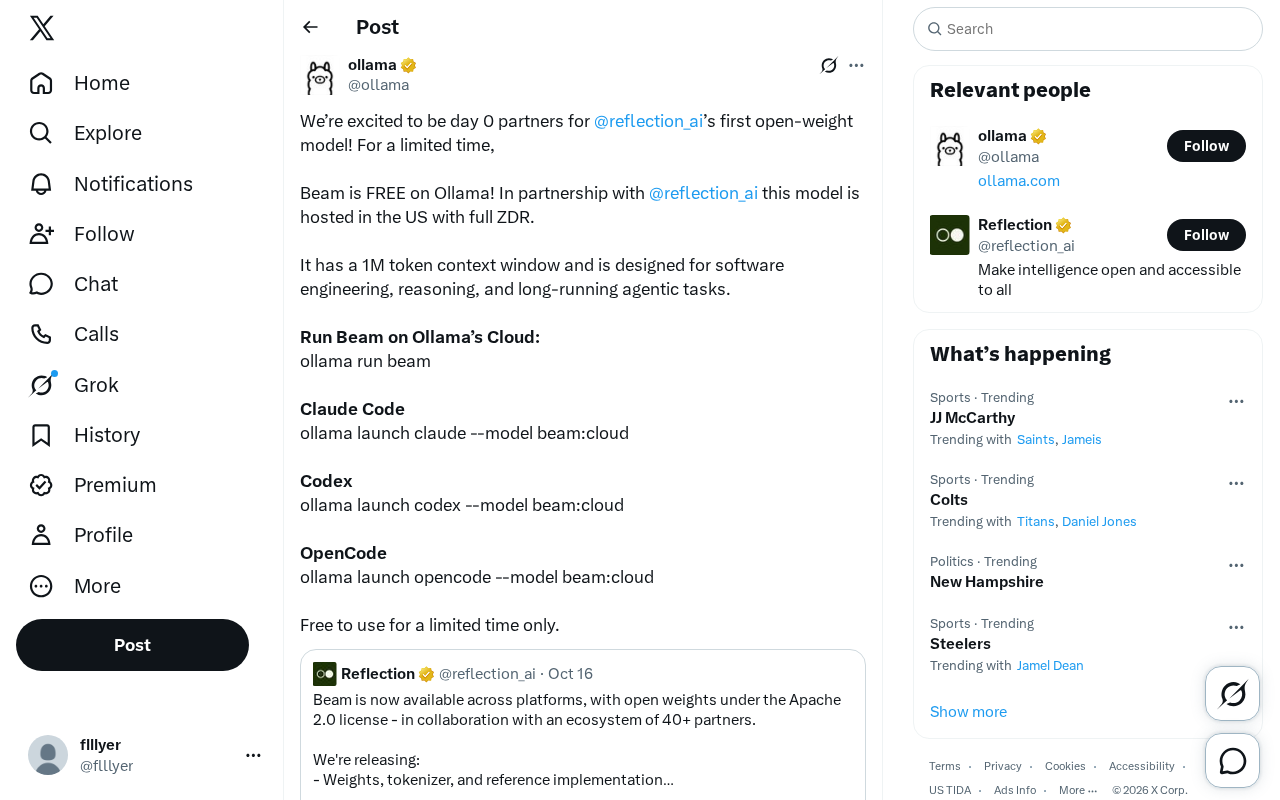
Ollama has partnered with Reflection AI to bring the latter's first open-weight model, Beam, to Ollama Cloud, free for a limited time. The news was first announced by Ollama on social media, with the key highlights being a 1-million-token context window, a focus on software engineering and long-running agentic tasks, and a privacy commitment of US-based hosting with full zero data retention (ZDR).
Model Positioning: Built for Software Engineering and Long-Running Agents
According to Ollama, Beam is not a general-purpose chat model but is explicitly optimized for three scenarios: software engineering, reasoning, and long-running agentic tasks. This positioning aligns closely with the direction of today's AI coding toolchain — developers need more than one-shot code generation; they need models that can continuously understand large codebases, reason across files, and maintain context coherence across multiple rounds of tool calls.
The 1-million-token context window is the technical foundation for this goal. For medium to large code repositories, this means the model can hold more source files, documentation, and conversation history within a single session, reducing reasoning breaks caused by context truncation. That said, Ollama's announcement did not disclose Beam's parameter count, training data composition, or benchmark results, so its actual capabilities still need to be validated by developers hands-on.
Long-running agentic tasks refer to models needing to autonomously accomplish complex goals involving multiple steps and multiple tool calls within a sustained session — for example, automatically fixing a bug that spans multiple files, iteratively generating and testing code based on requirements, or executing a series of search, edit, and verification operations in a repository. These tasks demand far more than single-turn Q&A: the model must maintain goal consistency across dozens or even hundreds of interactions, correctly accumulate intermediate results, and still accurately reference early information as the context keeps expanding. The million-token context window thus becomes key infrastructure supporting such tasks, not just a parameter-count selling point.
Three Major Coding Tools Work Out of the Box
Access follows Ollama's usual command-line style — developers can run Beam on Ollama Cloud with a single command:
ollama run beam
For mainstream AI coding CLI tools, Ollama also provides direct launch commands:
- Claude Code:
ollama launch claude --model beam:cloud - Codex:
ollama launch codex --model beam:cloud - OpenCode:
ollama launch opencode --model beam:cloud
This "model + tool" bundled launch approach lowers the friction for developers trying new models. For teams already using Claude Code or Codex workflows, switching to Beam requires changing only one model parameter, making side-by-side comparison testing easy.
Limited-Time Free Access and ZDR Privacy Commitment
Two business-level details in the announcement are worth noting. The first is limited-time free access: Beam is free on Ollama, but Ollama explicitly states "for a limited time only" without giving a specific end date, meaning the free window could close abruptly — developers who want to evaluate it should test early.
The second is data privacy. Ollama emphasizes that the model is hosted in the US and supports full ZDR (Zero Data Retention). For enterprise developers handling private codebases, whether data is retained for training is one of the core concerns in model selection, and the ZDR commitment addresses this to some extent. However, the announcement does not detail the specific scope of ZDR (whether it covers logs, intermediate inference results, etc.), so enterprises should still confirm compliance details with the provider before procurement.
Zero Data Retention (ZDR) is a data governance commitment meaning that after processing a user request, the service provider does not persistently store prompts, model outputs, or related interaction records, nor use them for model training or human review. For enterprise developers, ZDR differs from the usual "data not used for training" clause: the latter may still retain logs for operations or abuse detection, whereas ZDR requires more thorough immediate discarding. However, the exact boundaries of ZDR — whether it covers system logs, error tracking, billing metadata, or intermediate inference states — are typically specified in the service agreement, and implementations vary widely across vendors, which is something enterprises need to confirm item by item during compliance assessment.
A New Signal in the Open-Weight Model Competition
Reflection AI chose to enter the market with an "open weights + cloud hosting" combination rather than pure local deployment or a purely closed-source API — a route that is quite representative today. Open weights reduce the risk of platform lock-in, while cloud hosting solves the demanding local VRAM requirements of large-context models — a 1-million-token context is nearly infeasible on consumer hardware, making cloud inference the realistic choice.
From an ecosystem perspective, Ollama's first-day support as a "Day 0 partner" shows it is extending from a local model-running tool toward a cloud model distribution platform. For the developer community, having one more coding model option with long-context capability that is free for a limited time is itself a variable worth watching. As for whether Beam can challenge existing mainstream models on code generation quality, that will require comparison data from real projects to answer.
Open-weight means a model's trained parameters are publicly downloadable, and users can deploy and run it locally or on their own infrastructure, but the training data, training code, and full training pipeline may not be public — so it is not equivalent to a fully open-source model. Compared with closed-source APIs, open weights reduce platform lock-in risk and allow community fine-tuning and independent auditing; compared with pure local deployment, cloud-hosted open-weight models bypass the demanding VRAM requirements of large-context models. The "open weights + cloud hosting" combination adopted by Reflection AI is precisely an attempt to balance openness and accessibility — a typical compromise in current model distribution.
One-line Summary
Reflection AI's open-weight model Beam launches on Ollama Cloud, free for a limited time, featuring a million-token context and coding agents.
Paragraph Summary
Reflection AI's first open-weight model Beam is now on Ollama Cloud, free for a limited time. It is not a general chat model but is optimized for software engineering, reasoning, and long-running agentic tasks, with a 1-million-token context window that can hold large codebases and long conversations in a single session. Developers can run it with a single command and connect it directly to mainstream coding CLI tools like Claude Code, Codex, and OpenCode. Beam is hosted in the US with a full zero data retention (ZDR) commitment, addressing enterprise privacy concerns. Ollama's Day 0 partnership support reflects its expansion from a local running tool to a cloud model distribution platform. Parameter count and benchmark results have not been disclosed, and actual capabilities remain to be verified.
Related articles

Cursor Can Now Control Your Computer: AI Agents Can Drive Desktop Apps for Testing
Cursor adds desktop control: AI agents can drive desktop apps like the iOS Simulator to test their own features. We analyze the impact on dev workflows, possible technical approaches, and reliability concerns.

Vibecoding a Custom Inference Engine: High Hopes, Harsh Reality
A Reddit developer shares the real experience of vibecoding a custom inference engine: running GGUF Q4 models in the browser with WebGL2 and GLSL, only to fall into tokenizer debugging hell. This article analyzes the engineering challenges of browser-side LLM inference and why cloning llama.cpp is the more rational choice.

How High Are Anthropic's Early Investor Paper Returns Ahead of IPO?
Anthropic's early investor paper returns draw attention ahead of IPO. This article analyzes sources of book gains, capital structure, pre-IPO games and risks, and implications for the AI startup ecosystem.