Reflection Launches 501B-Parameter MoE Model Beam, CEO to Appear at Fireworks Forge

Reflection releases the 501B-parameter MoE model Beam, and its CEO will share lessons on building frontier open models at Fireworks Forge.
AI startup Reflection has released a 501B-parameter Mixture of Experts (MoE) model called Beam, positioning it as a "frontier open model." Co-founder and CEO Misha Laskin will attend Fireworks Forge for a conversation with @the_bunny_chen about the conditions and challenges of building frontier open models, with the keynote scheduled to livestream on November 3. The article notes that the 501B scale pushes open-model competition to a new order of magnitude; MoE expands capacity through sparse activation while controlling inference costs, but it also brings engineering challenges such as routing stability and load balancing. Beam's training data, benchmark results, and open-source license have not yet been disclosed; future attention should focus on its technical report, evaluation results, and licensing choices, which will determine its actual influence in the open-source community.
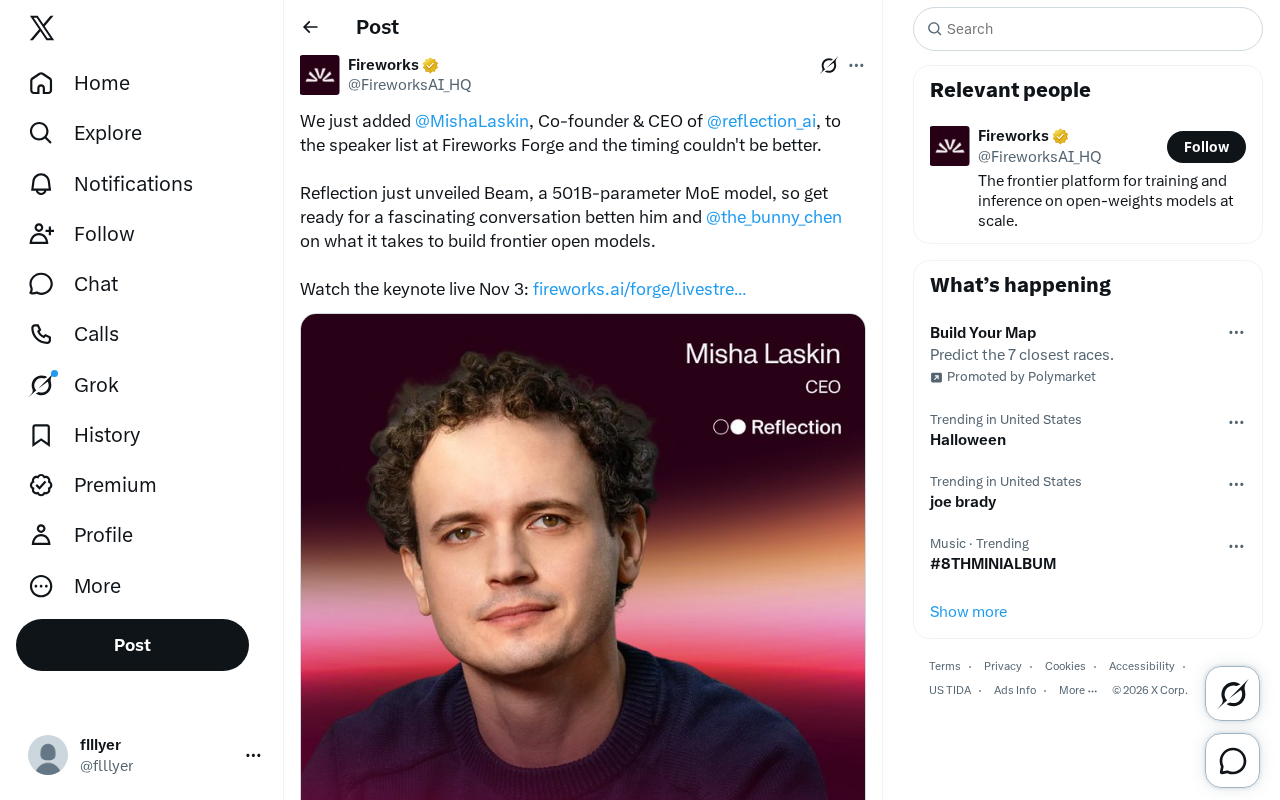
AI startup Reflection recently released a 501B-parameter Mixture of Experts (MoE) model called Beam, and its co-founder and CEO Misha Laskin will attend the Fireworks Forge event and deliver a keynote. After the news was announced on social media, it quickly sparked discussion about the path to building frontier open models.
Reflection and the Beam Model: Dual Signals of Scale and Architecture
According to public information, Beam is an MoE architecture model with 501B parameters. MoE (Mixture of Experts) sparsifies computation, controlling inference costs while maintaining a large parameter count, and has become an important direction for scaling current large models. The 501B parameter scale also means Reflection has directly entered the ultra-large-scale model race, forming a contrast with the technical approaches of leading industry players.
Reflection positions Beam as "frontier open models," which suggests that it is not only pursuing performance but may also be taking action on the degree of openness. However, specific training data, benchmark results, and open-source licensing for Beam have not yet been disclosed, and more details await further official release.
The core of the Mixture of Experts (MoE) architecture is "sparse activation": the model consists of multiple parallel expert subnetworks, and each input token is assigned by a gating (routing) network to a small number of experts for processing, while the remaining experts do not participate in computation. Therefore, the total parameter count of an MoE model can be far larger than the number of parameters actually activated in each forward pass, thereby expanding model capacity without proportionally increasing inference compute. This contrasts with dense models, where every token passes through all parameters.
The main engineering difficulties of MoE lie in routing and training stability: the gating network may experience severe imbalance in expert load (a few experts being overused), which needs to be constrained through load-balancing losses, capacity factor limits, and other means; in addition, in distributed training, experts distributed across different devices introduce extra communication overhead that affects throughput. For this reason, the actual effectiveness of MoE depends to a large extent on engineering implementation rather than parameter count alone.
Fireworks Forge: Conversation Focuses on "How to Build Frontier Open Models"
According to the event announcement, Misha Laskin will have a conversation with @the_bunny_chen at Fireworks Forge, centered on the conditions and challenges required to build frontier open models. The announcement said the timing "couldn't be better," clearly intending to use the momentum of Beam's release to help the outside world understand Reflection's thinking on model scaling.
Fireworks Forge itself is an AI technology event, and adding Laskin to the speaker list this time also reflects the industry's attention to the competitive landscape of open large models. The conversation may involve engineering practices for MoE architecture, training cost control, and strategic choices for the open-source ecosystem—topics that are currently hotly discussed in the developer community.
"Frontier open models" generally refer to models whose capabilities approach the industry's most advanced closed-source models while being released in the form of open weights or open licenses. The key to this term is "frontier": it emphasizes not only open source but also entering the top tier in terms of performance. Related to this are differences in degrees of openness—some models only open their weights, while others additionally publish technical reports, training data descriptions, or inference code. Different levels of openness greatly affect usability for downstream developers.
The barrier to building such models is extremely high, involving large-scale compute clusters, data mixing and cleaning, training stability tuning, and post-training (such as instruction fine-tuning and alignment). Therefore, discussions around "how to build frontier open models" often concern not only algorithms but also access to compute, cost sharing, and how teams organize their engineering capabilities.
Competition in Open Large Models Enters a New Stage
Seen against a broader backdrop, Reflection's release of the 501B MoE model is another example of the continued rise in parameter scale among open models. Multiple open models ranging from tens of billions to hundreds of billions of parameters have already appeared, and the 501B scale pushes competition to a new order of magnitude.
The adoption of MoE architecture is also noteworthy. Compared with dense models, MoE activates only part of the experts during training and inference, helping to support larger parameter counts under limited compute. But MoE also brings engineering challenges such as routing stability and load balancing. Whether Reflection can provide mature solutions on Beam will be key for outsiders assessing its technical strength.
When evaluating such models, parameter scale itself is not equivalent to capability. Commonly used comparison dimensions in the industry include scores on standard benchmarks (such as knowledge and reasoning evaluations), context window length, multilingual and code capabilities, and the actual cost of inference (price per token or GPU memory required for self-hosting). For MoE models, it is also necessary to distinguish total parameter count from activated parameter count, because the latter more directly determines inference overhead and deployment hardware requirements.
Another often overlooked dimension is the specific terms of the open-source license: whether commercial use is allowed, whether there are restrictions on redistribution or derivative models, and whether attribution or open derivative works are required. These terms significantly affect enterprises' willingness to adopt a model and are also an important basis for judging the actual influence of an "open-source" model.
Livestream Information and Follow-up Points
The announcement shows that the keynote will be livestreamed on November 3, and viewers can watch via the provided link. For developers following progress in open models, this conversation may reveal Beam's design tradeoffs and Reflection's roadmap.
Follow-up milestones worth watching include whether Beam's technical report or model card is released, whether benchmark results match its parameter scale, and Reflection's specific choices regarding open-source licensing. This information will determine Beam's actual influence in the open-source community.
Overall, Reflection has demonstrated through Beam its intention to enter the frontier open model space, while the Fireworks Forge conversation provides a window into understanding its approach. At a time when the capability gap between open and closed models continues to change, insights from frontline practitioners like these are highly valuable for reference.
Related articles

AI Tools Quietly Altering Settings: Postman Silently Installs Plugin, Codex Sharing Option Auto-Resets
AI Daily reports: Postman silently installs a Mac plugin and self-approves startup hooks, logged as auto-existing upgrade; Hacker News developers say Codex data-sharing opt-out flips back. Plus Simon Willison's raw float weight experiment with QEN 3.8-27B.

AI Learns to Rewrite AI: MIT's "Weightspace Programming" Redraws the Path to Recursive Self-Improvement
MIT team proposes weightspace programming: GPT-6 Astra reads and edits AI model weights directly. Math scores jump several-fold, hand-written networks beat trained models. Eight experiments analyzed, plus Anthropic's same-day warning and the real boundaries of recursive self-improvement.

Running Qwen 3.8 on a Laptop to Read Raw Weights: 46 Minutes Per Answer
Simon Willison reproduced weight space programming with Qwen 3.8 27B on a laptop: a 17GB model file, 46 minutes per answer, 43,506 reasoning tokens, Pong over an hour, Freeway failed. Suited for interpretability researchers.