Reframing Low-Resource Machine Translation with POMDP: Designing a Bengali Translation Agent

Using POMDP, MBR decoding, and active disambiguation to build an intelligent Bengali translation agent.
This article explores an innovative approach to low-resource machine translation for Bengali that reframes translation as a decision problem under uncertainty using POMDP. By combining Minimum Bayes Risk decoding, confidence-based active disambiguation, and multilingual backbone models like Whisper and NLLB, the system addresses challenges including lexical ambiguity, code-mixing (Banglish), and speech noise, offering a unified agent-based framework for ambiguity-dense translation tasks.
When Translation Is No Longer a Deterministic Problem
Traditional Neural Machine Translation (NMT) treats translation as a deterministic sequence-to-sequence task: input a sentence, output the corresponding translation. The Seq2Seq architecture, first proposed by Sutskever et al. in 2014, has become the foundational paradigm for neural machine translation. It uses an encoder to compress a source language sentence into a vector representation, then a decoder to incrementally generate the target language word sequence. Subsequent innovations like the Attention mechanism and Transformer architecture dramatically improved translation quality. However, the success of these models is highly dependent on large-scale parallel corpora — for instance, the English-French language pair has tens of millions of aligned sentence pairs, while high-quality parallel data for Bengali-English numbers only in the low millions and covers extremely limited domains and registers.
This paradigm works beautifully for high-resource language pairs like English, French, and Chinese, but frequently falls apart for low-resource language pairs like Bengali (Bangla) ↔ English. Low-resource language pairs face not just data scarcity, but systemic bottlenecks including the lack of linguistic tools (tokenizers, POS taggers, etc.) and a shortage of annotation expertise.
Recently, a developer shared an inspiring project concept on Reddit: instead of treating translation as a deterministic mapping, why not remodel it as an Agent Decision Problem under Uncertainty? This shift in perspective strikes at the very heart of Low-Resource Machine Translation (LRMT).
This article walks through the project's technical framework and explores why the combination of POMDP, MBR decoding, and active disambiguation might offer a promising new path for tackling ambiguity-dense translation tasks.
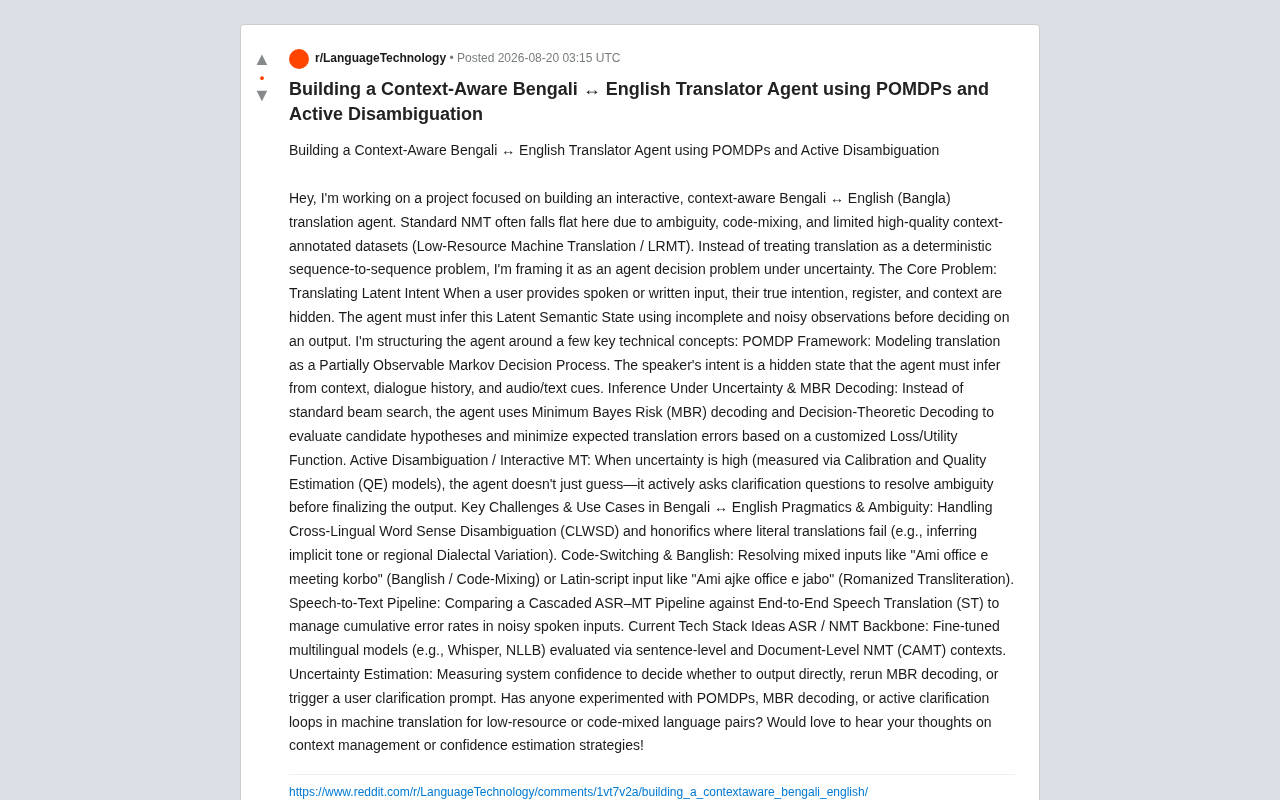
The Core Challenge: Translating Latent Intent, Not Surface Text
The author raises a crucial insight: the user's true intent, register, and context are fundamentally hidden states. When a user inputs text or speech, the system receives only an incomplete and noisy observation signal — the speaker's Latent Semantic State must be inferred.
This is especially pronounced in Bengali scenarios, manifesting in several categories of typical challenges:
Pragmatic and Ambiguity Issues
Bengali has a complex honorific system along with numerous dialectal variants. Verb conjugations and pronoun choices in Bengali shift systematically based on the social relationship between speaker and listener (age, status, closeness), forming at least three levels of honorifics (tumi/tui/apni). This distinction has no direct equivalent in English, and literal translation often loses the implied tone and social relationship information. This requires Cross-Lingual Word Sense Disambiguation (CLWSD) rather than simple lexicon mapping. Unlike monolingual Word Sense Disambiguation (WSD), CLWSD requires choosing among multiple possible translations in the target language for a polysemous word in the source language — essentially a cross-lingual semantic mapping problem that demands simultaneous understanding of both languages' semantic spaces.
Code-Mixing and the Banglish Phenomenon
In practice, Bengali speakers frequently mix in English words, for example:
"Ami office e meeting korbo"(Bengali + English mix, i.e., Code-Mixing)"Ami ajke office e jabo"(Romanized transliteration using Latin script)
This "Banglish" input makes it difficult for standard NMT models to perform reliably — the model must both identify language boundaries and understand mixed semantics. Code-Mixing and Code-Switching are ubiquitous linguistic phenomena in multilingual communities, particularly common in social media and instant messaging. For NLP systems, the challenges of such text include: standard language identification tools struggle to determine the language affiliation of each token; tokenization and morphological analysis tools are typically designed for a single language; and while existing pre-trained multilingual language models cover many languages, the proportion of mixed-language text in their training data is extremely low, resulting in insufficient representational capacity for such inputs.
Error Accumulation in Speech Transcription
For speech input, the author proposes comparing two technical approaches: the cascaded ASR–MT pipeline (speech recognition first, then translation) versus end-to-end Speech Translation (ST). The former has clean modular separation, but recognition errors accumulate and propagate to the translation stage — academically known as the "error propagation" problem, where every error produced in the ASR stage is treated as correct input by the downstream translation module, causing disproportionate degradation in translation quality. The latter attempts to circumvent this error compounding by jointly modeling the direct mapping from acoustic signals to target language text, avoiding the information bottleneck of intermediate text representation — but demands more training data. End-to-end speech translation requires large amounts of aligned source language audio and target language text, which is extremely scarce for low-resource language pairs.
The POMDP Framework: Incorporating Uncertainty into Translation Modeling
The project's technical backbone is built on the Partially Observable Markov Decision Process (POMDP).
A POMDP is defined by a seven-tuple: (S, A, T, R, Ω, O, γ), where S is the state space, A is the action space, T is the state transition function, R is the reward function, Ω is the observation space, O is the observation function, and γ is the discount factor. Unlike a standard MDP, an agent in a POMDP cannot directly observe the current state — it can only maintain a probability distribution over the true state via observation signals, known as the belief state. Solving POMDPs is typically PSPACE-complete, and practical applications often rely on approximate methods such as Point-Based Value Iteration or Monte Carlo Tree Search.
Within this framework:
- The hidden state is the speaker's true intent;
- Observations come from context, dialogue history, and audio/text cues;
- Actions are the agent's output decisions.
The value of POMDP lies in its inherent acknowledgment that "the system cannot directly observe the true intent," requiring the agent to reason and make decisions based on the belief state. Compared to traditional NMT which treats every step as a deterministic output, POMDP allows the system to continuously maintain a probability distribution estimate of the user's intent and make more robust choices accordingly. The innovation of introducing POMDP into the translation domain is that it provides a mathematically unified and computable framework for handling multiple sources of uncertainty (lexical ambiguity, pragmatic vagueness, noisy input), rather than designing ad-hoc heuristic rules for each source of uncertainty.
MBR Decoding: Shifting from Maximum Probability to Minimum Risk
For the decoding strategy, the project abandons mainstream beam search in favor of Minimum Bayes Risk (MBR) decoding and Decision-Theoretic Decoding.
MBR decoding originates from statistical decision theory, with the core idea of minimizing expected loss rather than maximizing posterior probability. Formally, the hypothesis selected by MBR is: argmin_h Σ_r P(r|x) · L(h, r), where h is a candidate hypothesis, r represents samples from the reference hypothesis set, and L is the loss function (typically the negative of translation quality metrics like BLEU or COMET).
The key difference between the two approaches lies in their optimization objectives:
- Beam search pursues the candidate sequence with the highest generation probability;
- MBR decoding uses a customized Loss/Utility Function to evaluate candidate hypotheses and select the one with "minimum expected translation error."
In other words, MBR doesn't ask "which translation is most probable" but rather "which translation carries the least cost of being wrong, even under uncertainty." This is especially suitable for scenarios with high ambiguity and strict error-tolerance requirements (such as translations involving honorifics and tone).
Since 2022, research by Freitag et al. at Google has shown that MBR decoding based on neural utility metrics (such as BLEURT, COMET) consistently outperforms beam search on WMT translation tasks. The trade-off is that it requires sampling dozens to hundreds of candidate translations from the model and computing utility scores for every pair of candidates, resulting in O(n²) computational complexity. Recent acceleration methods include pruning strategies, hierarchical sampling, and approximate utility computation. Applying this approach to low-resource language pairs, as this project does, is a practical direction worth tracking.
Active Disambiguation: Proactively Asking When Uncertain
This is the most distinctly "agent-like" component of the entire design.
Traditional translation systems can only "guess" an answer when faced with highly ambiguous input. This project introduces an Active Disambiguation / Interactive MT mechanism:
- The system measures its own confidence through Calibration and Quality Estimation (QE) models;
- When uncertainty exceeds a threshold, the agent does not output directly but instead proactively poses clarifying questions to the user;
- Only after the ambiguity is resolved does it generate the final translation.
Translation Quality Estimation (QE) refers to the technique of automatically evaluating machine translation output quality without reference translations. Modern QE systems are typically fine-tuned on pre-trained multilingual models (such as XLM-R) and can provide quality scores at the word, sentence, and document levels. Calibration focuses on whether a model's confidence aligns with its actual accuracy — i.e., when the model says "I'm 80% confident," its output should indeed be correct about 80% of the time. Common calibration methods include Temperature Scaling, Label Smoothing, and Monte Carlo Dropout. In active disambiguation scenarios, good calibration is critical: if the model is systematically overconfident, it will miss opportunities to seek user clarification; if overly conservative, it will frequently interrupt users and degrade the experience.
This "knowing what you don't know" capability essentially converts uncertainty estimation into interactive actions. It transforms translation from one-directional output into bidirectional dialogue, making it particularly suited for high-noise input scenarios like colloquial speech and code-mixed text.
Technology Stack and Architecture Design
The author's planned technology stack reflects pragmatic considerations for low-resource constraints:
Backbone Model Selection
- ASR / NMT backbone: Fine-tuning multilingual models such as Whisper (speech recognition) and NLLB (No Language Left Behind, translation).
Whisper is a general-purpose speech recognition model released by OpenAI in 2022, based on a Transformer encoder-decoder architecture and trained on 680,000 hours of multilingual weakly-supervised data. Its standout features include broad multilingual coverage (99 languages) and strong robustness to noise and accents, though performance on low-resource languages still shows significant quality gaps. NLLB (No Language Left Behind) is a multilingual translation model released by Meta in 2022, supporting direct translation between 200 languages and based on a Sparse Mixture of Experts architecture, with the largest NLLB-200 version having 54B parameters. For Bengali, NLLB demonstrates solid baseline performance on the FLORES-200 benchmark, but still requires domain-adaptive fine-tuning for colloquial expressions, dialectal variants, and code-mixed text.
- Evaluation dimensions: Both sentence-level evaluation and Document-Level NMT (Context-Aware MT, CAMT) context are incorporated to capture cross-sentence dependencies. Document-level translation addresses linguistic phenomena that extend beyond single-sentence boundaries, such as pronoun anaphora resolution, discourse coherence, and terminology consistency. Traditional sentence-level translation models cannot leverage preceding context to resolve ambiguity in the current sentence, while document-level models can better handle translation problems requiring cross-sentence reasoning by expanding the context window or introducing document memory mechanisms.
Confidence-Based Three-Tier Decision Loop
The system uses confidence measurements to dynamically decide whether to output directly, re-run MBR decoding, or trigger a user clarification prompt. This forms a confidence-based three-tier decision loop that serves as the scheduling hub of the entire Agent architecture. This layered decision mechanism draws from the concept of "Metacognition" in cognitive science — the system must not only execute the translation task but also monitor its own execution quality and adjust strategy accordingly. In engineering terms, this requires the confidence estimation module to have sufficient discriminative power: reliably classifying inputs into three zones — "high certainty, output directly," "moderate uncertainty, resample needed," and "high ambiguity, human intervention required."
Reflections and Outlook
The greatest value of this project may not lie in any specific module, but rather in the unified problem framework it provides: converging seemingly disparate challenges like ambiguity, code-mixing, speech noise, and pragmatic inference in translation under the single lens of "decision-making under uncertainty."
Of course, significant challenges remain for real-world deployment: belief state updates in POMDP are computationally expensive for real-time translation — even with approximate inference methods like particle filters, maintaining and updating the state distribution of hundreds of particles may introduce tens of milliseconds of latency, which could be unacceptable in real-time conversational translation scenarios; MBR decoding requires generating large numbers of candidate samples with substantial inference overhead, typically needing 50-200 candidate translations and computing pairwise utility scores across all of them; and the interactive design for active disambiguation must balance "accuracy" against "user disruption" — overly frequent clarification requests severely damage user experience, while overly conservative triggering strategies render the mechanism ineffective.
From a broader perspective, this project reflects an important trend in NLP: shifting from maximizing single-point model performance to building agent systems with self-awareness and interactive capabilities. This aligns with the current development trajectory of Large Language Model (LLM) Agents — systems are no longer passive input-output mappers but decision-making entities capable of active planning, uncertainty assessment, and environmental interaction.
The author also posed a question to the community at the end of the post: has anyone experimented with POMDP, MBR decoding, or active clarification loops on low-resource or code-mixed language pairs? This is both a technical sharing and an open invitation to explore. For those interested in low-resource machine translation and agent-based NLP systems, this approach deserves continued attention.
Related articles

DeepCell: One-Click AI Generation of Documents, Spreadsheets, and Slides
DeepCell tops Product Hunt with one-click generation of documents, spreadsheets, and slides, using the .deepcell format for linked updates, designed for System 2 tasks like modeling and sales reviews.

Doneas: 15-Minute Daily Accountability Calls That Keep Indie Developers From Procrastinating
Doneas is a daily accountability tool for indie developers: plan tasks on Monday, join a 15-minute call with five builders each day, and log deliveries on a public progress page. This article analyzes its core mechanics, effectiveness, and potential issues around retention and matching.

Fastlane 2.0: Fully Automated AI Ad Campaigns, From Creative to Optimization
Fastlane 2.0 is an AI ad automation tool: enter your website and it learns your brand, generates video and image ads, and runs and optimizes them on Meta, TikTok, Instagram, and YouTube.