Regret Analysis without Optimal-Arm Feedback: New Advances in Bandits under Reward-Dependent Delays
Studies stochastic bandits with reward-dependent delays and no optimal-arm feedback, proposing the BHO algorithm and deriving regret lower bounds.
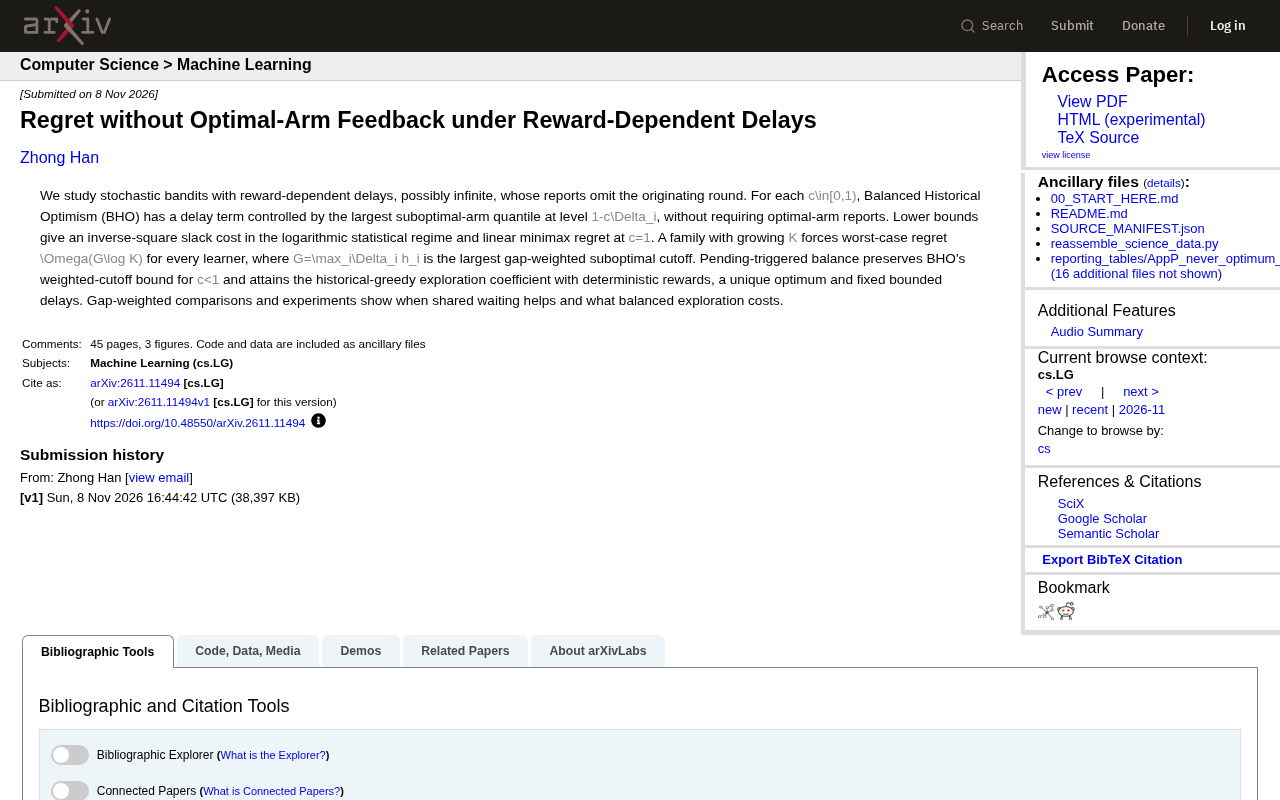
This paper studies stochastic bandits where delays are reward-dependent, feedback omits original round information, and no optimal-arm feedback is available. It proposes the Balanced Historical Optimism (BHO) algorithm, which uses suboptimal-arm quantiles to construct delay terms and balance exploration and exploitation without optimal-arm feedback. Theoretical analysis establishes regret lower bounds, including linear minimax regret when c=1 and an Ω(G log K) worst-case bound for growing arms. A pending-triggered balance mechanism achieves the historical greedy exploration coefficient under specific conditions. Experiments reveal when shared waiting helps and the cost of balanced exploration, offering new theoretical tools for delayed bandit problems.
The classic stochastic bandit setting assumes that the reward feedback for the chosen arm is received every round, but in reality feedback is often delayed—and the delay length may even depend on the reward itself: the higher the reward, the later the feedback may arrive. More challenging still, feedback may completely lack information about the optimal arm. A recent study tackles this "reward-dependent delay with no optimal-arm feedback" scenario, proposing the Balanced Historical Optimism (BHO) algorithm along with regret lower bounds and an experimental analysis.
Problem Setting: The Dual Challenge of Delays and Missing Feedback
The study considers a stochastic bandit problem in which delays are reward-dependent and may even be infinite, and the feedback reports omit the original round information. This means the learner not only faces delays but also cannot directly learn the feedback of the optimal arm—traditional optimistic algorithms rely on reward estimates of the optimal arm to construct confidence intervals, and this path is cut off.
In this setting, the delay distribution of each suboptimal arm determines the difficulty of learning. The authors introduce a key quantity: the maximum gap-weighted suboptimal truncation value (G = \max_i \Delta_i h_i), where (\Delta_i) is the gap of arm (i) and (h_i) is its delay-related quantile. This quantity characterizes the impact of delays in the worst case.
The stochastic bandit problem is a classic model of sequential decision-making: each round the learner selects one of K arms, receives a random reward for that arm, and aims to minimize cumulative regret (the difference from the payoff of always choosing the optimal arm). The standard setting assumes immediate reward feedback for the chosen arm each round, but in reality feedback is often delayed or even missing. Reward-dependent delay means the delay length is correlated with the reward value—for example, feedback for high rewards may arrive later. Infinite delay means some feedback may never appear, further increasing learning difficulty. Feedback that omits original round information prevents the learner from mapping delayed feedback to specific decision rounds, rendering traditional timestamp-based delay handling ineffective. Together, these challenges form a bandit variant that is closer to practice but more complex to analyze theoretically.
The BHO Algorithm: Balanced Historical Optimism
For each (c \in [0,1)), the BHO algorithm constructs a delay term controlled by the quantile of the maximum suboptimal arm at level (1 - c\Delta_i), and it does not require feedback reports from the optimal arm. Intuitively, the algorithm balances exploration and exploitation using information from suboptimal arms in historical data; even when optimal-arm feedback is missing, it can infer from the delay structure of suboptimal arms.
The theoretical analysis provides a lower bound: within the logarithmic statistical regime, there is a cost that relaxes inversely with the square; when (c=1), the minimax regret is linear. Moreover, for a family of problems with growing number of arms (K), any learner faces worst-case regret (\Omega(G \log K)), where (G) is the maximum gap-weighted suboptimal truncation. This lower bound shows that even without optimal-arm feedback, the delay structure leads to unavoidable regret growth.
Regret lower bound is a theoretical benchmark for algorithm performance, representing the minimum cumulative regret that no algorithm can avoid in the worst case. Minimax regret refers to the smallest possible upper bound on the expected regret of an algorithm under the worst distribution over problem instances. Logarithmic statistical regime usually refers to the regime where regret grows logarithmically with time, common in the analysis of optimistic algorithms. Inverse-square relaxation cost describes the phenomenon where, when some relaxation is allowed, the cost decreases inversely with the square of the relaxation amount, reflecting the exploration-exploitation trade-off. Linear minimax regret means regret grows linearly with time, indicating that the problem is extremely difficult. The (\Omega(G \log K)) lower bound states that as the number of arms K grows, the worst-case regret is at least proportional to G log K, where G is the maximum gap-weighted suboptimal truncation, revealing the unavoidable regret growth caused by the delay structure.
Pending-Triggered Balance: Maintaining the Weighted Truncation Bound
The authors further propose a "pending-triggered balance" mechanism that maintains the weighted truncation bound of BHO when (c<1), and in the setting of deterministic rewards, a unique optimal arm, and fixed bounded delays, achieves the historical greedy exploration coefficient. This is an interesting conclusion: under specific conditions, the cost of balanced exploration can be reduced to the same coefficient as the greedy strategy, showing that BHO's design achieves a delicate trade-off between exploration and exploitation.
Historical greedy exploration coefficient refers to the exploration coefficient when a greedy strategy (always choosing the estimated best arm) is used based on historical data, typically 1. Weighted truncation bound is the upper bound on the delay term constructed in the BHO algorithm via the maximum gap-weighted quantile, used to control exploration cost. Pending-triggered balance mechanism is a dynamic adjustment strategy: when the delay information of suboptimal arms in historical data suffices to trigger the balance condition, the algorithm adjusts the exploration rate to maintain the weighted truncation bound; otherwise it degenerates to a greedy strategy. Under deterministic rewards, a unique optimal arm, and fixed bounded delays, this mechanism can achieve the same exploration coefficient as the historical greedy strategy, indicating that the cost of balanced exploration can be minimized, realizing a fine-grained exploration-exploitation trade-off.
Experiments and Insights: When Shared Waiting Helps
Through gap-weighted comparisons and experiments, the authors show when shared waiting (i.e., multiple arms sharing delay information) helps and the cost of balanced exploration. Experimental results show that when the delay structure of suboptimal arms provides sufficient information, BHO can effectively compensate for the missing optimal-arm feedback; however, under some extreme delay distributions, the cost of balanced exploration rises significantly.
This study provides new theoretical tools for delayed bandit problems, especially how to leverage suboptimal-arm information to design algorithms when feedback is incomplete. For practical applications such as recommender systems and online advertising, where feedback delays and missing feedback are common, BHO's ideas may inspire more robust algorithm designs.
One-line Summary
Studies stochastic bandits with reward-dependent delays and no optimal-arm feedback, proposing the BHO algorithm and establishing regret lower bounds.
Paragraph Summary
This paper studies a challenging stochastic bandit scenario where delays are reward-dependent, feedback omits original round information, and no optimal-arm feedback is available. The authors propose the Balanced Historical Optimism (BHO) algorithm, which uses suboptimal-arm quantiles to construct delay terms and balances exploration and exploitation without optimal-arm feedback. The theoretical analysis provides regret lower bounds: within the logarithmic statistical regime there is an inverse-square relaxation cost, and when c=1 the minimax regret is linear; for problems with growing numbers of arms, any learner faces worst-case regret of Ω(G log K). A further pending-triggered balance mechanism achieves the historical greedy exploration coefficient under specific conditions while maintaining the weighted truncation bound. Experiments reveal when shared waiting helps and the cost of balanced exploration, offering new theoretical tools and algorithm design ideas for delayed bandit problems.
Related articles

MIT PhD Takes You from Scratch to Build DeepSeek: A 25-Hour Hardcore Course
MIT PhD Raj Dandekar launches a 25+ hour Bilibili course building DeepSeek from scratch—MoE, MLA, GRPO, hand-written code plus math derivations, aiming to reproduce mini R1.

DeepSeek Harness in Practice: From Installation to Plugin Ecosystem, Building a Fully Automated AI Workflow
Based on a hardcore Bilibili tutorial, this guide systematically covers DeepSeek Harness installation, three plugin installation methods, and real-world use cases to help developers quickly build customizable AI Agent workflows.

DeepSeek Harness in Practice: From Installation to Automated Workflows
Hands-on DeepSeek Harness tutorial covering Mac/Windows installation, login, workspace binding, model & permission setup, and minimal closed-loop verification for AI automation workflows.