Reinforcement Learning AI Takes on Touhou Project: Lessons from a 24-Hour Live Training Stream

A 24/7 live-streamed RL agent learns Touhou Project from scratch, turning AI training into watchable emergent intelligence.
A reinforcement learning agent is live-streaming its attempt to conquer the bullet hell game Touhou: Mountain of Faith on YouTube around the clock, putting the entire from-scratch learning process on public display. What makes the project fascinating is the tension at its core: while the machine possesses reaction speed and precision far beyond any human, it starts with zero knowledge of the game and must discover rules and strategies entirely through trial and error — its physical edge cancelled out by a complete cognitive blank slate. The live format turns abstract training logs into an intuitive visual narrative, letting viewers watch an agent evolve from dying to the same bullet patterns repeatedly to handling complex attacks. As a case study in game-driven AI research, the project demonstrates RL's core logic of trial-and-error optimization while highlighting bullet hell games as a uniquely demanding environment for high-speed continuous decision-making.
When Reinforcement Learning Meets Bullet Hell
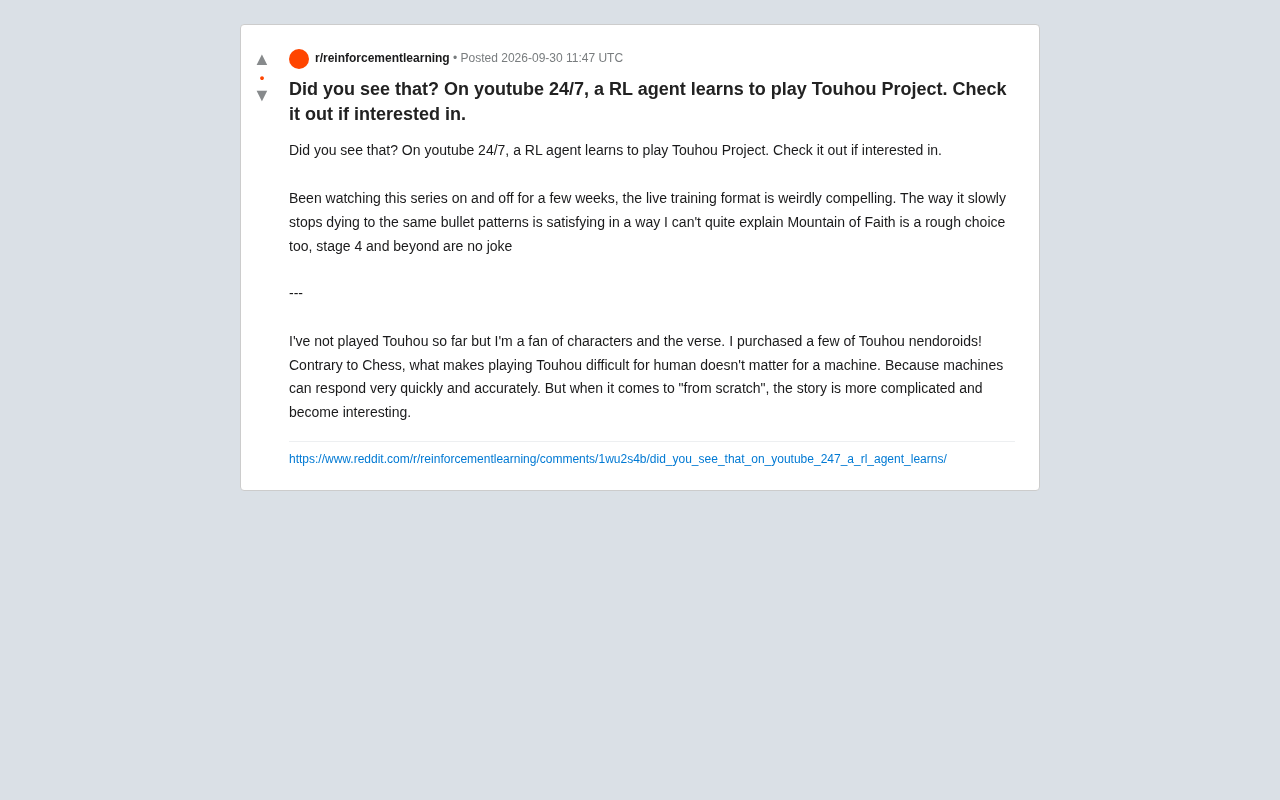
A reinforcement learning (RL) agent streaming 24/7 on YouTube is taking on the classic bullet hell shooter Touhou Project, sparking widespread discussion in the community. This project isn't chasing some impressive final score — it's putting the entire process of an AI learning from scratch on full public display. Viewers can watch in real time as an agent goes from repeatedly crashing into the same wave of bullets to gradually learning how to dodge complex attack patterns.
This "live training" format turns out to be surprisingly compelling. As one Reddit user described it: "It slowly stops dying to the same bullet patterns, and the satisfaction from that progress is hard to put into words." This captures the most fundamental appeal of reinforcement learning — the process of iteratively converging toward better strategies through trial and error is itself a visible form of emerging intelligence.
Reinforcement learning is one of the three major paradigms of machine learning, with its core ideas rooted in operant conditioning from behavioral psychology. An agent takes actions within an environment, the environment returns new states and reward signals, and the agent's goal is to learn a policy that maximizes long-term cumulative reward. Unlike supervised learning, RL doesn't rely on labeled data, and no one tells it what the "correct answer" is — its only learning signal comes from the consequences of its own actions. This mechanism makes it especially well-suited for complex tasks with fixed rules but optimal solutions that are too difficult to hand-code. Landmark achievements like DeepMind's AlphaGo and OpenAI Five are both built on RL at their core. In a bullet hell game, the agent must choose a movement direction every frame based on the current screen state, and the reward signal can be designed around survival time, score, or enemy defeats — a perfect fit for the RL framework.
Why Touhou Project?
The Touhou Project series is famous for its brutally difficult bullet patterns, and Mountain of Faith — the specific game chosen for this training run — is widely recognized as a serious challenge even among hardcore players. Community members were blunt about it: "Mountain of Faith is a tough pick. Past stage 4, it's no joke." For human players, these games test the limits of reaction speed, pattern recognition, and sustained focus over long periods.
Interestingly, one commenter raised a thought-provoking point: unlike chess, the aspects of Touhou that make it hard for humans don't actually pose the same obstacles for machines. A machine can respond with extreme speed and precision — dense, fast-moving bullet patterns are essentially their "comfort zone." From a pure execution standpoint, AI theoretically has an innate advantage that far exceeds human capability.
"From Scratch" Is the Real Challenge
The complexity of the story, however, lies precisely in that "from scratch" premise. Even though a machine has response speed and precision far beyond what any human can achieve, it starts out knowing absolutely nothing about the game's rules, bullet logic, or scoring mechanics. It has to figure out through massive trial and error which actions lead to rewards and which lead to failure.
This is the key distinction between RL and traditional scripted AI. A rule-based bot can perfectly dodge known bullet patterns, but an RL agent trained from zero has to build up an understanding of its environment without any prior knowledge. The physical execution advantage is cancelled out by a complete cognitive blank slate, and the shape of the learning curve ends up being far more winding than you'd expect — which is exactly what makes watching it grow so captivating.
Visualizing the Emergence of Intelligence
The value of the live streaming format is that it transforms abstract data — normally buried in training logs — into something visually intuitive. Viewers aren't watching a loss function curve. They're watching a "living thing" start out clumsily, fail over and over, and then occasionally flash a moment of surprising brilliance. This narrative quality makes reinforcement learning, which normally has a steep technical barrier, feel surprisingly accessible.
Games as a Research Testbed for AI
Using games to train AI is nothing new — from Atari to Go, from StarCraft to DOTA 2, games have always been the ideal proving ground for reinforcement learning. They have clear rules, immediate feedback, and reproducible environments, while still offering enough complexity to genuinely stress-test algorithms.
As a bullet hell game, Touhou Project provides a high-dimensional, high-speed environment that emphasizes real-time decision-making — a stark contrast to the turn-based, discrete-action nature of board games. It's much closer to continuous control and rapid-response tasks, placing heavy demands on an agent's ability to integrate perception and decision-making. Projects like this one, which might look like mere entertainment, are quietly putting algorithms through rigorous tests of robustness in complex, dynamic environments.
Bullet hell games (Danmaku) present AI with a uniquely challenging class of continuous control problems. The state space is extremely high-dimensional — there can be hundreds of projectiles on screen simultaneously, each with its own position and velocity vector. The action space is relatively low-dimensional (typically eight-directional movement), but decisions must be made within millisecond-level time windows. The key difference from classic RL benchmarks like Atari is that Atari has a fixed frame rate and relatively sparse bullet density, while Touhou's primary challenge comes from the need to simultaneously track and predict the trajectories of large numbers of fast-moving objects. For modern deep RL algorithms, questions about how to design effective state representations (convolutional visual features vs. structured bullet coordinates), how to balance exploration and exploitation, and the sparse reward problem (most deaths occur late in a stage, leaving very little early feedback) are all genuine engineering challenges.
Conclusion
This 24-hour Touhou Project live training project uses an approachable and entertaining format to demonstrate the core logic of reinforcement learning: the interplay between a machine's physical advantages and its cognitive blank slate, and the real challenge that comes with learning "from scratch." For viewers who are both gamers and AI enthusiasts, it offers a rare window into understanding how intelligence actually gets "trained" into existence. Regardless of whether the agent ever clears the game, this publicly shared journey of growth is already more than worthwhile on its own.
Related articles

Workbuddy for Absolute Beginners: How a Desktop AI Agent Fits Into Real Workflows
A beginner's guide to the Workbuddy desktop AI agent: installation, claiming credits, file management, and building automated workflows—compared with CodeX for fit and cost, helping professionals shift from AI question-askers to AI managers.

OpenAI's New Agent Stack: Computer Use, Decisions API, and Ultra-Fast Workflows
OpenAI Dev Day unveiled a new agent stack: Computer Use outperforms humans, Decisions API delivers ultra-low-latency classification via Luna, Agents API opens the same Computer Use capabilities, and GPT-6.1 Sol costs only one-seventh of Astra. Core updates, benchmark data, and developer insights.

Liang Wenfeng Open-Sources DeepInfo Inference Framework, Takes On U.S. Ban
DeepSeek open-sources its DeepInfo inference framework after its models, featuring GPU/CPU cross-pipelining, small-model prediction with large-model verification, and full Huawei Ascend and NVIDIA chip support—facing the U.S. federal ban head-on. This article analyzes its significance for AI deployment and open-source strategy.