Reinforcement Learning Builds VR Fighting Opponents: A Martial Arts Motion Skill Learning Framework

RL pre-trains a martial arts skill library and adapts it to tasks, generating diverse opponent animations for VR fighting games.
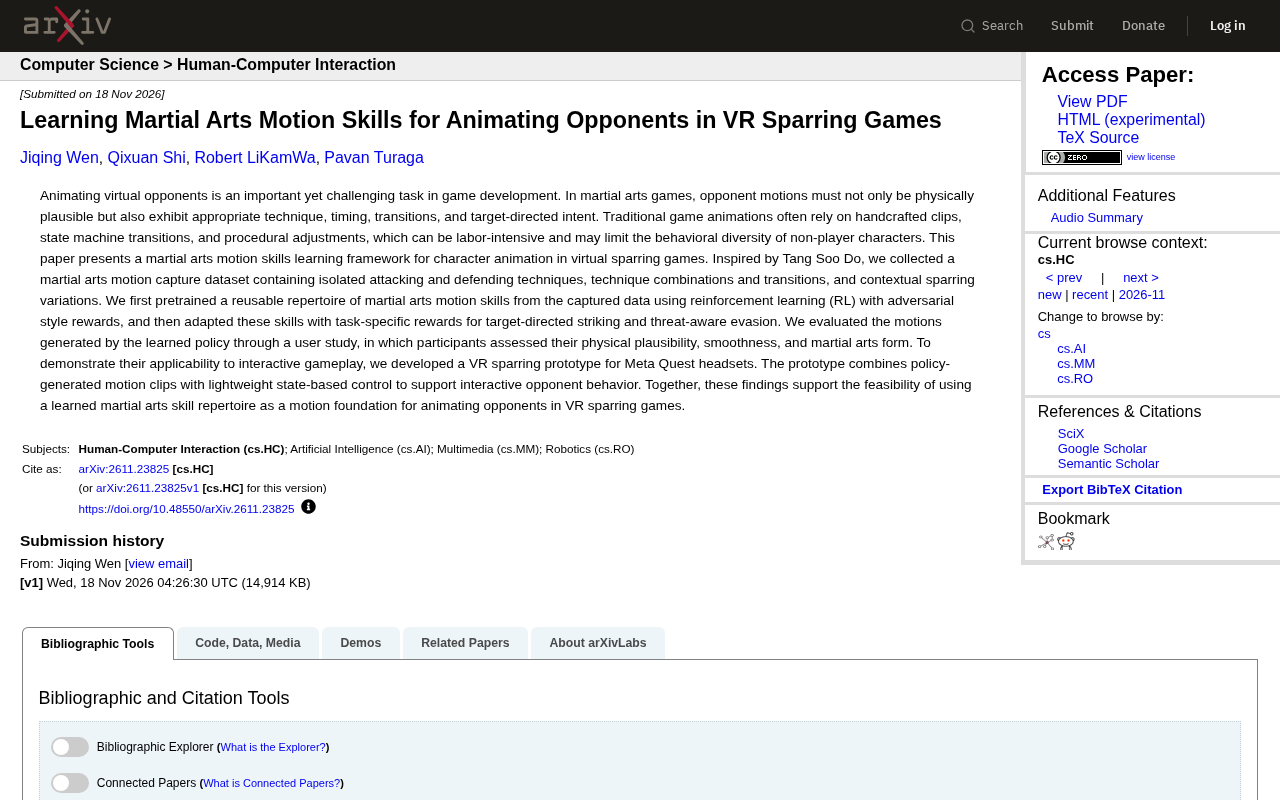
The paper tackles costly, repetitive virtual opponent animation in martial arts fighting games with a two-stage framework. Inspired by Tang Soo Do, the team built a mocap dataset of isolated techniques, combo transitions, and situational sparring. Stage one uses RL with an adversarial style reward to pre-train a reusable martial arts skill library with authentic style; stage two applies task-specific rewards to adapt skills for goal-directed strikes and threat-aware evasion. A user study assessed physical plausibility, smoothness, and martial arts form, and a Meta Quest VR sparring prototype combining policy-generated motion with lightweight state control validated interactive feasibility, offering a reusable, stylized motion foundation that reduces reliance on hand-authored animation.
Virtual opponent animation has long been a challenge in game development—especially in martial arts fighting games, where opponents' motions must not only be physically plausible but also exhibit appropriate technique, timing, transitions, and goal-directed intent. Traditional approaches rely on hand-authored animation clips, state machine transitions, and procedural adjustments, which are labor-intensive and limit the behavioral diversity of non-player characters. A recent paper proposes a martial arts motion skill learning framework for virtual sparring games: it uses reinforcement learning to pre-train a reusable skill library from motion capture data, then adapts those skills for goal-directed strikes and threat-aware evasion, offering a new approach to opponent animation in VR fighting games.
Bottlenecks of Traditional Animation and Data-Driven Solutions
In traditional game animation pipelines, animators must hand-craft large numbers of motion clips and manage transitions between them via state machines. While this approach offers strong controllability, the cost of manual authoring rises sharply when faced with the rich technique combinations, timing variations, and situational responses of martial arts combat—and it struggles to cover all possible sparring scenarios. As a result, non-player character behavior often becomes repetitive and predictable, undermining player immersion.
Inspired by Tang Soo Do, the research team built a martial arts motion capture dataset containing isolated attack and defense techniques, technique combinations and transitions, and situational sparring variants. This dataset provides a rich motion foundation for subsequent skill learning, enabling the model to learn style and technique from real martial arts movements.
Tang Soo Do is a traditional Korean martial art that blends karate, Chinese martial arts, and traditional Korean fighting techniques. It emphasizes the harmony of hard and soft techniques, clear attack-defense transitions, and distinctive stances and footwork. It includes a rich set of isolated techniques (such as the straight punch, knife hand, front kick, and side kick), technique combinations (combos and transitions), and one-on-one sparring practice. The researchers chose Tang Soo Do as the motion capture blueprint because its technical system is well-structured, its movement style is distinctive, and its attack-defense intent is clear—making it easy to build a dataset covering attacks, defenses, and situational sparring, and providing an identifiable "martial arts form" evaluation criterion for generated motion.
Two-Stage Learning: From Skill Pre-training to Task Adaptation
The research team adopted a two-stage learning strategy. In the first stage, reinforcement learning (RL) combined with an adversarial style reward is used to pre-train a reusable martial arts motion skill library from the captured data. The role of the adversarial style reward is to make generated motions stylistically close to real martial arts movements, not merely physically feasible. The goal of this stage is for each skill in the library to possess plausible martial arts form and transition capabilities.
In the second stage, the pre-trained skills are adapted to specific tasks. The team designed task-specific reward functions for goal-directed striking and threat-aware evasion. This means the learned policy can not only perform martial arts motions but also select appropriate techniques and adjust timing based on the opponent's position and threat level, exhibiting goal-directed intent.
Adversarial Style Reward is a reinforcement learning reward design inspired by generative adversarial networks (GANs). Specifically, researchers train a discriminator to distinguish "real martial arts motions from motion capture data" from "motions generated by the policy"; the policy (generator) then receives an additional reward based on how well it "fools the discriminator." In this way, while pursuing task rewards (e.g., hitting a target), the policy is also pushed to imitate the distributional characteristics of real motions—including posture, rhythm, and transition style—rather than merely satisfying physical constraints. Compared with hand-designed style losses, adversarial rewards can capture high-dimensional style details that are difficult to model explicitly, and are commonly used to make virtual character motion more natural and human-like.
Skill Pre-training and Task Adaptation is a common two-stage paradigm in hierarchical reinforcement learning. The first stage learns a reusable skill library from large amounts of heterogeneous data, where each skill corresponds to a short, composable motion primitive; the second stage freezes or fine-tunes the skill library and learns only a high-level policy to select skills and adjust parameters to accomplish a specific task. Its advantages are: the skill library provides a strong motion prior, so downstream tasks can adapt with only a few samples, avoiding the high cost of end-to-end learning from scratch; and skills can be reused across tasks, reducing the overhead of retraining for new tasks. In character animation, this paradigm can also ensure motion diversity and style consistency.
User Study and VR Prototype Validation
To evaluate the quality of generated motion, the research team conducted a user study in which participants rated motions generated by the learned policy along three dimensions: physical plausibility, smoothness, and martial arts form. Although the original paper did not disclose specific rating data, the user study results support the acceptability of the generated motion along these dimensions.
More importantly, the team developed a VR sparring prototype for the Meta Quest headset, combining policy-generated motion clips with lightweight state control to support interactive opponent behavior. This hybrid architecture preserves the motion diversity and natural transitions brought by the learned policy while ensuring the controllability and responsiveness of game logic through state control. The prototype demo shows that the learned martial arts skill library can serve as the motion foundation for opponent animation in VR sparring games.
Implications for VR Fighting Game Development
The core contribution of this work is validating the feasibility of the "learned skill library + task adaptation" paradigm for martial arts fighting animation. Unlike end-to-end learning of entire sparring behavior, a pre-trained skill library provides a reusable motion foundation, reducing the cost of retraining for new tasks while preserving the martial arts style of motions. The introduction of lightweight state control addresses the shortcomings of pure learned policies in game logic control, offering a compromise for practical production.
Of course, the research is still at the prototype stage, and the dataset size, the coverage of the skill library, and performance on different VR hardware remain to be further validated. But the direction is clear: extracting skills from real martial arts data with reinforcement learning and combining them with game state control could free opponents in VR fighting games from repetitive animation and deliver richer, more credible fighting behavior.
One-line Summary
Reinforcement learning pre-trains a martial arts skill library and adapts it to tasks, generating diverse opponent animations for VR fighting games.
Paragraph Summary
Addressing the high cost and repetitive behavior of virtual opponent animation in martial arts fighting games, this paper proposes a two-stage learning framework. Inspired by Tang Soo Do, the team built a motion capture dataset containing isolated techniques, combination transitions, and situational sparring. In the first stage, reinforcement learning with an adversarial style reward pre-trains a reusable martial arts skill library, giving motions authentic martial arts style beyond physical plausibility; in the second stage, task-specific rewards adapt skills to goal-directed striking and threat-aware evasion. A user study evaluated the generated motion on physical plausibility, smoothness, and martial arts form, supporting its acceptability; the team also built a VR sparring prototype on Meta Quest combining policy-generated motion with lightweight state control, validating interactive feasibility. This paradigm provides a reusable, stylized motion foundation for VR fighting game opponent animation, reducing reliance on hand-authored animation.
Related articles

Abnormal Error Rate Spike in Claude Mythos 5.2 and Fable 5.2
Claude Mythos 5.2 and Claude Fable 5.2 show an abnormal spike in request error rates, marked as investigating on the official status page. This article covers the incident overview, practical impact on developers, and recommended responses.

ReAct Runtime Context Trimming: Why Claude Code Acts at 70%
A deep dive into ReAct runtime context trimming: why Claude Code compresses at ~70% usage, why tool calls dominate, why messages must be dropped in pairs, and why codebases don't need RAG.

AI Agent vs LLM: How Cursor and Claude Code Actually Work
An in-depth analysis of the essential difference between AI Agents and LLMs: LLMs generate code suggestions, while Agents modify files and run tests via tool calls. Using a Spring Boot bug fix as an example, it breaks down the workflows, permission control, and verification mechanisms of Cursor and Claude Code.