Rejecting AI as a Differentiator: The Engineering Rationale Behind the Anti-AI Movement

Rejecting AI as a deliberate stance reveals engineering rationality amid the industry's AI hype bubble.
As AI-washing becomes rampant, some tech practitioners are publicly declaring they never use AI — not out of ignorance, but from engineering rationality. This article explores the motivations behind the anti-AI stance, including concerns about reliability, privacy, cost, and supply chain dependency. It also examines whether this contrarian position is sustainable and argues that the most mature approach lies in scenario-based technology selection grounded in solving real problems.
When Rejecting AI Becomes a Stance
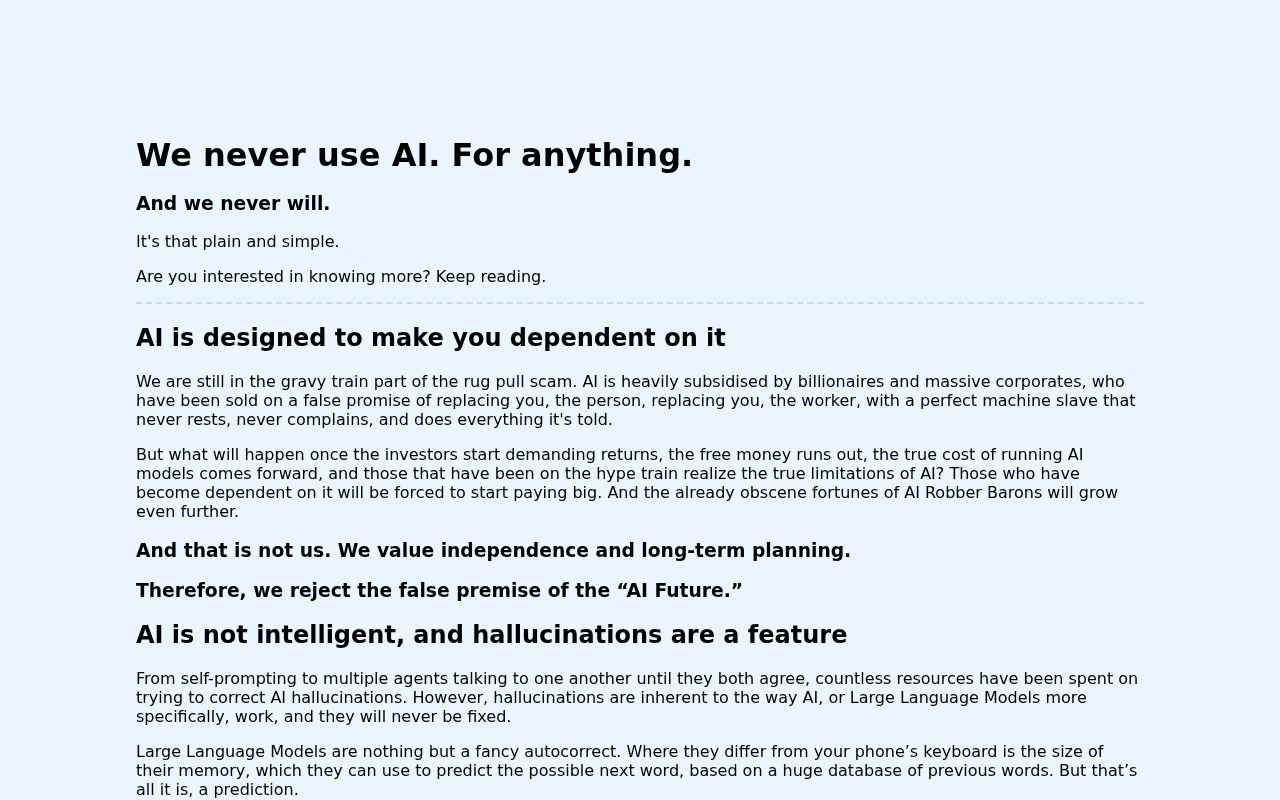
At a time when nearly every tech company is scrambling to cram "AI" into their products, marketing copy, and fundraising narratives, a post titled We never use AI. For anything sparked a discussion on Hacker News. The slightly rebellious title is itself a statement — in an era where AI is hailed as a skeleton key, openly declaring "we never use AI" has paradoxically become a notable way to differentiate.
The post wasn't a viral sensation (23 upvotes, 10 comments), but it touched on a topic quietly fermenting within the tech community: When AI mutates from a tool into a marketing label, is anyone willing to swim against the current?
The Motivations Behind "No AI"
Pushback Against the AI Hype Bubble
Over the past two years, "AI-powered" has become practically mandatory at every product launch. From to-do list apps to pet feeders, countless products have slapped on the AI label to grab attention and command a premium. This pervasive "AI-washing" phenomenon has triggered a strong backlash among some tech practitioners.
The concept of AI-washing is analogous to the earlier phenomenon of "greenwashing" — companies that aren't substantively using AI technology but plaster AI labels all over their marketing to attract investors and consumers. In 2024, the U.S. Securities and Exchange Commission (SEC) began investigating and penalizing AI-washing, fining two investment advisory firms for exaggerating their use of AI. A Goldman Sachs survey found that the frequency of S&P 500 companies mentioning "AI" in earnings calls grew more than sixfold between 2023 and 2024, though much of it remained at the aspirational level rather than actual deployment. The proliferation of this phenomenon is fertile ground for the "anti-AI" stance.
For these people, publicly stating "we never use AI" is fundamentally about drawing a line against the industry's inflated rhetoric. The subtext is: We rely on solid engineering capabilities and deterministic logic, not probabilistic black boxes. In an environment where everyone is chasing trends, sticking with the tried-and-true has itself become a source of trust.
Commitment to Reliability and Determinism
The core characteristic of large language models is probabilistic generation, which means they inherently suffer from "hallucinations" and unpredictability. A "hallucination" refers to the model generating content that appears plausible but is actually incorrect or entirely fabricated. This problem is rooted in how LLMs work: the model is essentially performing "next token prediction," selecting the statistically most likely subsequent words rather than retrieving facts from a structured knowledge base. The model doesn't "understand" truth or falsehood — it merely generates the statistically most coherent text sequence. While techniques like Retrieval-Augmented Generation (RAG) and Chain-of-Thought prompting have partially mitigated the hallucination problem, no method can completely eliminate it. In multiple benchmarks in 2024, even the most advanced models still exhibited 5%–15% error rates in factual accuracy — unacceptable for zero-tolerance scenarios.
For certain high-accuracy scenarios — financial calculations, medical data processing, legal documents, or core system logic — introducing generative AI actually increases risk. This touches on a deeper engineering philosophy: the fundamental difference between deterministic and probabilistic systems. In software engineering, a "deterministic system" is one that always produces the same output given the same input, and its behavior can be fully tested, verified, and audited. Traditional rule engines, relational database queries, and mathematical computation modules all fall into this category. AI systems based on deep learning are inherently probabilistic — even with the same input, outputs may differ due to temperature parameters, random seeds, and other factors. Deterministic systems allow precise unit tests, and bugs can be pinpointed through logs. In probabilistic systems, "errors" are often fuzzy and hard to reproduce, rendering traditional software quality assurance methodologies nearly ineffective.
Some developers believe that rather than replacing mature deterministic code with an AI component that might err and is hard to debug, it's better to stick with proven traditional solutions. "Not using AI" here isn't conservatism — it's risk management grounded in engineering rationality.
Concerns About Privacy, Cost, and Dependency
Completely avoiding AI may also stem from more practical considerations:
- Data privacy: Calling third-party AI services typically means transmitting user data to external servers, which is unacceptable for privacy-focused products.
- Cost control: Inference costs for large models are steep, and for thin-margin businesses, AI may not be worth the expense. Taking GPT-4-class models as an example, the cost per million input tokens was around $30 in early 2024, dropping to a few dollars by the end of the year. But for applications processing millions of requests daily, annualized costs could still reach hundreds of thousands or even millions of dollars. There are also hidden costs: the human investment in prompt engineering, building output quality monitoring systems, and customer service and PR costs when AI makes mistakes. By comparison, a well-optimized traditional algorithm might accomplish the same task with minimal computational resources — provided the task doesn't inherently require AI's generative capabilities. For businesses with single-digit profit margins (such as SaaS tools or e-commerce infrastructure), the ROI of AI truly demands careful calculation.
- Supply chain dependency: Over-reliance on external APIs from OpenAI, Anthropic, and others leaves products at the mercy of third-party pricing, rate limiting, and policy changes.
Is the Contrarian Stance Sustainable?
A core debate triggered by this "anti-AI" stance is: Is it rational restraint, or stubbornness destined to be left behind by the times?
Supporters argue that AI is just a tool, not an end in itself. Truly excellent products should focus on solving problems, not on whether they use AI. In this sense, "we never use AI" is a return to the essence of product building.
But the opposing argument is equally compelling. As model capabilities continue to evolve and costs decline rapidly, AI is transitioning from "nice to have" to "infrastructure." Looking back at history, this kind of technological infrastructuralization is not without precedent. In the 1990s, some companies openly questioned the necessity of the internet. Newsweek published a famous 1995 article titled The Internet? Bah!, predicting that online databases would never replace the daily newspaper. Today, AI is undergoing a similar infrastructuralization process: at the operating system level (Apple Intelligence, Windows Copilot), at the developer tools level (GitHub Copilot is used by over a million developers), and at the cloud services level (AWS, Azure, and GCP all position AI capabilities as core offerings). Gartner predicts that by 2026, over 80% of enterprises will use generative AI APIs or models in production environments, up from less than 5% in early 2023. This pace of penetration means the space for completely avoiding AI is systematically shrinking.
Just as no company today would proclaim "we never use the internet," completely rejecting AI in the future could lead to significant disadvantages in efficiency and user experience. Categorically shutting out AI may mean sacrificing long-term competitiveness for a momentary stance.
The Middle Ground Worth Considering
In reality, black-and-white attitudes are likely both misguided. A more mature approach to technology selection might be:
- Differentiate by scenario: Embrace AI in high-tolerance, creativity-intensive scenarios (such as content drafting and code assistance); stick with traditional approaches for core logic that demands determinism.
- Communicate transparently: Whether or not you use AI, be honest with users — don't exaggerate or conceal for marketing purposes.
- Maintain control: Even when using AI, preserve system explainability and controllability to avoid becoming a slave to the black box. Maintaining explainability and controllability in AI systems is an active area of research and engineering. Common strategies in practice include: implementing "Human-in-the-Loop" mechanisms where AI-generated results must be reviewed by humans before taking effect; using structured outputs (such as JSON Schema constraints) to limit the model's output format and scope; deploying "Guardrails" systems to filter and validate AI outputs in real time; and maintaining "AI-degradable" architectural designs — so that when the AI component fails, the system can automatically fall back to traditional logic. These practices represent a pragmatic middle path: leveraging AI's capabilities without surrendering the system's fate entirely to a probabilistic black box.
"We never use AI" resonates precisely because it hits a nerve about the industry's restlessness. It reminds us: The starting point for technology selection should always be solving real problems, not chasing labels and trends. Whether you ultimately choose to embrace or reject AI, clear-headed judgment is the scarcest capability of all.
Conclusion
This small-scale discussion around "never using AI" reflects a sober reconsideration of the AI frenzy within the tech community. It's not about denying AI's value — it's about reminding every practitioner not to let the tool override the purpose. In an age where everyone is shouting about AI, daring to say "no" may take courage. But more importantly, whether you say "yes" or "no," the decision should be grounded in a deep understanding of your own business and user needs — not in following the herd.
Related articles

DeepCell: One-Click AI Generation of Documents, Spreadsheets, and Slides
DeepCell tops Product Hunt with one-click generation of documents, spreadsheets, and slides, using the .deepcell format for linked updates, designed for System 2 tasks like modeling and sales reviews.

Doneas: 15-Minute Daily Accountability Calls That Keep Indie Developers From Procrastinating
Doneas is a daily accountability tool for indie developers: plan tasks on Monday, join a 15-minute call with five builders each day, and log deliveries on a public progress page. This article analyzes its core mechanics, effectiveness, and potential issues around retention and matching.

Fastlane 2.0: Fully Automated AI Ad Campaigns, From Creative to Optimization
Fastlane 2.0 is an AI ad automation tool: enter your website and it learns your brand, generates video and image ads, and runs and optimizes them on Meta, TikTok, Instagram, and YouTube.