Remedy Reveals the Design Philosophy Behind the Wildest Mission in Control Resonant

Remedy shares the open-ended design philosophy behind Control Resonant's multi-timeline mission "Recursions and Iterations."
The article introduces the design approach behind the "Recursions and Iterations" mission in Control Resonant. The mission has protagonist Dylan Faden jumping between converging, overlapping, and even parallel timelines, breaking linear narrative logic to create disorientation and a desire to explore. Remedy's design team did not establish a framework first and then fill in content but instead allowed all kinds of seemingly wild ideas into the discussion before finding ways to connect them—a core philosophy that can be summarized as "anything goes." The mission deliberately leaves blanks without providing clear answers, sparking community interpretation and discussion, and reflecting Remedy's consistent tendency to uphold authorial expression in commercial games. The article concludes by noting that this approach of relinquishing absolute control requires team chemistry and post-production integration capability, offering a case study worth learning from for game design.
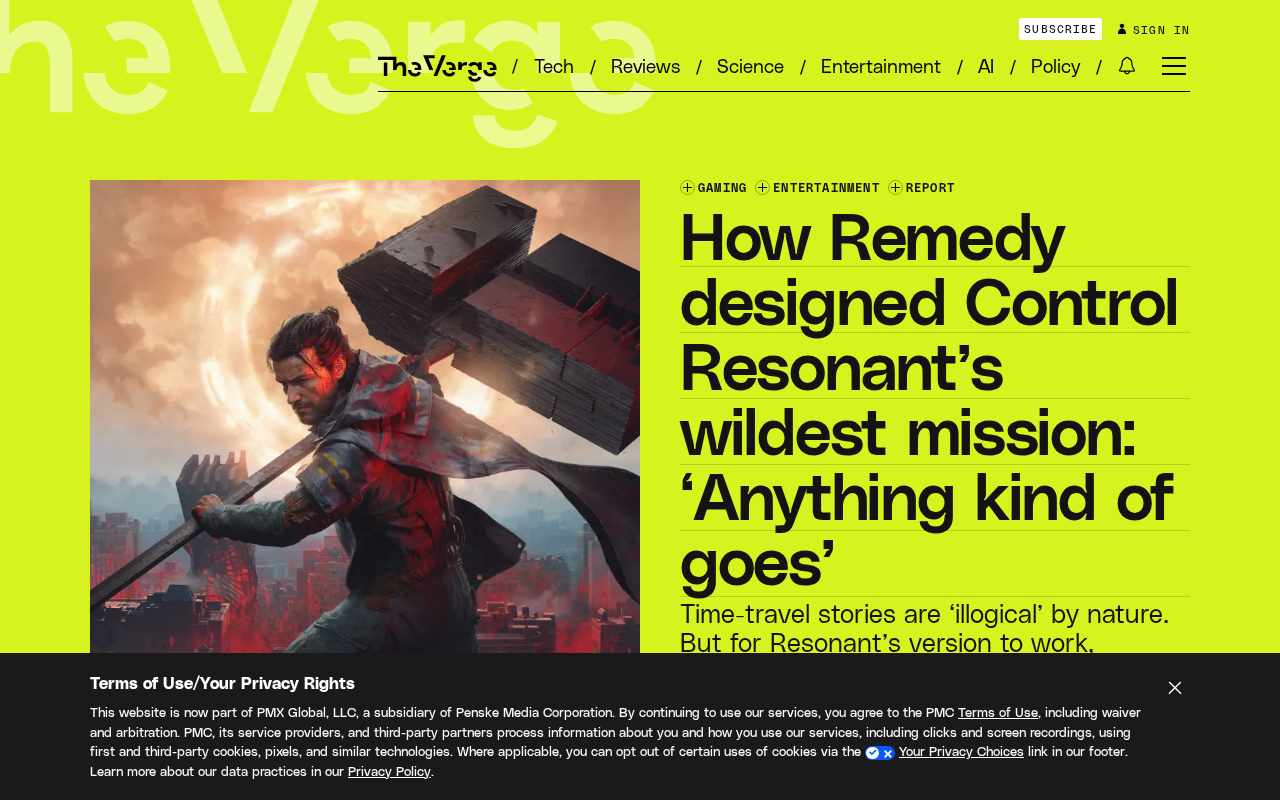
In Control Resonant, there is one mission that players still talk about to this day: it involves time travel—or rather, something like a time-travel experience. Multiple timelines converge, overlap, and even run in parallel. The protagonist, Dylan Faden, encounters several researchers who are trapped within these timelines and trying to study them. This mission, titled "Recursions and Iterations," is arguably one of the most memorable levels in the game. Remedy Entertainment recently shared the design approach behind this mission, and its core philosophy can be summed up in a single phrase: "Anything goes."
When Timelines Start Fighting
What makes "Recursions and Iterations" so memorable is that it breaks conventional narrative logic. Players no longer advance along a single linear path but instead jump between multiple versions of time, each with subtle or drastic differences. This design creates a sense of disorientation while also sparking the desire to explore—you want to know what will happen in the next timeline.
When conceiving this mission, Remedy's design team did not strictly follow traditional level design rules. They allowed all kinds of wild ideas into the discussion, even some that seemed unreasonable. This open attitude ultimately produced a mission that is structurally complex yet flows smoothly as an experience.
The concepts of "recursion" and "iteration" originate from computer science and mathematics, forming a metaphorical echo with the multi-timeline interweaving design in the article.
Recursion refers to a function calling itself directly or indirectly during execution, breaking a problem down into smaller subproblems of the same kind until it reaches a "base case" and then returning results layer by layer. It inherently carries the sense of "nested layers, constantly returning to itself."
Iteration, on the other hand, refers to repeatedly executing a piece of logic through a loop, with each round building on the previous round's results, emphasizing "versions evolving through repetition."
Put together, the two correspond perfectly to the experiential structure of the mission: players travel back and forth between multiple time versions (recursive backtracking) while driving the story to constantly change through repetition (iterative evolution). This naming is not arbitrary but hints at the organizational logic of the level—timelines are both cyclical and constantly generating new differences.
Design Philosophy: Embracing Chaos
According to Remedy, the design process for this mission was full of experimentation. The team did not try to constrain every detail with logic but instead let creativity flow freely first, then looked for ways to connect it all together. This approach is not common in game development, as most studios prefer to establish a framework before filling in content.
But it is precisely this "anything goes" attitude that gives "Recursions and Iterations" its unique charm. Every unexpected twist players encounter in the mission is backed by the design team's deliberate deviation from convention. They believe that sometimes making players feel confused is also an effective narrative tool—as long as that confusion can ultimately be resolved in a satisfying way.
The article mentions that the design team "let creativity flow freely first, then looked for ways to connect it all together," which in the industry typically corresponds to prototype-driven and grayboxing workflows.
Prototype-driven means first building the core experience of gameplay or a level into a rough but playable version to quickly validate "is this fun?" before deciding whether to invest in art and narrative resources. Grayboxing uses simple geometry and placeholder assets to build levels, specifically testing whether spatial layout, pacing, and guidance work.
The value of this process lies in the fact that the creative phase is not constrained by frameworks, while the integration phase relies on repeated playtesting to eliminate ideas that don't work. It shifts "control" from the early stage to the later stage—this is the specific technical context behind the article's "let loose first, then repeatedly test and adjust."
Player Experience and Narrative Experimentation
Judging from player feedback, this mission succeeded in generating discussion. Many players shared their interpretations in the community, trying to sort out the order and logic of the timelines. This sense of participation is exactly what Remedy hoped for. The mission does not provide clear answers but leaves enough room for interpretation, allowing players to piece together the full picture of the story themselves.
This narrative experimentation also reflects Remedy's consistent style: incorporating authorial expression into commercial games. From Alan Wake to Control, and now to Control Resonant, the studio has always been exploring new boundaries of interactive storytelling.
The multi-timeline and metanarrative techniques that recur in Remedy's works are related to its longstanding tradition of shared universe worldbuilding. From Alan Wake to Control, the studio has built an interconnected "Remedy Connected Universe," where characters, organizations, and supernatural elements from different works reference one another.
The Federal Bureau of Control (FBC) in Control and its premise of researching paranormal objects inherently provide fertile ground for plots like "researchers trapped in anomalous timelines."
Understanding this background helps clarify that the "Recursions and Iterations" mission is not an isolated narrative showpiece but is built on the studio's long-cultivated worldbuilding—the more familiar players are with the lore, the more tension the interpretive space left by deliberate ambiguity creates.
Implications for Game Design
The design process of "Recursions and Iterations" offers an interesting case study for peers: sometimes, giving up absolute control over every detail can yield a more impactful experience. Of course, this requires the team to have sufficient chemistry and post-production integration capability; otherwise, it easily descends into chaos. Remedy's approach was to let loose first, then ensure experiential coherence through repeated testing and adjustment in the later stages.
For players, such a mission reminds us that video games as a medium still have far more untapped potential. When developers are willing to take risks, players can also embark on a more unforgettable journey.
Remedy did not disclose the specific development timeline or technical details of this mission but acknowledged that it was a bold creative experiment for the team. As for whether players bought into it, the lively discussions in the community have already provided part of the answer.
One-line Summary
Remedy shares the open-ended design philosophy behind the multi-timeline mission "Recursions and Iterations" in Control Resonant.
Paragraph Summary
The article introduces the design approach behind the "Recursions and Iterations" mission in Control Resonant. The mission has protagonist Dylan Faden jumping between converging, overlapping, and even parallel timelines, breaking linear narrative logic to create disorientation and a desire to explore. Remedy's design team did not establish a framework first and then fill in content but instead allowed all kinds of seemingly wild ideas into the discussion before finding ways to connect them—a core philosophy that can be summarized as "anything goes." The mission deliberately leaves blanks without providing clear answers, sparking community interpretation and discussion, and reflecting Remedy's consistent tendency to uphold authorial expression in commercial games. The article concludes by noting that this approach of relinquishing absolute control requires team chemistry and post-production integration capability, offering a case study worth learning from for game design.
Related articles
 Tech Frontiers
Coldframe: A Honeypot Disguised as a Supermarket Freezer Controller
Coldframe is a honeypot disguised as Danfoss AK-SM 800A and Dixell XWEB freezer controllers, built as a single Python file that detects CVE-2025-41450 attempts and is identified as real devices on Shodan.
 Tech Frontiers
GRFNet: A Lightweight PyTorch Model Designed for Multichannel Time-Series Classification
GRFNet is a lightweight PyTorch model for multichannel time-series classification, originating from EEG decoding research. With only 3,847 parameters, it is based on the ROCKET architecture, combining random convolution kernels with learnable spatial filters, supports arbitrary input lengths, and will soon be evaluated on the PhysioNet dataset.
 Tech Frontiers
CUDA-Accelerated Rocket League Simulator: A Player-Made Hardcore Experiment
A Reddit post shows a "100% Accurate" Rocket League simulator accelerated with CUDA. We analyze its technical context, CUDA's value in game physics simulation, and the significance and limitations of such community projects.