Render Sandboxes: A Dedicated Linux Computer for Every AI Agent

Render launches Sandboxes, giving each AI agent a dedicated Linux computer with sub-second startup and idle suspension without billing.
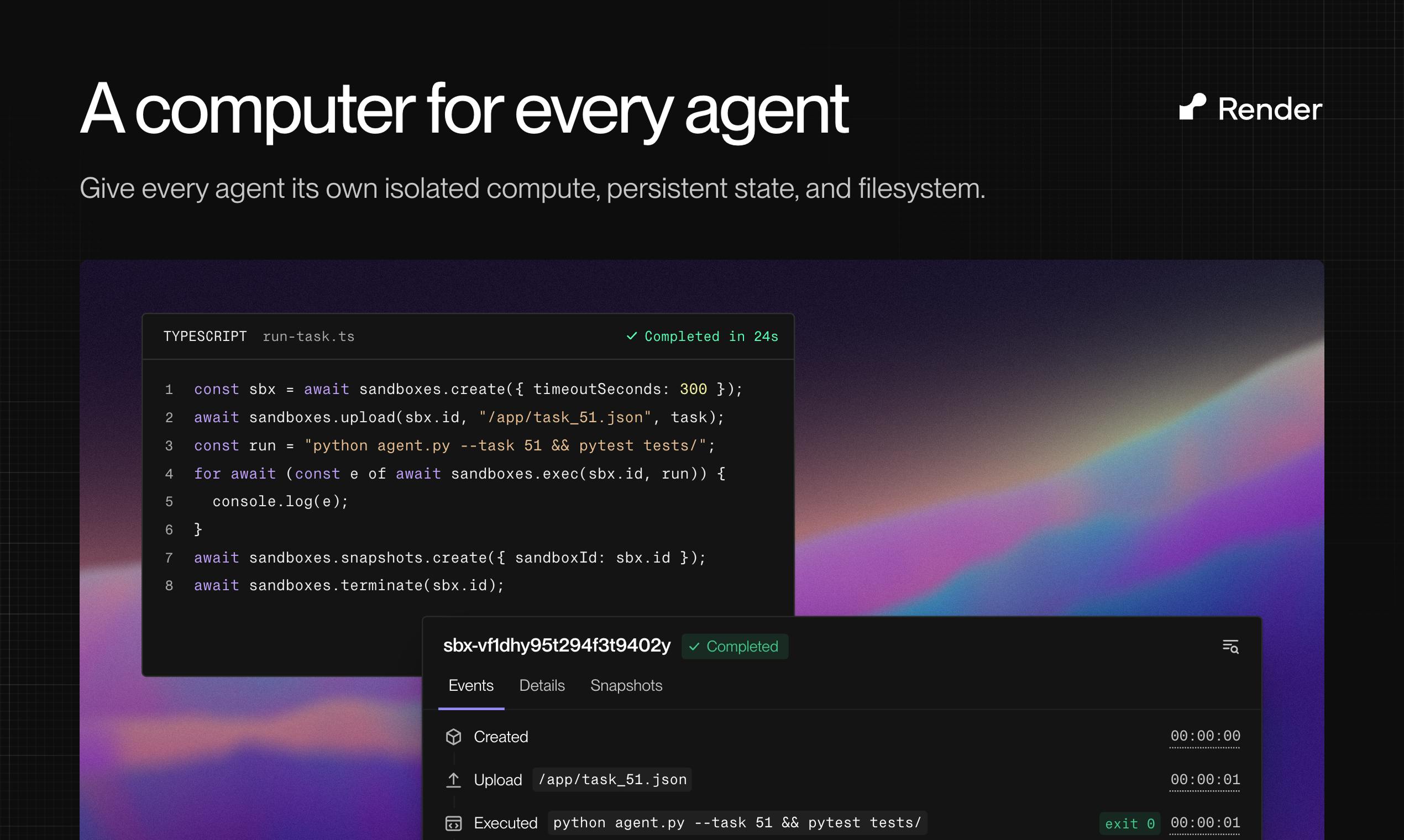
Render released Render Sandboxes on Product Hunt with the tagline "A computer for every agent," providing a dedicated Linux execution environment for each AI agent. Key features include sub-second startup, automatic suspension with compute billing stopped when idle, full file and memory state preservation on wake, domain-level network access control, support for any agent like Claude Code and Codex, and running user apps via Docker Compose for verification. Render claims thousands of sandboxes can reliably run concurrently on the same platform, sharing infrastructure with the rest of the application. The product received 99 votes and ranked 7th for the day—demand is real but awareness is still early, and the underlying isolation implementation details remain to be verified.
Render has launched a new product on Product Hunt called Render Sandboxes, with the tagline "A computer for every agent." It targets a rapidly expanding need: as AI agents move from demos to production, they require a secure, isolated, and quickly bootable execution environment.
When Agents Need a Computer
Over the past year, coding agents like Claude Code and Codex have continually expanded their capabilities, but when it comes time to actually do work, they face a practical question: where do they run? Running directly on a developer's local machine means security risks, environment conflicts, and uncontrolled resource consumption. Running in shared containers makes it hard to guarantee isolation and reproducibility.
Render Sandboxes' answer is: one dedicated Linux computer per agent. This abstraction is simple enough and closely matches how agents actually work—they need a filesystem, network access, and the ability to run commands. Essentially, they need a machine.
Sub-Second Startup and Suspend/Resume
According to the official description, Sandboxes start in under one second. This number is critical for agent workflows: if every task assignment required waiting tens of seconds for environment initialization, the benefits of parallelization would be swallowed up.
More noteworthy is the lifecycle design. When an agent goes idle, the sandbox automatically suspends and compute charges stop; when it wakes up again, file and memory state are fully preserved. This "pay-as-you-go, no state loss" model directly addresses the bursty, intermittent nature of agent tasks—much of the time is spent waiting for model responses or human confirmation rather than continuously occupying CPU.
The company also emphasizes that thousands of sandboxes can reliably run simultaneously on the same platform, sharing the same infrastructure as the rest of the user's application. This means teams don't need to build a separate orchestration and operations system for agents.
Suspend and memory state preservation technically usually relies on checkpoint/restore or similar mechanisms: persisting the process tree, memory pages, file descriptors, and other runtime state to storage, then remapping them back into memory upon resume. Traditional VM snapshot restore often takes seconds to tens of seconds, while container-based or lightweight virtualization approaches can compress this to sub-second levels. It's worth noting that full memory state preservation means storage resources are still consumed during suspension, and the billing basis for cold start versus warm resume may differ; also, sandboxes suspended for long periods may face consistency issues upon resume such as kernel version, dependency libraries, or clock drift. These details are worth probing when evaluating production readiness.
Network Access Under Your Control
Security is a core issue for agent execution environments. Render Sandboxes lets users decide which domains each sandbox can access. This granularity of control is practically meaningful: an agent responsible for writing code may need access to package managers but not internal databases; an agent processing external data needs access to specific APIs but should be blocked from other services.
Pushing network policy down to the individual sandbox level is more thorough than intercepting at the application layer and better aligns with the principle of least privilege.
Principle of Least Privilege requires that a subject have only the minimum access permissions necessary to complete the current task. In agent scenarios, the difficulty of implementing this principle lies in the fact that permissions often need to change dynamically: an agent may need to access different domains at different stages of a task. Domain-level allowlists are closer to developer mental models than IP-level or port-level controls, but there are two easily overlooked issues in practice: first, DNS resolution itself can be used for data exfiltration (DNS tunneling); second, domains on an allowlist may host multi-tenant content, so allowing one domain means allowing all capabilities behind it. Therefore, domain allowlists should be viewed as one layer of defense in depth, not the sole barrier.
Runs Any Agent and Your Applications
Render Sandboxes claims it can run any agent or harness, including Claude Code and Codex. At the same time, agents can run your own applications via Docker Compose to verify the changes they make—this is a key capability. Agents don't just generate code; they can run it in an environment close to reality, test it, and iterate.
For developers, this reduces the back-and-forth cost of "agent modifies code, human manually verifies." For the platform, supporting Docker Compose means the sandbox is not just a code executor but a complete copy of the development environment.
Agent harness refers to the runtime framework wrapping the large model, responsible for tool calls, loop control, context management, permission confirmation, and error retry. Claude Code and Codex CLI both fall under the category of harness. Different harnesses have very different requirements for the execution environment: some depend on specific language runtimes and package managers, some need persistent shell sessions, and some require access to the local filesystem or a browser. Claiming to "run any harness" actually means the sandbox needs to provide a sufficiently general, near-standard Linux environment rather than a trimmed-down function-computing sandbox—this is also the fundamental difference in execution model between the "one computer" abstraction and serverless functions.
Positioning from Multiple Perspectives
On Product Hunt, Render Sandboxes received 99 votes and 5 comments, ranking 7th for the day. This level of interest shows the need is real, but the discussion volume also reflects that the product is still in an early awareness phase. Cross-referencing the official description with community feedback, the core consensus centers on three points: sub-second startup, idle suspension without billing, and deployment on the same platform as the original application.
The point of divergence is the specific implementation details of "isolation strength"—the company emphasizes dedicated Linux computers and domain-level network control, but does not elaborate on the underlying virtualization or containerization approach in its launch materials. For security-sensitive teams, this will be an area requiring further verification.
Who Should Pay Attention
If you are building coding agents, automated operations agents, or any AI application that needs to execute untrusted code, the abstraction offered by Render Sandboxes is worth evaluating. It productizes the idea of "giving an agent a computer," packaging startup speed, state preservation, network policy, and scale scheduling together rather than having every team reinvent the wheel.
The real test lies in production stability and isolation guarantees. Sub-second startup and thousands of concurrent instances sound great, but the bursty nature of agent workloads will put unique pressure on the scheduling system. Whether Render can deliver on these promises under real load will determine whether it becomes one of the default options for agent infrastructure.
One-line Summary
Render launches Sandboxes, providing a dedicated Linux computer for every AI agent with sub-second startup and idle suspension without billing.
Paragraph Summary
Render has released Render Sandboxes on Product Hunt with the tagline "A computer for every agent," providing a dedicated Linux execution environment for each AI agent. Its core selling points include startup time under one second, automatic suspension with compute billing stopped when idle, full preservation of file and memory state upon wake, domain-level network access control, support for running any agent such as Claude Code and Codex, and running user applications via Docker Compose for verification. The company claims thousands of sandboxes can reliably run concurrently on the same platform, sharing infrastructure with the rest of the application. The product received 99 votes and ranked 7th for the day—the need is real but awareness is still early, and the underlying implementation details of isolation strength remain to be verified.
Related articles
 Tech Frontiers
Sherlock: An Open-Source Tool for Tracking Usernames Across Social Networks
Sherlock is an open-source Python tool that tracks social accounts across networks by username. This article covers its core features, why developers love it, typical use cases, and privacy compliance considerations.
 Tech Frontiers
GitHub Daily·Nov 07: Agent-Ready and Context Compression
GitHub Trending Nov 07: meta's agent-ready design system astryx, billion-context's 5x context compression, sherlock nearing 100k stars, plus local-first localthings and bare-metal GPU orchestration nvke.
 Tech Frontiers
Buoyant Open-Sources Kinference: An Inference Control Plane for vLLM on K8s
Buoyant open-sources Kinference, an inference control plane for vLLM on Kubernetes, with declarative routing, KV-cache-aware load balancing, and per-tenant metrics—claiming 95% lower median TTFT in official benchmarks.