Replacing a $2,500/Month VA with an n8n Workflow: An Automation Experiment

A creator replaced a $2,500/month VA with a five-node n8n workflow, cutting annual costs to $420, but hidden costs remain.
The article introduces a discussion-provoking automation case: a creator claims to have replaced a $2,500/month virtual assistant with a five-node n8n workflow for only $420 a year. The workflow is triggered every 15 minutes by a Schedule Trigger, fetches new inquiry emails, reads the full conversation thread, has AI draft replies that "sound like the person," sends them via SMTP, and syncs records to Google Sheets, forming a sense—decide—execute—record loop. The article also points out blind spots in the cost comparison: the $420 does not include token fees for the model API, and the exception handling, priority judgment, and human judgment performed by a VA still cannot be covered by standardized processes. The conclusion is that "replacement" should be understood as offloading repetitive work; during implementation, keep manual review, regularly check records, and monitor API costs—and the free workflow sharing is essentially a customer acquisition funnel.
A creator claims he replaced a virtual assistant (VA) costing $2,500 per month with an n8n workflow for just $420 a year. This case has sparked discussion in the automation community: as AI agents can handle emails, generate replies, and log data, the boundaries of traditional outsourced roles are being redefined.
How the Five-Node Workflow Operates
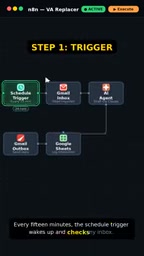
According to the video demo, the core of this system is a five-node n8n workflow. Every 15 minutes, a Schedule Trigger wakes up and checks the inbox for new inquiries—emails that were originally handled by the VA. The workflow fetches each new email, reads the full conversation thread, and then an AI model drafts a reply that "sounds like the person themselves."
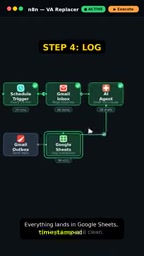
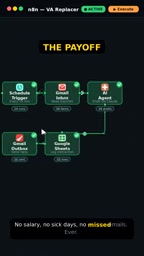
According to the creator, replies are typically sent in under a minute—no salary, no sick days, and no missed emails. All processing records are synced to Google Sheets with timestamps, keeping things tidy and traceable.
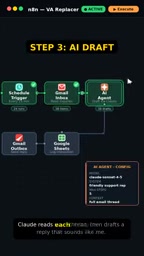
The clever part of this process is that it strings together "sense—decide—execute—record" into a closed loop: email triggering is sensing, AI drafting is deciding, SMTP sending is executing, and spreadsheet archiving is recording. Each step is an off-the-shelf node, requiring no complex coding.
What is n8n: n8n is an open-source workflow automation tool, positioned similarly to Zapier and Make, but it supports self-hosting. Nodes are connected visually, and custom code can also be inserted. Its core abstractions are "nodes" and "triggers": triggers listen for events (such as schedules, incoming emails, or webhook calls), and subsequent nodes then perform data reading, model calls, sending, writing, and other actions in sequence. The Schedule Trigger, SMTP sending, and Google Sheets writing mentioned in the article are all built-in n8n nodes, so even non-developers can build a complete pipeline in the graphical interface. Self-hosting means data doesn't have to pass through third-party SaaS, but you need to maintain the server and upgrades yourself; cloud hosting saves on operations but is billed monthly, which is the main source of the $420 cost figure.
The Real Ledger Behind the Cost Comparison
The creator's numbers are straightforward: a VA costs about $30,000 a year (at $2,500 per month), while the workflow costs $420 a year. But he also admits that this $420 is mainly for n8n hosting or cloud service fees and does not include the API call costs for the AI model—if email volume is high and replies are long, token costs will rise significantly.
More noteworthy are the hidden costs. A VA can not only reply to emails but also handle exceptions, judge priorities, and make decisions in ambiguous situations. AI workflows excel at standardized processes, but when it comes to customer complaints, changes in contract terms, or emails requiring human judgment, human backup is still needed. Understanding "replacement" as "offloading repetitive work" is more accurate than "complete substitution."
Token Billing and API Costs: Large language models typically bill by token, and a token is the smallest unit of text processed by the model, roughly equivalent to half to one English word (about one to two Chinese characters). The cost of a single email reply depends on both input and output: reading the full conversation thread is input, and drafting the reply is output; long threads significantly increase input tokens. If you handle dozens of emails per day, each with threads of hundreds to thousands of tokens, monthly costs could range from a few dollars to tens of dollars, depending on the model tier chosen. This is the key to the creator's note that "$420 does not include model fees"—automation costs are not fixed but grow linearly with business volume and email length, so a usage estimate should be done before implementation.
Implications for Independent Entrepreneurs
The value of this case lies not in the "VA unemployment" narrative, but in demonstrating a feasible path to low-cost automation. For businesses with high inquiry volume and a high degree of templated replies (such as consultation booking, course registration, and basic customer service), a five-node workflow can indeed handle most initial screening and reply work.
Three points to note during implementation: first, AI-drafted replies should retain a manual review toggle, especially for emails involving quotations and commitments; second, Google Sheets records should be checked regularly to prevent errors from accumulating; third, API costs need to be monitored monthly to avoid automation costs overtaking labor costs.
At the end of the video, the creator offers the workflow file for free—this "demo + giveaway" model is itself a customer acquisition funnel: the workflow is free, but hosting, tuning, and model fees are ongoing expenses. For readers, recognizing this is more important than getting the template.
One-line Summary
A creator replaced a $2,500/month VA with a five-node n8n workflow, cutting annual costs to $420, but hidden costs remain.
Paragraph Summary
The article introduces a discussion-provoking automation case: a creator claims to have replaced a $2,500/month virtual assistant with a five-node n8n workflow for only $420 a year. The workflow is triggered every 15 minutes by a Schedule Trigger, fetches new inquiry emails, reads the full conversation thread, has AI draft replies that "sound like the person," sends them via SMTP, and syncs records to Google Sheets, forming a sense—decide—execute—record loop. The article also points out blind spots in the cost comparison: the $420 does not include token fees for the model API, and the exception handling, priority judgment, and human judgment performed by a VA still cannot be covered by standardized processes. The conclusion is that "replacement" should be understood as offloading repetitive work; during implementation, keep manual review, regularly check records, and monitor API costs—and the free workflow sharing is essentially a customer acquisition funnel.
Related articles

Chain of Thought Isn't Just for AI: How Humans Can Use CoT to Improve Thinking Quality
Chain of Thought isn't just a prompt trick for large models. Starting from a Hacker News discussion, this article analyzes why CoT works for human thinking too, breaks down actionable ways to transfer it, and highlights the key differences between human CoT and machine CoT.
Cloudflare Teams Up with OpenAI: Closi…
Cloudflare Teams Up with OpenAI: Closing the Loop from Vulnerability Discovery to Defense with AI
Cloudflare uses OpenAI Daybreak to investigate security vulnerabilities and generate reviewable remediation plans, while developers use Codex to boost coding efficiency and quality.

Orca Multi-Agent Orchestration in Practice: A Guide to Parallel Collaboration with Claude and Codex
Orca is Stable AI's free open-source agent workbench supporting 34 agents like Claude Code and Codex in parallel. Learn its Git worktree isolation, multi-model orchestration, and mobile management.