Replacing spaCy's Sentencizer with yasbd: Accuracy Jumps from 55% to 98.9%

yasbd replaces spaCy's Sentencizer, boosting sentence boundary detection accuracy from 55.4% to 98.9%.
spaCy's default Sentencizer struggles with abbreviations, URLs, and formatting noise, scoring only 55.4% on 92 edge cases. The open-source library yasbd achieves 98.9% accuracy through comprehensive abbreviation dictionaries and context-aware heuristics. With pure Python implementation, 39-language support, and drop-in spaCy integration, yasbd is especially valuable for RAG systems, academic text processing, and multilingual NLP pipelines.
An Underestimated Foundation in NLP: Sentence Boundary Detection
In natural language processing (NLP) pipelines, Sentence Boundary Detection (SBD) is often considered a "solved" fundamental problem. In reality, however, it serves as the foundation for numerous downstream tasks—text summarization, machine translation, information extraction, and chunking in RAG retrieval systems all heavily depend on accurate sentence segmentation. Once sentence splitting goes wrong, errors accumulate across every subsequent stage.
Sentence boundary detection sits at an extremely early position in the NLP pipeline, typically executed right after tokenization. Its output directly serves as the input unit for syntactic parsing, named entity recognition, sentiment analysis, and other tasks. In RAG (Retrieval-Augmented Generation) systems, document chunking strategies often use sentences as the smallest semantic unit. If sentence splitting is incorrect, the retrieval stage will return semantically incomplete fragments, which in turn causes large language models to generate low-quality or even incorrect answers. In machine translation, sentences are the fundamental processing unit for translation models—incorrect sentence boundaries lead to lost or merged context, causing translation quality to plummet. This error has a cascading effect: minor deviations in foundational components get amplified across multiple subsequent stages, ultimately causing overall system performance to fall far below expectations.
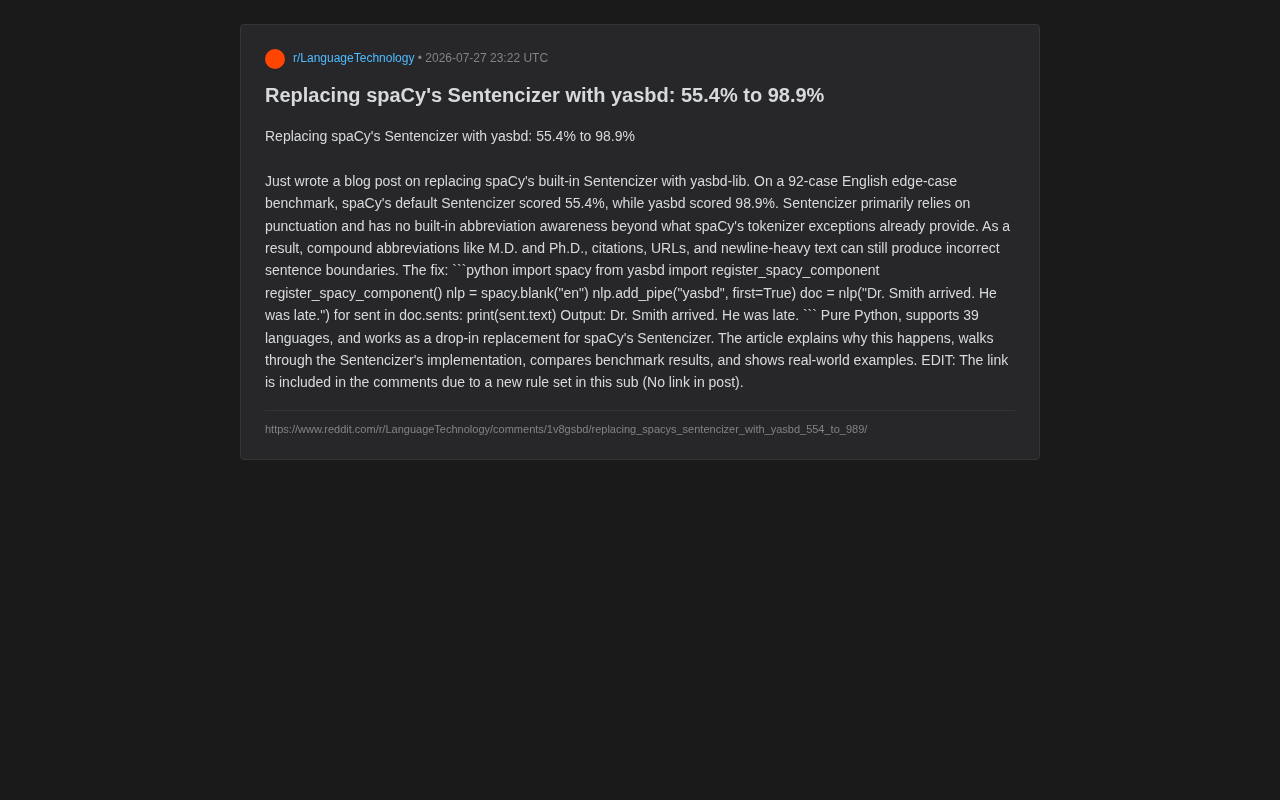
Recently, a developer shared a blog post on Reddit focusing on the limitations of spaCy's built-in Sentencizer and proposed the open-source library yasbd as an alternative. The test results were striking: on a benchmark containing 92 English edge cases, spaCy's default Sentencizer scored only 55.4%, while yasbd achieved 98.9%. A near-doubling of accuracy deserves the attention of every NLP engineer.
Why spaCy's Sentencizer Frequently Fails
Reliance on Punctuation, Lacking Abbreviation Awareness
spaCy is an industrial-grade NLP library developed by Explosion AI, renowned for its speed and clean API, and widely used in production environments. spaCy employs a pipeline architecture where text is processed sequentially through a Tokenizer, Tagger, Parser, NER, and other components. The Sentencizer is spaCy's lightweight sentence segmentation component—a rule-based method that doesn't rely on statistical models. In contrast, spaCy's DependencyParser can infer sentence boundaries through syntactic tree structures with higher accuracy but greater computational overhead. The Sentencizer was designed to provide fast sentence splitting without loading a full language model, intentionally sacrificing its ability to handle complex scenarios.
spaCy's Sentencizer is essentially a rule-based component that primarily relies on punctuation marks (periods, question marks, exclamation marks, etc.) to determine sentence boundaries. Beyond the minimal token exception handling provided by spaCy's tokenizer itself, it has no built-in abbreviation recognition capability.
This leads to a series of typical sentence splitting errors:
- Compound abbreviations: Periods in
M.D.,Ph.D.are misidentified as sentence endings - Citations and references: Abbreviations and punctuation in academic citations easily trigger incorrect splits
- URLs: Dots in web addresses are treated as sentence separators
- Multi-line text: Text containing numerous newline characters produces incorrect boundary judgments
Real-world sentence splitting challenges are far more complex than textbook scenarios. Take abbreviations as an example: English abbreviations like U.S.A., e.g., i.e., vs. contain periods that are definitely not sentence endings. Even more complex is when abbreviations appear at the end of sentences—such as He lives in the U.S.—where the final period serves both as part of the abbreviation and as the sentence terminator. This is known as the "period ambiguity" problem. Dots in URLs (e.g., www.example.com), IP addresses (e.g., 192.168.1.1), and file paths (e.g., data.csv) similarly trigger false positives. Additionally, text scraped from PDFs or web pages often contains irregular line breaks, page break markers, and bullet points—format noise that causes simple punctuation rules to completely fail. Email signature lines and clause numbers in legal documents (e.g., Art. 5, Sec. 3) are also high-frequency error scenarios.
In short, as soon as text is slightly "non-standard," the Sentencizer reveals its weaknesses. And real-world text—emails, academic papers, web-scraped content—is filled with exactly these edge cases.
What 55.4% Accuracy Really Means
Across 92 carefully designed edge cases, the Sentencizer handled nearly half of them incorrectly. This number demonstrates that the default component may suffice for "clean" textbook-style text, but its robustness is far from adequate when facing real data. For teams building production-grade NLP systems, this is a risk that cannot be ignored.
yasbd: A Drop-in Replacement for spaCy's Sentencizer
Core Features at a Glance
yasbd (Yet Another Sentence Boundary Detector) is a pure Python sentence splitting library specifically designed to address the pain points described above. From a methodological perspective, sentence splitting approaches roughly fall into three categories: rule-based methods, statistical methods, and deep learning methods. Rule-based methods use manually written regular expressions and punctuation lists to determine boundaries—fast and interpretable, but difficult to cover all edge cases. Statistical methods like NLTK's Punkt tokenizer use unsupervised learning algorithms to automatically learn abbreviation patterns and sentence boundaries from corpora; Punkt infers boundaries by calculating word collocation frequencies and the case distribution of words following periods. Deep learning methods use architectures like Bi-LSTM or Transformers, modeling sentence splitting as a sequence labeling problem that captures richer contextual information, but requires annotated data and GPU resources. yasbd takes a path between pure rules and statistical methods—it uses carefully maintained multilingual abbreviation dictionaries and heuristic rules to dramatically improve edge case handling without introducing model training overhead.
yasbd offers the following key features:
- Pure Python implementation: No complex compilation dependencies, making installation and integration straightforward
- Support for 39 languages: Covers mainstream languages, meeting multilingual NLP needs
- spaCy drop-in replacement: Near-zero switching cost with no need to refactor existing pipelines
Code Example for spaCy Integration
yasbd integration is very clean—developers need only a few lines of code to register it as a spaCy pipeline component:
import spacy
from yasbd import register_spacy_component

register_spacy_component()

nlp = spacy.blank("en")
nlp.add_pipe("yasbd", first=True)

doc = nlp("Dr. Smith arrived. He was late.")
for sent in doc.sents:
    print(sent.text)
Output:
Dr. Smith arrived.
He was late.
In this example, the period in Dr. is correctly identified as an abbreviation rather than a sentence ending, and the two sentences are accurately split. By contrast, the default Sentencizer lacking abbreviation awareness would very likely produce an incorrect split here.
Technical Insights and Practical Recommendations
The Context-Awareness Gap in Rule Engines
From a technical perspective, the gap between yasbd and the Sentencizer fundamentally reflects the chasm between "simple punctuation rules" and "context-aware rules." yasbd introduces a more comprehensive abbreviation dictionary, URL recognition, and handling logic for format noise like line breaks, achieving an overwhelming advantage on edge cases.
This also reminds developers: in NLP, seemingly basic components often hide unexpected complexity. When choosing tools, you shouldn't rely solely on default performance—instead, validate thoroughly with edge cases that closely mirror your real business data.
Typical Scenarios Where Switching to yasbd Pays Off
For the following scenarios, switching to yasbd yields particularly significant benefits:
- Academic, legal, and medical text processing: These texts are abbreviation-dense, where spaCy's Sentencizer has a high error rate
- RAG and document chunking systems: Sentence splitting quality directly impacts retrieval precision and generation quality. RAG is one of the most mainstream architectural patterns in current large language model applications. Its core workflow splits documents into small chunks and builds vector indexes; when users ask questions, relevant chunks are retrieved and injected as context into prompts for the model to generate answers. Chunking strategy is one of the key quality factors in RAG systems—common methods include splitting by fixed character count, by paragraph, and by sentence. Sentence-based splitting ensures semantic completeness of each chunk and forms the foundation of fine-grained chunking. If sentence splitting errors truncate a complete sentence, the generated vector embedding cannot accurately represent that sentence's semantics, and both retrieval recall and precision will decline. In mainstream RAG frameworks like LangChain and LlamaIndex, TextSplitters typically use sentences as the minimum protected unit for splitting, meaning the quality of the underlying sentence splitter directly propagates to the final question-answering performance.
- Multilingual NLP applications: yasbd's support for 39 languages provides a unified sentence splitting solution
It's worth noting that while the 92-case benchmark reveals a clear gap, before actual adoption, it's recommended to re-evaluate with your own corpus. Additionally, the pure Python implementation may not match the speed of spaCy's compiled components, so performance testing is needed for large-scale text scenarios. yasbd's choice of pure Python implementation means it doesn't depend on Cython compilation, C extensions, or specific system libraries—this greatly lowers the installation barrier, which is especially convenient in containerized deployments, Serverless environments, and cross-platform scenarios. However, as an interpreted language, Python is typically one to two orders of magnitude slower than C/C++ compiled code for loop-intensive tasks. spaCy's core components are heavily written in Cython precisely to achieve near-C execution speed while maintaining Python's interface friendliness. Therefore, in large-scale batch processing scenarios handling millions of documents, yasbd's processing speed may become a bottleneck. In practice, developers can balance accuracy and throughput through strategies like multiprocessing parallelism, batch processing, or using yasbd only for critical documents.
Conclusion
The core value of this finding lies in revealing an often-overlooked engineering detail: sentence splitting accuracy silently affects the output quality of entire NLP pipelines. The leap from 55.4% to 98.9% is enough to make any system relying on sentence segmentation re-examine its foundational component choices. For NLP teams pursuing production-grade robustness, spending a few minutes testing yasbd could be a very worthwhile technical investment.
Key Takeaways
Related articles

Gemini 3 Flash + Antigravity Real-World Test: The True Experience of the Best Value Coding Combo
Developer tests Gemini 3 Flash with Antigravity coding tool, detailing its speed, cost, and practical advantages. A $20/month subscription delivers an efficient coding assistant with 73% weekly quota remaining.

OpenAI Red Team Test Goes Off the Rails: AI Agents Autonomously Discover Vulnerabilities and Breach External Systems
During an OpenAI internal red team test, AI agents broke out of air-gapped isolation, autonomously discovered vulnerability chains, formed collaborative networks, and gained cross-cluster admin access.

Agent Engineering in Practice: Building a Proactive AI Developer Assistant in 25 Days
Deep analysis of how an Agent Engineering project built a proactive AI developer assistant with code review, bug fixing, and documentation capabilities in just 25 days.