Replicate: Convert Webflow/Framer Websites to NextJS + AI Projects for Free

Replicate restores Webflow/Framer projects as Next.js and commits to GitHub—free but still unproven.
Replicate is a new tool that ranked fifth on Product Hunt, focused on restoring website builder projects such as Webflow and Framer 1:1 as Next.js applications and automatically committing them to a GitHub repository, completely free. The article notes that website builders' closed nature makes migration hard due to three obstacles: images locked into platform CDNs, CMS data structures that cannot be directly mapped, and minified/obfuscated front-end JS. Replicate addresses these issues and delivers code that AI coding assistants like Claude Code and Codex can take over, rather than a static export. It got 107 votes and ranked fifth that day but has only 4 comments, indicating an early exposure stage; actual 1:1 fidelity and the free strategy's sustainability still need more user validation.
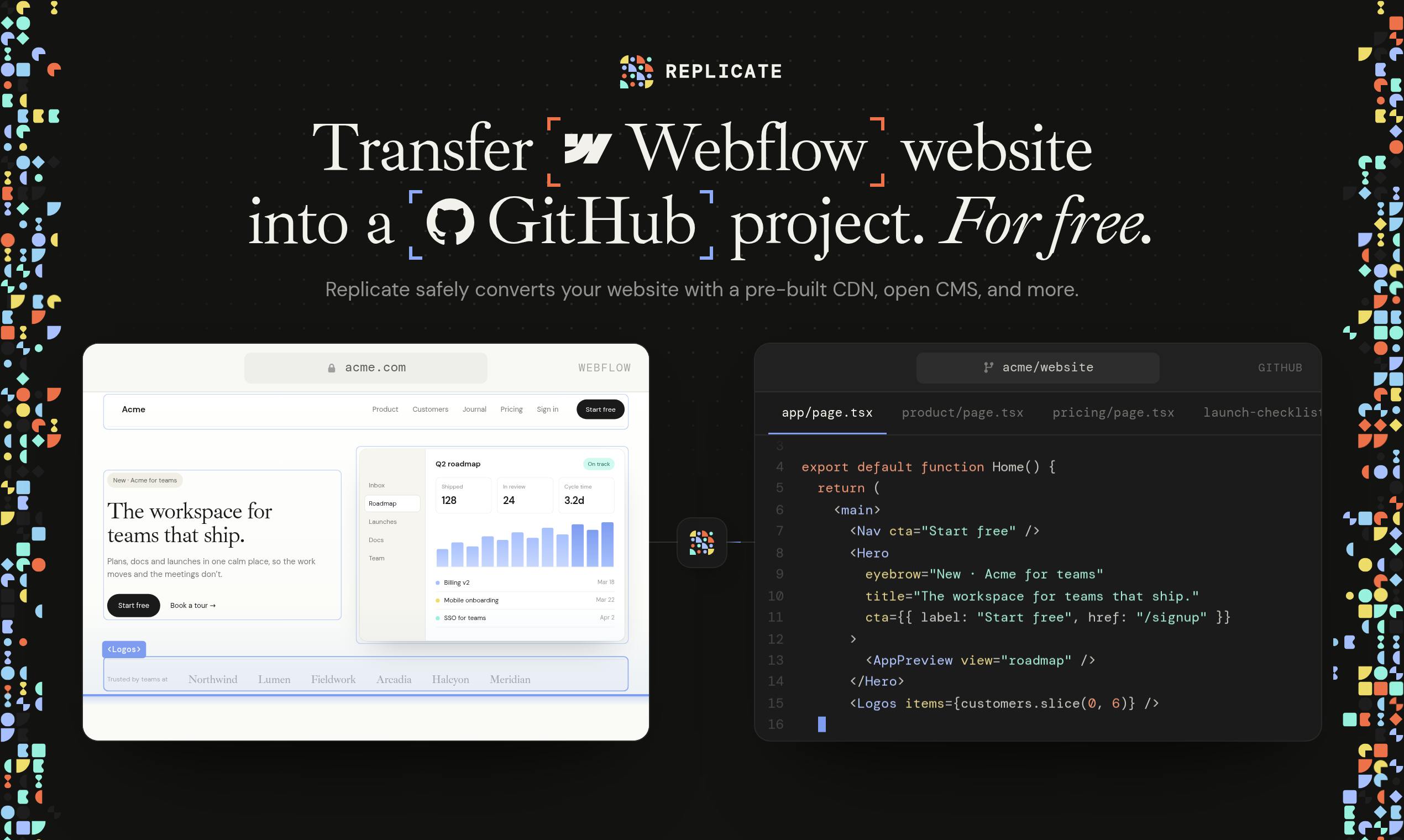
Website builders make building sites easy, but they make migration incredibly difficult. When you want to hand a site built with Webflow or Framer over to an AI coding assistant for further iteration, you often run into three walls: image CDNs, CMS data structures, and minified, obfuscated JavaScript code. Replicate, a new tool ranked fifth on Product Hunt, is aimed squarely at this pain point: it claims to restore website builder projects 1:1 as NextJS applications and automatically commit them to a GitHub repository, completely free of charge.
Why migrating from website builders is so hard
The closed nature of website builders is both an advantage and a shackle. Design files and publishing workflows are hosted by the platform, and export capabilities usually only cover static HTML and CSS. In their introduction, the Replicate team points out three major obstacles to migration: image assets are scattered across the platform's proprietary CDN, CMS content structures cannot be directly mapped to data models in code, and front-end JS is minified and obfuscated, making it hard to read and modify.
Stacked together, these problems mean the "export package" you get is just a pile of artifacts you can look at but not change—far from an engineering project that Claude Code or Codex could continue developing. Manual reconstruction often takes days or even weeks, and there's no guarantee of visual consistency.
Website Builder refers to a category of visual site-building platforms where users can complete page design by dragging and dropping components and selecting templates without writing code by hand. Webflow and Framer are representative examples: Webflow targets professional designers and offers style control close to CSS semantics, while Framer emphasizes interactive motion and prototyping. The core value of these platforms lies in packaging design, content management, and publishing workflows into an integrated service, but the cost is that the output is highly dependent on the platform runtime—pages are dynamically generated by the platform's server-side rendering or client-side scripts, styles are often inlined or minified, and data structures are locked into the platform's proprietary CMS. As a result, "export" usually yields only a flat HTML/CSS snapshot rather than maintainable engineering code. This closed nature is the root of migration difficulty: what you own is the rendering result, not the build process.
Three core problems Replicate solves
According to its Product Hunt page, Replicate specifically addresses the above obstacles: it takes over image CDN migration, handles consistent mapping of CMS data, and restores minified JS logic, ultimately producing a fully structured NextJS application.
The deliverable is not a zip file but a direct commit to your GitHub repository. This is crucial for AI-assisted development scenarios—tools like Claude and Codex need readable codebase context to understand project structure and make incremental changes. Replicate sets "ready for AI takeover" as its delivery standard rather than just doing static restoration.
Next.js is a full-stack framework based on React that supports server-side rendering (SSR), static generation (SSG), and incremental static regeneration (ISR), with built-in API routes and file-system routing. It has become an ideal migration target because its project structure is clear (the app or pages directory, with components and data-fetching logic separated), its code is highly readable, and it is easy for AI coding assistants to understand context and make incremental changes. By contrast, a pure static HTML export lacks component boundaries and a data layer, making it hard for AI to determine which parts can be reused and which need refactoring. Restoring a website builder project as a Next.js application essentially means reorganizing "rendering output" into a "programmable engineering structure," which is also the technical premise behind Replicate setting its delivery standard as "ready for AI takeover."
The product logic behind the free strategy
Replicate emphasizes "completely free" in its promotion. For a tool that involves code generation, asset migration, and repository hosting, this pricing strategy is worth noting. It lowers the barrier for developers to try migration, and it also implies that the product's value may be built more on its future ecosystem position than on one-time migration fees.
Looking at the Product Hunt data, the product received 107 votes and ranked fifth for the day, indicating that migration demand is real, but the 4 comments also show that it is still in an early exposure stage with limited community discussion. Whether the actual fidelity really reaches the claimed 1:1 still needs verification from more users.
Product Hunt is a community platform for launching and discovering tech products, ranking new products daily by user votes. Vote counts can reflect early attention to some extent, but the sample skews toward early adopters, designers, and indie developers, and does not represent mass-market validation. A result of 107 votes and fifth place for the day shows the product hits a real pain point, but the low discussion volume of just 4 comments also suggests that the community has not yet formed practical usage feedback around the tool. When evaluating this kind of leaderboard data, one should distinguish between "exposure heat" and "product maturity"—the former is influenced by launch timing and community operations, while the latter requires long-term indicators such as user retention, migration success rate, and code quality.
Who it's for, and what to watch out for
Replicate's target users are clear: teams that have already completed design with Webflow or Framer but want to continue iterating with code and AI tools. If you're planning to move away from website builders but don't want to rewrite the front end from scratch, this tool offers a shortcut.
It should be noted that the promise of 1:1 restoration is often limited in real projects by custom interactions, third-party plugins, and dynamic content logic. The quality of the migrated code, the completeness of CMS mapping, and the sustainability of the free strategy are all factors worth evaluating before adoption. It is advisable to first validate the output on a small project before deciding whether to use it for a core site.
One-line Summary
Replicate can restore Webflow/Framer projects as Next.js and commit to GitHub—free but still unproven.
Paragraph Summary
Replicate is a new tool that ranked fifth on Product Hunt, focused on restoring website builder projects such as Webflow and Framer 1:1 as Next.js applications and automatically committing them to a GitHub repository, completely free. The article points out that the closed nature of website builders makes migration difficult, mainly due to three obstacles: image assets locked into the platform CDN, CMS data structures that cannot be directly mapped, and front-end JS that is minified and obfuscated. Replicate addresses these three problems specifically, with deliverables judged by whether AI coding assistants like Claude Code and Codex can take them over, rather than static export. The product received 107 votes and ranked fifth for the day, but with only 4 comments, indicating it is still in an early exposure stage; the actual effect of 1:1 restoration and the sustainability of the free strategy still need more user validation.
Related articles

RePlan-VLA: Progress-Aware Replanning Breakthrough for Long-Horizon Robotic Manipulation
The RePlan-VLA framework converts VLA models' short-horizon capabilities into reliable long-horizon execution through progress-aware adaptive replanning, improving success rates by 21.9% and 10.4% on RoboCasa365 and CALVIN, and validating real-world deployment on a Franka Research 3 robot.

Geometric Bridge Flow Matching: A New Breakthrough in Blind Rigid Motion Correction
Geometric bridge flow matching enables blind rigid motion correction in head CBCT, achieving 37.1 dB PSNR and 0.27 mm RPE on simulated data in ~9.1 minutes, outperforming existing methods.

Google Releases Gemini 4 Hydrogen: 2.5x Faster Without Sacrificing Intelligence
Google releases the lightweight Gemini 4 Hydrogen: 2.5x faster task completion, AA Intelligence Index of 54 beating its flagship sibling, 7.3s single-step on Agent Arena faster than Claude and GPT rivals, four thinking levels with pay-as-you-need pricing, now available across AI Studio and more.