Replit Agent 4 Hands-On: Building Websites, Apps, and 3D Games with a Single Prompt

Replit Agent 4 enables full-stack coding and deployment driven by natural language through parallel multi-agent processing
Replit Agent 4 represents a new high for vibe coding, where users simply input natural language prompts and multiple AI agents work in parallel to complete design, development, and deployment. Its four core capabilities include an infinite design canvas, multi-agent parallel processing, multiple artifact outputs, and real-time collaboration. In hands-on testing, a creator completed three entirely different projects—a cookie shop website, an invoice management app, and a 3D space shooter game—without writing a single line of code.
A New High for Vibe Coding
Vibe Coding is no longer a new concept. Formally coined by OpenAI co-founder Andrej Karpathy in early 2025, it describes an entirely new paradigm of human-AI collaborative programming: instead of writing code line by line, developers describe their intent in natural language and let AI handle the actual code generation. From a technical evolution perspective, it represents the latest stage in the progression from code completion (the GitHub Copilot era) → conversational programming (the ChatGPT era) → autonomous programming agents (the Agent era).
But most tools can only handle part of this pipeline—they're either good at design, or can write code, or can handle deployment, but none of them can tie everything together in one place. Replit Agent 4 aims to change that: you type a single natural language prompt, and multiple AI agents launch in parallel, simultaneously completing design, development, and deployment.
This article is based on a hands-on demo by a creator who used Replit Agent 4 to complete three entirely different projects in a single session: a cookie shop website, an invoice management app, and a 3D space shooter game. Not a single line of code was written throughout the entire process.
Four Core Capabilities of Replit Agent 4
Replit Agent 4 introduces four key capabilities that no other vibe coding tool currently offers:
Infinite Design Canvas: Unlike traditional chat-based interactions, Agent 4 provides a visual design canvas where you can intuitively view and manipulate all design proposals. The Infinite Canvas as an interaction paradigm was first widely adopted in creative tools—Figma, Miro, Notion, and others popularized it. Its core advantage lies in breaking through the information density limitations of linear conversation. Replit's introduction of this paradigm into AI coding tools has solid cognitive science backing: research shows that when making design decisions, spatialized visual comparison aligns better with how our brains work than sequential text descriptions—we're naturally better at "seeing" differences than "describing" them. Multiple design variants are displayed side by side on the canvas, where you can directly circle elements and write annotations, and the AI understands your markup intent in real time.
Multi-Agent Parallel Processing: This is the most disruptive feature. Traditional AI coding tools follow a linear workflow—send a prompt, wait for completion, then send the next one. Agent 4 is powered by the rapidly evolving Multi-Agent System (MAS) architecture: complex tasks are decomposed into multiple subtasks, executed concurrently by specialized agents, then integrated through a coordination layer. Representative frameworks in the industry include Microsoft's AutoGen and Stanford's AgentVerse. Replit encapsulates this complex architecture in an invisible backend—the system autonomously determines how to split tasks. This is analogous to microservice architecture in traditional software engineering—except the execution units have changed from code services to AI agents.
Multiple Artifact Outputs: Within a single project, you can build websites, mobile apps, slideshows, animations, spreadsheets, and even 3D games.
Real-Time Collaboration: Team members can submit tasks simultaneously and watch agents execute all work in parallel.
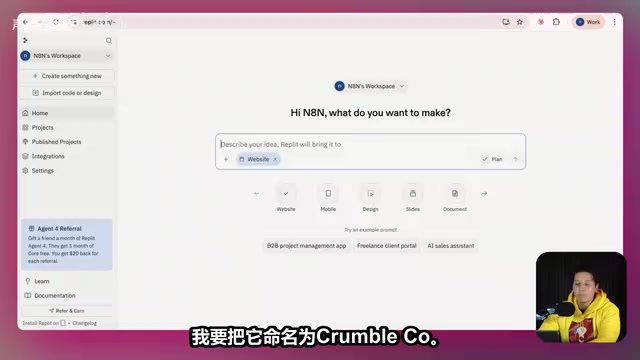
Test 1: Building a Cookie Shop Website from Scratch
The demonstrator entered a prompt requesting a website for a small cookie shop called "Crumble Co." What happened next was quite impressive:
The agent first entered planning mode, scanned the entire project requirements, then autonomously launched three independent design agents, simultaneously generating three completely different design proposals:
- One with a dark, moody aesthetic featuring deep brown typography
- One taking a bright, minimalist approach with generous whitespace and thin fonts
- One presenting a warm bakery atmosphere with soft orange tones, a fresh cookie hero image, and rounded buttons
All three proposals were presented on the infinite canvas, where users could annotate directly. The demonstrator circled the hero section on the warm-toned version and wrote "make the heading slightly larger and add a call-to-action button," and the agent completed the update in real time.
The significance of this interaction model: When users can directly circle elements and write annotations on the canvas, the AI receives multimodal instructions with spatial context, which carries far richer intent information than plain text prompts. You no longer need verbose text to precisely describe every design change—instead, you point directly at the issue like communicating on a whiteboard, dramatically lowering the barrier of "prompt engineering."

After selecting a design proposal, the demonstrator simultaneously submitted three improvement requests: enhance the visual effects of the menu section, improve the contact form and add a newsletter subscription feature, and optimize the mobile responsive layout. Replit provides a kanban-style task panel where you can track each task's status in real time from draft to in-progress to completed.
The final product was a fully responsive website that could be loaded on a phone in real time by scanning a QR code, with all elements perfectly adapting to different screen sizes. This was a published, real website, built from scratch without writing a single line of code.
Test 2: Building a Fully Functional Invoice App with AI
The second project had more practical value. The demonstrator entered the prompt: "Build me a fully functional invoice application that should let me create and send invoices, manage clients, and track payment status."
Related articles
 Product Reviews
The Programmer's Desk Setup Guide: Building a Workspace That Feels Like Home
Discover how programmers build productive, comfortable workspaces. From multi-monitor setups to ergonomic design, explore the desk philosophy that drives focus and flow.
 Product Reviews
Qoder vs Cursor Real-World Comparison: Which $20/Month AI IDE Is Better?
Hands-on comparison of Qoder vs Cursor AI IDEs: Agent autonomy, human interaction count, and architecture decisions. Qoder needed only 2 interactions vs Cursor's 8.
 Product Reviews
Cursor Cloud Agent Demo: Eliminating Bottlenecks Across the Entire Software Development Lifecycle
Deep analysis of Cursor's Cloud Agent demo showing how cloud VMs, automated test artifacts, and a full-chain control plane systematically eliminate human bottlenecks across the software development lifecycle.