Replit Agent Connects to Slack: Trigger Project Auto-Optimization with a Single Message

Replit Agent turns Slack feedback into code changes with one instruction, shortening the feedback loop.
Replit demonstrated a new use case: with one natural language instruction, the Agent reads feedback from a specified Slack channel, locates the corresponding project, and starts modifying code. This compresses the manual handoff between collecting feedback, writing requirements, and scheduling development. The Agent can also reuse the same feedback across multiple projects in the same conversation. Its workflow—project location, feedback extraction, editing initiation—relies on semantic understanding of unstructured information. This cross-system operation (Slack and codebase) raises new concerns around permissions and context boundaries; teams must clarify which channels and projects the Agent can read and modify. The overall direction: Agents are moving from "tell it what to write" to "it figures out what needs changing."
From Slack Conversation to Code Change, in Just One Sentence
When teams vent about the onboarding flow in Slack, it usually dies in the chat history—no one has the energy to turn it into actual product improvements. A recent use case demonstrated by Replit tries to change that: by directly asking the Agent in conversation to "read last week's feedback in the #product_feedback channel and use it to optimize the onboarding flow for my customer portal," the Agent will locate the corresponding project on its own, pull the relevant feedback content, and start making changes.
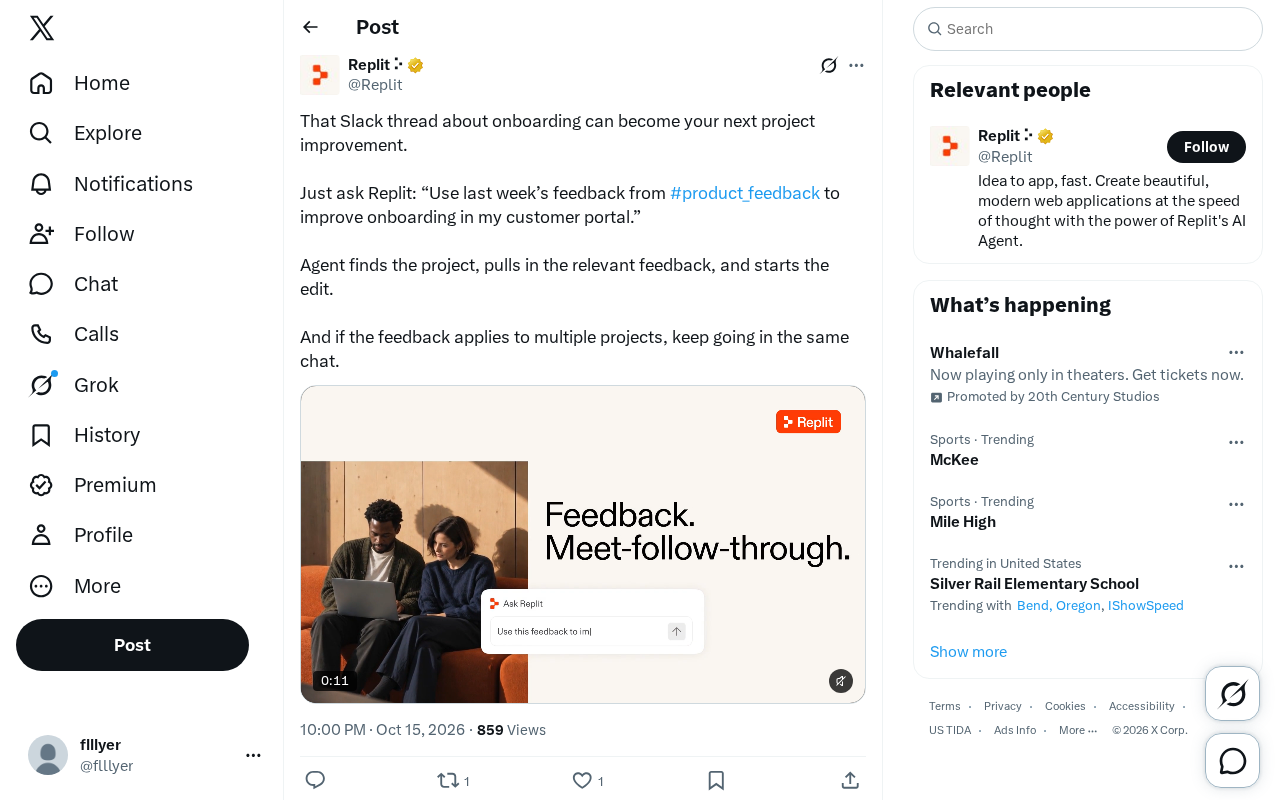
The significance of this workflow lies in compressing the manual handoff between "collecting feedback" and "executing improvements." In the past, someone had to organize the feedback, write it into requirements, and hand it off to developers for scheduling. Now, that entire chain is replaced by a single natural language instruction.
To understand this scenario, it's important to first clarify what Replit Agent is. Replit is a browser-based cloud development environment (IDE) where users can write, run, and deploy code without local configuration. Replit Agent is an autonomous coding assistant built on top of it: it doesn't just autocomplete code—it can receive high-level goals (such as "optimize the onboarding flow"), break them down into steps on its own, manipulate files, run commands, and verify results. Unlike traditional code completion tools like Copilot, the Agent has "multi-step planning + tool invocation" capabilities—it can proactively call external services (like the Slack API) to gather information, then return to the codebase to make changes. This is precisely the technical prerequisite that allows it to bridge the two systems of "conversation" and "code." Understanding this is essential to seeing why each link in the workflow described below requires an Agent rather than an ordinary assistant.
Cross-Project Reuse: Continuous Progress Within the Same Conversation
Replit specifically mentions an extended scenario: if this batch of feedback applies to multiple projects simultaneously, users don't need to switch tools or start a new session—they can continue issuing instructions in the same chat.
This means the Agent's context isn't limited to a single codebase. Feedback, as a kind of "input resource," can be referenced and distributed across multiple projects. For teams maintaining multiple customer portals or product lines, this capability reduces the cost of repeatedly describing requirements—the same batch of user voices can drive changes in multiple places at once.
From a product design perspective, this goes a step beyond mere "AI writing code": it positions the Agent as a hub for information flow, not just a code generator.
Breaking Down the Agent's Workflow
According to Replit's description, this instruction triggers several consecutive actions:
- Project location: The Agent finds the corresponding project based on the description "my customer portal." Users don't need to manually specify a repository or path.
- Feedback extraction: It pulls last week's feedback from the Slack #product_feedback channel and identifies the parts related to onboarding.
- Editing initiation: It begins modifying code directly based on the extracted feedback.
Every link in this chain depends on the Agent's ability to understand unstructured information—Slack messages themselves are scattered and colloquial. Turning them into executable code changes requires cross-modal semantic mapping.
The term "cross-modal semantic mapping" here deserves elaboration. Slack messages are unstructured natural language: they may include emojis, abbreviations, omitted context, and emotional expressions, such as "last time the signup step froze so badly I wanted to smash my keyboard." To translate this into executable code changes, the Agent needs to accomplish three layers of understanding: first, semantic extraction—identifying the specific pain point from colloquial expression (e.g., too many signup steps); second, intent classification—determining whether this falls under UI adjustments, flow simplification, or a performance issue; third, code localization—finding the corresponding component or logic in the project. This process relies on the large language model's semantic understanding and code retrieval capabilities, not simple keyword matching. This is also why the same batch of feedback can be reused across multiple projects—the Agent understands "the meaning of the feedback," not just the words themselves.
Potential Impact on Team Collaboration Models
If this workflow proves stably usable, the most immediate change is a shortened feedback loop. Product team discussions in Slack are no longer merely "on the record"—they can be turned into action items at any time.
Another point worth noting is permissions and context boundaries. The Agent needs to access Slack channel content while also operating on code projects. This cross-system access capability brings convenience but also raises issues of data flow and permission management. When adopting similar workflows, teams need to clarify which channels and which projects can be read and modified by the Agent.
What Replit has demonstrated is just one use case, but the direction it points to is fairly clear: Agents are evolving from "you tell it what to write" to "it finds out for itself what needs changing."
This touches on a more fundamental concept: cross-system permission boundaries. When an Agent is connected to both Slack and a code repository, it effectively holds access credentials for two systems and moves data between them. This is fundamentally different from traditional single-system bots (such as a Slack Bot that only replies to messages). Security best practices typically require following the principle of least privilege—granting the Agent only permission to read specific channels and operate on specific repositories, rather than full access. Additionally, context isolation must be considered: feedback from one project should not accidentally leak into another unrelated project. The scenario Replit currently demonstrates has not detailed these control mechanisms, but when teams implement similar workflows, they should plan in advance the visibility scope of channels, write-permission whitelists for projects, and audit capabilities for operation logs, so that convenience doesn't come at the cost of data governance.
One-line Summary
Replit Agent turns Slack feedback directly into code changes with a single instruction, shortening the feedback loop
Paragraph Summary
Replit demonstrated a new use case: with just one natural language instruction, the Agent can read feedback from a specified Slack channel, locate the corresponding project on its own, and begin modifying code. This workflow compresses the manual handoff between "collecting feedback—writing requirements—scheduling development." The Agent can also reuse the same batch of feedback across multiple projects within the same conversation, without switching sessions or repeating requirements. Its workflow consists of three steps—project location, feedback extraction, and editing initiation—each relying on semantic understanding of unstructured information. This cross-system autonomous operation (between Slack and the codebase) also introduces new issues around permissions and context boundaries; teams need to clarify which channels and projects can be read and modified by the Agent. The overall direction is that Agents are evolving from "telling it what to write" to "it finds out for itself what needs changing."
Related articles

Chain of Thought Isn't Just for AI: How Humans Can Use CoT to Improve Thinking Quality
Chain of Thought isn't just a prompt trick for large models. Starting from a Hacker News discussion, this article analyzes why CoT works for human thinking too, breaks down actionable ways to transfer it, and highlights the key differences between human CoT and machine CoT.
Cloudflare Teams Up with OpenAI: Closi…
Cloudflare Teams Up with OpenAI: Closing the Loop from Vulnerability Discovery to Defense with AI
Cloudflare uses OpenAI Daybreak to investigate security vulnerabilities and generate reviewable remediation plans, while developers use Codex to boost coding efficiency and quality.

Orca Multi-Agent Orchestration in Practice: A Guide to Parallel Collaboration with Claude and Codex
Orca is Stable AI's free open-source agent workbench supporting 34 agents like Claude Code and Codex in parallel. Learn its Git worktree isolation, multi-model orchestration, and mobile management.