Replit: Building an MVP in One Weekend and Passing Apple Review on the First Try

Developer builds MVP with Replit in one weekend, passes Apple review on first submission
A developer shared how switching from Cursor to Replit delivered a massive productivity leap: completing an app MVP in just one weekend and passing Apple's strict review on the very first submission. As an all-in-one cloud development environment, Replit uses its AI Agent to automate the entire pipeline from code generation to environment configuration and deployment, representing the paradigm shift in AI programming tools from simple code completion to autonomous programming Agents.
From Cursor to Replit: Another Leap in AI-Powered Development Efficiency
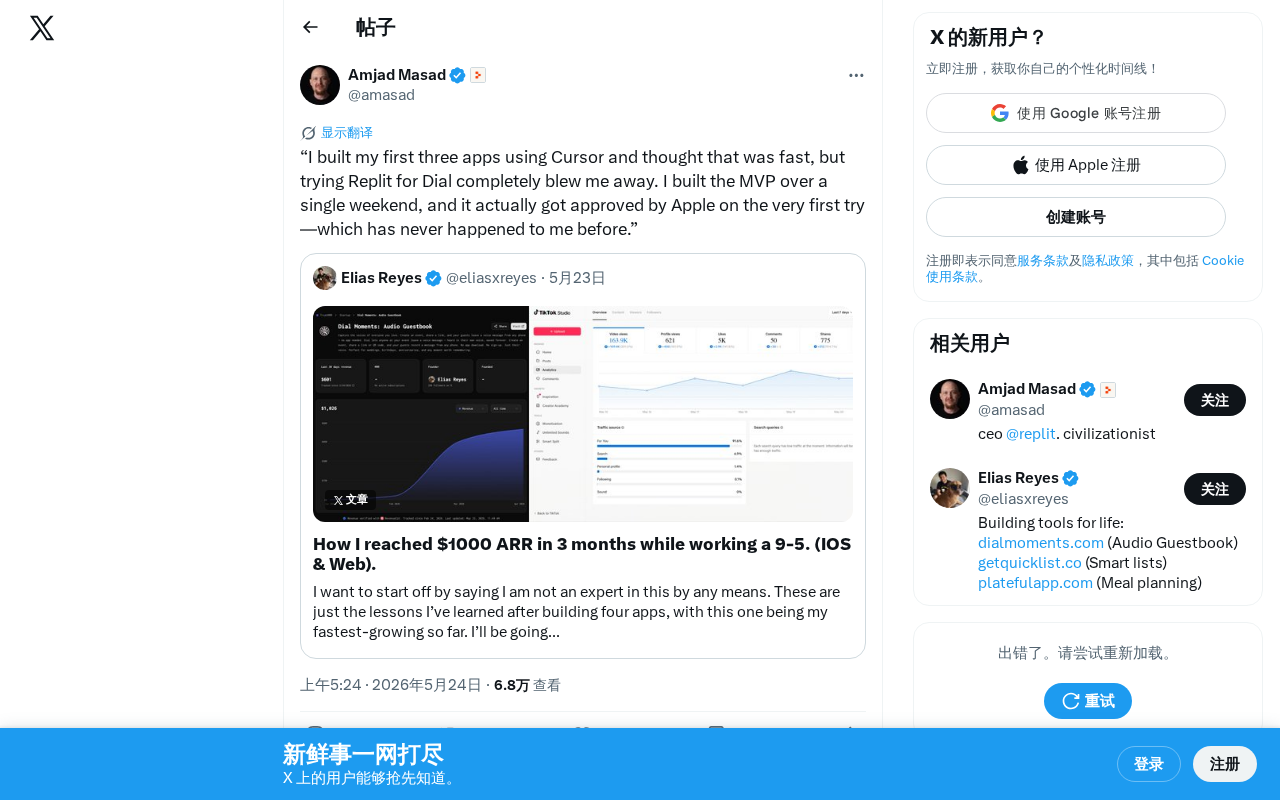
A developer recently shared an astonishing experience on Twitter about building an app with Replit: he completed the entire MVP in just one weekend, and it passed Apple's review on the very first submission — something that had never happened in his entire development career.
Comparing the Experience: From Cursor to Replit
This developer had previously built three apps using Cursor and already felt the development speed was impressively fast.
Cursor is an AI-native IDE built on top of a deeply modified VS Code. Its core technology involves deeply embedding large language models (LLMs) into the code editing workflow. It employs a "codebase-aware" context mechanism that uses vectorized indexing to understand the entire project's code structure, rather than just processing the currently open file. This allows Cursor to reference the project's global context when performing code completion, refactoring, and Q&A, generating code that better matches the project's style. Cursor supports multiple mainstream LLM backends (including GPT-4, Claude, etc.) and offers a "Composer" mode for multi-file collaborative editing. However, it is fundamentally still a local IDE tool — developers must manage their own runtime environments, dependency installation, build processes, and deployment on their own. This is the most fundamental difference between Cursor and Replit.
When he switched to Replit to develop an app called "Dial," the experience completely exceeded his expectations. Replit goes far beyond code completion or generation — it provides a complete end-to-end environment from development to deployment. This integrated experience clearly delivered a qualitative leap in productivity.
Replit's technical architecture is fundamentally different from traditional IDEs. It is a browser-based cloud development environment (Cloud IDE), where each project runs in an isolated container (based on the Nix package management system), eliminating the need for developers to install any runtimes or dependencies locally. Replit's AI feature, "Replit Agent," can not only generate code but also automatically handle environment configuration, install dependencies, run debugging commands, and even trigger the deployment process directly. This "Agentic" approach means the AI isn't just a code suggester — it's a true executor. Replit also has built-in infrastructure services such as databases, object storage, and authentication. Developers can describe their requirements in natural language, and the Agent handles everything from code generation to service configuration across the entire pipeline.
What's Behind Building an MVP in One Weekend
The "MVP in one weekend" timeline is worth reflecting on. MVP (Minimum Viable Product) is a core concept in Lean Startup methodology, systematically articulated by Eric Ries in The Lean Startup. The core idea is to build a product version that can validate key hypotheses with minimal development cost, quickly put it in front of real users, and use data to drive subsequent iterations. In traditional software development, the MVP build cycle is often constrained by tech stack setup, team collaboration costs, and engineering standards — even a "minimum" version typically takes weeks.
When AI tools can automatically handle environment configuration, boilerplate code generation, and UI framework scaffolding, developers can focus their energy almost entirely on the core decisions around product logic and user experience — this is the underlying logic that makes "building an MVP in one weekend" possible. Even for experienced developers, building an app that can pass App Store review typically takes weeks or even months. This involves far more than just writing code:
- Environment configuration and project setup: Replit's cloud development environment eliminates the hassle of local environment configuration
- UI/UX design and implementation: AI assistance can rapidly generate interface code
- Feature logic development: Implementing core business logic
- Testing and debugging: Ensuring the app runs stably
- Packaging and submission: Meeting Apple's various review standards
Completing all of this within 48 hours demonstrates that Replit has achieved tremendous optimization across the entire development workflow.
The Significance of Passing Apple Review on the First Try
Apple App Store's review process is widely recognized as one of the strictest app distribution mechanisms in the industry. The review team examines submitted apps across multiple dimensions: on the technical side, this includes using Xcode's static analysis tools to detect memory leaks, crash risks, and API misuse; on the compliance side, they verify the consistency between privacy manifests, permission declarations, and actual usage; on the design side, they evaluate UI compliance against the Apple Human Interface Guidelines (HIG), including safe area adaptation, dynamic type support, and more.
The main reasons for low first-submission pass rates are typically: incomplete permission declarations, missing or inaccurate privacy policies, UI layout issues on specific device sizes, and use of private APIs. Since AI-generated code is trained on large volumes of standards-compliant open-source projects, it tends to follow standard patterns more consistently than hand-written code — this may be a key reason why AI-assisted development improves review pass rates.
The developer specifically emphasized that "this has never happened to me before," which implies that even experienced developers typically need to go through several rounds of review revisions. Passing on the first submission means the app met standards in all of the following areas:
- Compliance with Apple's Human Interface Guidelines
- No crashes or serious performance issues
- Privacy policy and permission usage compliance
- Complete functionality with accurate descriptions
The Competitive Landscape of AI Programming Tools
This tweet also reflects the intense competition in today's AI programming tools market. The market is currently undergoing a paradigm shift from "code completion" to "autonomous programming Agents." The first generation of tools, represented by GitHub Copilot, was essentially intelligent code completion based on the Codex model, solving the problem of "writing code faster." Second-generation tools like Cursor introduced conversational programming and multi-file editing capabilities. Third-generation tools, represented by Replit Agent, are evolving toward "autonomously completing tasks" — AI not only generates code but also plans tasks, executes commands, handles errors, and completes deployments. The technical foundation for this evolution is LLMs with longer context windows, stronger reasoning capabilities, and the maturation of Function Calling/Tool Use mechanisms.
Cursor, Replit, GitHub Copilot, Windsurf, and other tools each have their own focus:
- Cursor: Focused on AI assistance at the IDE level, suited for experienced developers, offering deep codebase understanding and multi-file editing capabilities
- Replit: Provides a complete cloud development + deployment environment, with an Agent that can autonomously execute end-to-end tasks, lowering the barrier across the entire workflow
- GitHub Copilot: A code completion tool deeply integrated into VS Code, leveraging the Microsoft and GitHub ecosystem
- Windsurf (formerly Codeium): Maintains the local IDE experience while providing enhanced AI assistance through its "Cascade" approach
Related articles
 Product Reviews
The Programmer's Desk Setup Guide: Building a Workspace That Feels Like Home
Discover how programmers build productive, comfortable workspaces. From multi-monitor setups to ergonomic design, explore the desk philosophy that drives focus and flow.
 Product Reviews
Qoder vs Cursor Real-World Comparison: Which $20/Month AI IDE Is Better?
Hands-on comparison of Qoder vs Cursor AI IDEs: Agent autonomy, human interaction count, and architecture decisions. Qoder needed only 2 interactions vs Cursor's 8.
 Product Reviews
Cursor Cloud Agent Demo: Eliminating Bottlenecks Across the Entire Software Development Lifecycle
Deep analysis of Cursor's Cloud Agent demo showing how cloud VMs, automated test artifacts, and a full-chain control plane systematically eliminate human bottlenecks across the software development lifecycle.