Replit CEO Reveals Dropping Anthropic: Cost and Model Testing Were Key Factors

Replit CEO says the company stopped working with Anthropic due to cost and model testing, reflecting a shift in how AI coding tools choose models.
Replit's CEO publicly stated that the company has stopped working with Anthropic, citing cost pressure and model test results. The statement drew attention because Replit is a major player in AI coding tools and Claude has long been a top choice for code generation. The article notes that AI coding agents involve high call frequency, long contexts, and complex tasks, multiplying token consumption and directly eroding gross margins — unit economics is becoming a hard constraint. Meanwhile, general leaderboard rankings are hard to translate into advantages in specific scenarios; coding agents value long-horizon planning, tool-calling stability, and error recovery more. Replit's public pivot may prompt more product teams to re-evaluate suppliers, but a single company's choice should not be overinterpreted. The core takeaway: a switchable multi-model architecture is more prudent than betting on a single supplier.
An Unusual Public Statement
According to a widely discussed post on Reddit, Replit's CEO publicly stated that the company has stopped working with Anthropic, citing two main reasons: cost pressure and model test results. This statement drew attention not only because Replit is a major player in the AI coding tools space, but also because Anthropic's Claude series has long been regarded as one of the top options for code generation scenarios.
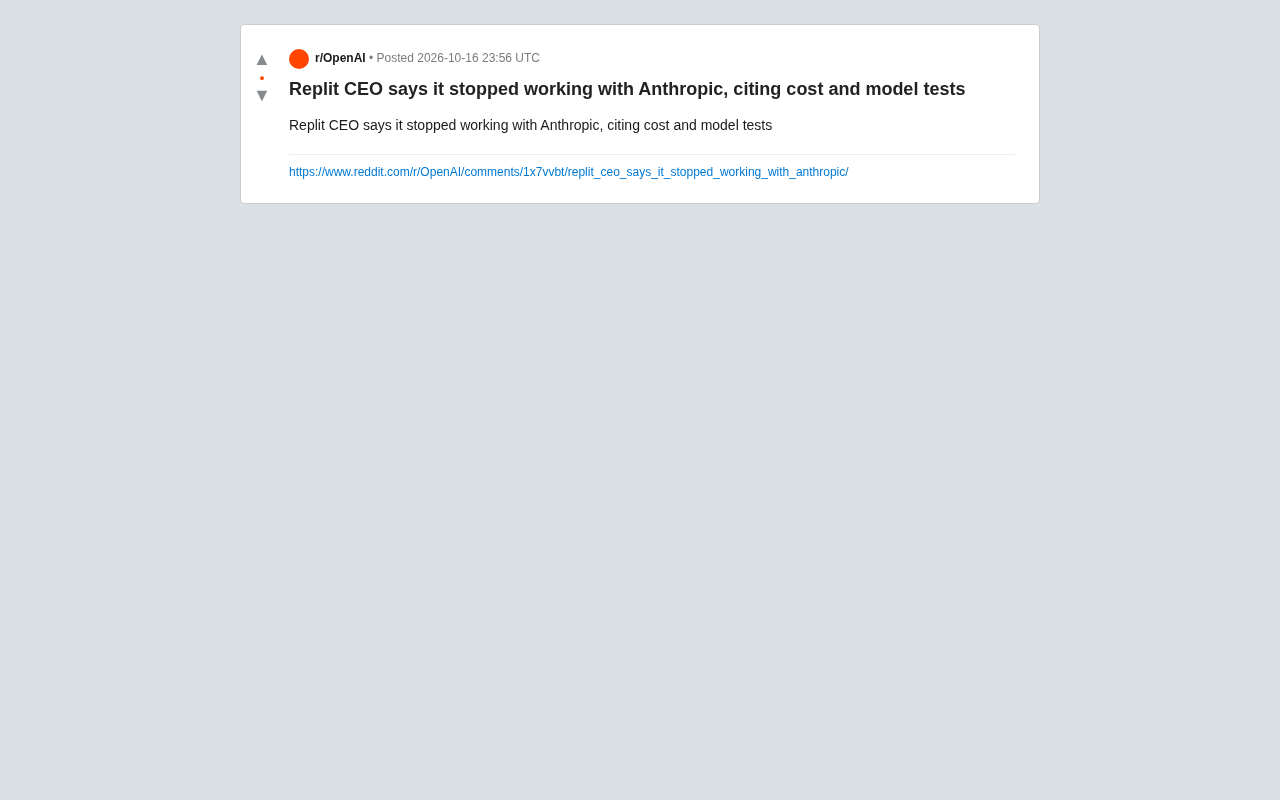
It should be noted that the publicly available information remains at the headline level only — which specific model, which metrics were tested, and how large the cost gap was have not been disclosed. But that doesn't prevent us from understanding the real considerations behind such decisions based on industry logic.
Why Cost Has Become a Sensitive Nerve for AI Coding Tools
AI coding tools differ fundamentally from ordinary chat products: they involve high call frequency, long contexts, and complex single tasks. An agent-style coding task may require repeatedly reading and writing files, executing commands, and rolling back and retrying — token consumption far exceeds single-turn Q&A. This means the unit price of model APIs gets multiplied several times over, directly eroding product gross margins.
Replit's business model includes subscriptions and usage-based billing. If the underlying model's call costs remain high, the company must either compress profits or pass costs on to users — both of which affect competitiveness. The CEO listing cost as the primary reason suggests that at this stage, model capability gaps may no longer be the sole decision variable; unit economics is becoming a hard constraint for AI coding products when choosing suppliers.
Unit economics refers to an analytical framework that calculates revenue and costs per individual user, per individual call, or per individual order. Core metrics include unit revenue, unit variable cost, and unit gross margin. For AI coding tools, model API fees are a typical variable cost: the more users use the product and the more complex the tasks, the higher the cost. Only when unit revenue consistently exceeds unit variable cost can scaling bring positive profits; otherwise, the faster the growth, the larger the losses. Therefore, when choosing underlying models, product teams look not only at absolute prices but also at the total cost required to complete each real task (such as a code modification or an agent execution). This is the economic basis for Replit listing cost as the primary reason.
The amplification mechanism of token consumption deserves separate mention. Large model billing is typically based on separate pricing for input tokens and output tokens, and the context of agent-style coding tasks accumulates continuously across conversation turns: reading files, executing commands, observing errors, retrying modifications — each step requires re-feeding historical information into the model. This makes the cumulative token volume for a single task potentially more than ten times that of ordinary Q&A, with input tokens often accounting for the majority. If the model supports long contexts, prices usually rise in tiers with context length. Therefore, the "price per million tokens" of model APIs may show little difference on paper, but in real coding workflows it gets significantly amplified, directly determining the product's gross margin space.
Model Testing: Capability Evaluation Is Returning to Scenario-Based Assessment
The second reason is model testing. This reveals a signal: rankings on general-purpose leaderboards may not translate into advantages in specific product scenarios. Coding agents need long-horizon task planning, tool-calling stability, and error recovery capabilities — dimensions that don't fully overlap with simple code completion benchmarks.
If Replit's internal tests show that a certain model underperforms expectations in its own workflow, then switching suppliers is a rational choice. Conversely, this also serves as a reminder to model vendors — optimization for agent scenarios is more effective at winning enterprise customers than topping leaderboards.
The difference between code completion benchmarks and agent evaluation is key to understanding the "model testing" reason. Traditional benchmarks like HumanEval and MBPP mainly measure a model's ability to generate a single correct code snippet based on a function signature — short-horizon, single-turn, tool-free tasks. But coding agents need capabilities including: multi-step task decomposition and planning, format stability in tool calls (reading/writing files, running terminals), self-correction based on execution feedback, and maintaining goal consistency in long contexts. These dimensions are hard to capture on static leaderboards but directly determine product experience. Recent industry evaluations like SWE-bench, based on real GitHub issues, attempt to narrow this gap, but internal workflows still vary greatly across companies, making self-built evaluations a necessary action for product teams.
Potential Impact on the Industry Landscape
Replit's public statement may have a demonstration effect. Product teams in the AI coding space commonly run A/B tests across multiple models, and once a leading player publicly pivots, other teams will more actively re-evaluate their supplier portfolios. For Anthropic, losing a high-profile customer is a loss at the signaling level; for competitors, it's a window to enter enterprise coding scenarios.
However, overinterpretation should be avoided. A single company's choice is influenced by its own cost structure, tech stack, and user profile, and cannot be directly extrapolated to mean that a particular model is overall inferior. The real trend depends on whether more product teams follow suit and how quickly each model iterates on agent evaluations.
Implications for Product Teams
The core lesson here is: in an era of multiple available models, supplier lock-in is a risk rather than an advantage. Product teams need to build a switchable model abstraction layer, keep evaluation authority in their own hands, and base decisions on real tasks rather than public leaderboards. The balance point between cost and capability shifts rapidly with model iterations, and maintaining flexibility is more prudent than betting on a single supplier.
One-line Summary
Replit CEO says the company stopped working with Anthropic due to cost and model testing, reflecting a shift in how AI coding tools choose their models.
Paragraph Summary
Replit's CEO publicly stated that the company has stopped working with Anthropic, citing cost pressure and model test results as the two main reasons. The statement drew attention because Replit is a major player in the AI coding tools space and Claude has long been regarded as a top option for code generation. The article notes that AI coding agents involve high call frequency, long contexts, and complex tasks, multiplying token consumption and directly eroding product gross margins — unit economics is becoming a hard constraint on supplier selection. Meanwhile, general leaderboard rankings are hard to translate into advantages in specific product scenarios; coding agents value long-horizon planning, tool-calling stability, and error recovery more. Replit's public pivot may prompt more product teams to re-evaluate their supplier portfolios, but a single company's choice should not be overinterpreted. The core takeaway: a switchable multi-model architecture is more prudent than betting on a single supplier.
Related articles

JobRunner MCP Server: AI Agents Can Now Fix Failed Java Jobs
JobRunner launches an open-source MCP server enabling AI agents to view cluster status, diagnose failures, and recover Java jobs—incident response from any cloud coding environment or existing agent.

MLAI Digital Launches 9 Security Agents: MCP Server Safeguards the Full Lifecycle of Agentic AI
MLAI Digital launches Security MCP Server with nine built-in specialized security agents covering vulnerability discovery, attack simulation, prompt injection detection, API and infrastructure assessment, and accelerated remediation—embedding security validation across the full Agentic AI lifecycle from development to production.

Running Isaac Lab on H100 GPUs: Exploring Better Approaches
Exploring optimization methods for running Isaac Lab on NVIDIA H100 GPUs, including MIG configuration, mixed precision, TensorRT acceleration, and community experience to improve robotics simulation and reinforcement learning efficiency.