Replit Ends Partnership with Anthropic, CEO Confirms

Replit confirms ending its partnership with Anthropic, shifting fully to OpenAI, with cost as the main reason.
Replit CEO Amjad Masad confirmed that the company has officially terminated its partnership with Anthropic, ending speculation about their relationship. Masad said the decision was driven by multiple reasons, with cost being a key consideration. Since Replit's collaboration with Anthropic had never been heavily publicized, this is more a confirmation of separation than an announcement of a breakup. Meanwhile, Replit's cooperation with OpenAI dates back earlier and was officially announced in August without explicitly noting the Anthropic split. This shift reflects the real challenges AI coding platforms face in model selection: massive token consumption, significant cost pressure, and high multi-vendor integration costs, making single-vendor focus a trade-off among cost, performance, and engineering efficiency.
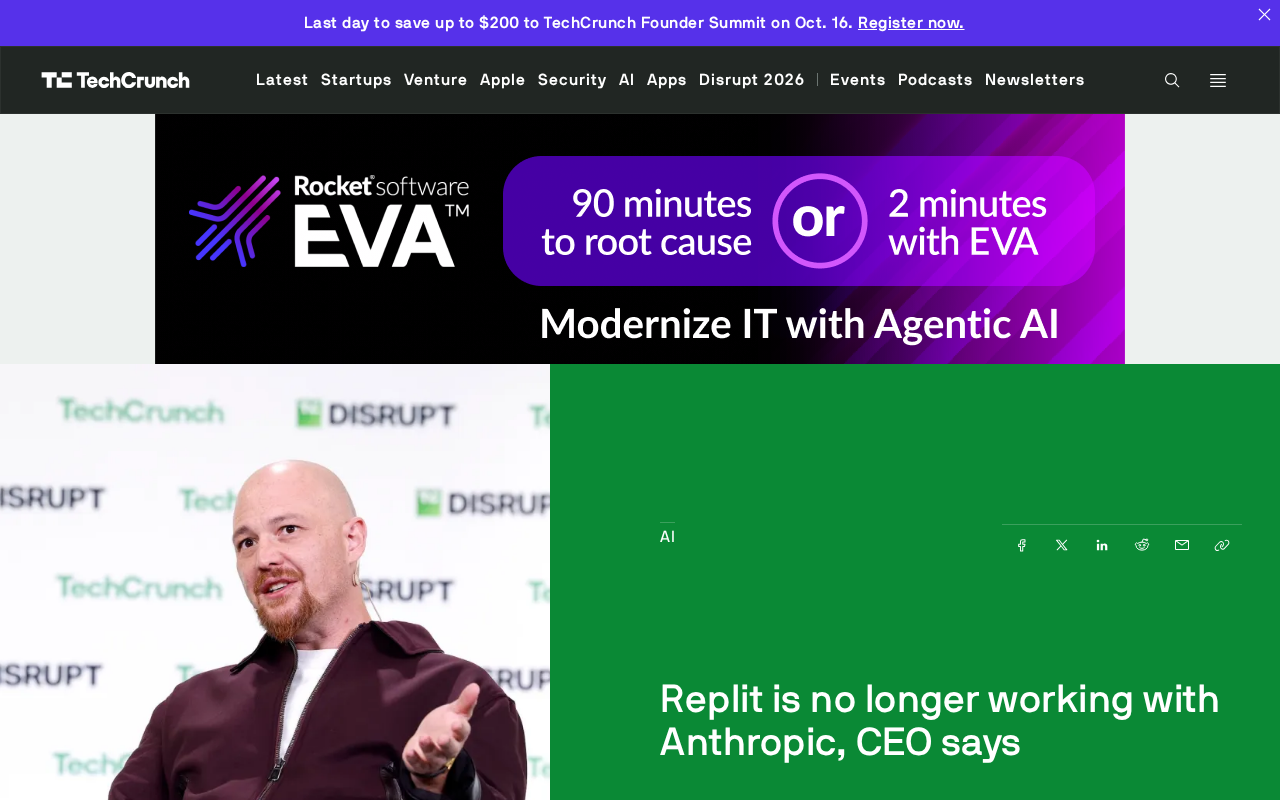
The partnership between AI coding platform Replit and AI safety company Anthropic has officially come to an end. Replit CEO Amjad Masad confirmed the news, putting an end to speculation about the state of the relationship between the two companies.
Partnership Ends: A Decision Driven by Multiple Factors
Masad stated that the decision was made for "several different reasons," with cost being a significant consideration. He did not disclose specific cost figures, but this statement suggests that within Replit's operating framework, the cost of calling Anthropic's models may have exceeded what the company could sustain.
Interestingly, Replit's prior partnership with Anthropic was never heavily publicized, and the outside world had limited understanding of the depth and specific form of their collaboration. As a result, this termination news is more of a "confirmation of separation" than an "announcement of a breakup."
From Anthropic to OpenAI: A Shift in Partnership Focus
Replit's relationship with OpenAI dates back further, and in August of this year, Replit officially announced its partnership with OpenAI. However, at the time, Replit did not explicitly state that it had terminated its collaboration with Anthropic, leading outsiders to believe that Replit might be maintaining partnerships with multiple AI model providers simultaneously.
Now Masad's confirmation makes the situation clear: Replit has completely shifted its partnership focus to OpenAI. For an AI coding platform, the choice of underlying model directly affects product experience, cost structure, and long-term competitiveness. This shift could have implications far beyond a simple vendor switch.
The Positioning Differences Between Anthropic and OpenAI Models
Anthropic was founded by former OpenAI research executives, and its Claude series models are known for long-context processing, instruction following, and safety alignment, with a strong reputation in code comprehension and large codebase analysis tasks. OpenAI's GPT series, meanwhile, has a more mature ecosystem, a richer third-party toolchain, and broader developer recognition. The two companies' APIs differ in pricing strategies, rate limits, context window sizes, and fine-tuning capabilities. For platforms like Replit, choosing a vendor involves not just per-unit pricing but also business terms such as caching mechanisms, batch processing discounts, and enterprise-level SLAs. Therefore, a shift in partnership focus is often not simply a comparison of capabilities, but the result of comprehensive cost, engineering fit, and business negotiations.
Cost Pressure: The Real Dilemma Facing AI Coding Platforms
Cost being listed as the primary reason is no coincidence. AI coding assistants and code generation tools require frequent calls to large language models, with token consumption far exceeding typical conversational scenarios. For a platform like Replit that serves millions of developers, model calling costs can constitute an enormous operational burden.
Choosing a more cost-effective model provider, or negotiating prices among multiple providers, has become an important strategic issue for companies at the AI application layer. Replit's choice reflects a broader industry trend: as the capability gap between models gradually narrows, cost-effectiveness is becoming a core consideration in platform selection.
Impact on Developers and the Ecosystem
For Replit's users, the switch in underlying models may bring changes in experience. Different models differ in code generation style, error handling approaches, supported programming languages and frameworks, and more. OpenAI's models perform well on certain coding tasks, but developers' actual experience will need time to validate.
From an ecosystem perspective, this partnership change also reminds developers: the model providers behind AI coding tools may change at any time, and long-term reliance on a single platform needs to be carefully evaluated.
Tokens and Pay-as-You-Go Pricing
Large language model APIs typically charge by token, where a token is the basic unit of text that the model processes, roughly equivalent to 0.75 English words or 1-2 Chinese characters. Billing is divided into input tokens (prompt) and output tokens (completion), with output typically priced higher. What makes AI coding scenarios special is that: code file contexts are often very long, a single completion may need to carry hundreds or even thousands of lines of code as context, and developers trigger calls at high frequency, resulting in per-user token consumption far exceeding ordinary chat scenarios. For a platform serving millions of developers, this means monthly token bills could reach hundreds of thousands or even millions of dollars. It is precisely this linear cost structure of pay-as-you-go pricing that makes model calling costs one of the most sensitive operational variables for AI coding platforms.
The Challenge of Multi-Model Strategies
Replit's experience reveals a structural challenge facing companies at the AI application layer: maintaining partnerships with multiple model providers simultaneously may not be economical. Each vendor has different APIs, pricing models, and technical characteristics, and integration costs cannot be ignored.
Among the "several different reasons" Masad mentioned, besides cost, there may also be factors such as technical integration complexity and disagreements over business terms. When a platform decides to focus on a single model provider, it often means making a trade-off between cost, performance, and engineering efficiency.
The long-term effect of this decision will depend on whether OpenAI's models can continue to meet the needs of Replit's users, and whether the partnership can achieve a commercial win-win for both sides.
Model Abstraction Layers and Multi-Vendor Integration Costs
To address the problem of multi-model integration, model abstraction layers (such as LangChain, LiteLLM, etc.) have emerged in the industry, using unified interfaces to shield differences in vendor APIs. But abstraction layers can only solve calling format issues; they cannot smooth over differences in model output style, context windows, function calling capabilities, and error code semantics. If a platform integrates multiple models simultaneously, it needs to separately perform prompt engineering, evaluation testing, fallback fault tolerance, and cost monitoring for each model path, with engineering complexity rising non-linearly. In addition, different vendors have varying rate limits and failure modes, and operations teams must establish independent monitoring and alerting for each pathway. When the capability gap between models gradually narrows but switching costs remain high, focusing on a single vendor actually becomes a rational choice for reducing total cost of ownership (TCO).
One-line Summary
Replit confirms ending its partnership with Anthropic, shifting fully to OpenAI, with cost as the main reason.
Paragraph Summary
Replit CEO Amjad Masad confirmed that the company has officially terminated its partnership with Anthropic, ending speculation about the state of their relationship. Masad stated that the decision was made for multiple reasons, with cost being an important consideration. Replit's partnership with Anthropic had never been heavily publicized, so this is more a confirmation of separation than an announcement of a breakup. Meanwhile, Replit's cooperation with OpenAI dates back further, and it officially announced the partnership in August of this year, without explicitly stating at the time that it had broken up with Anthropic. This shift reflects the real dilemma AI coding platforms face in model selection: enormous token consumption, significant cost pressure, and high multi-vendor integration costs, making focus on a single vendor a trade-off between cost, performance, and engineering efficiency.
Related articles

Chain of Thought Isn't Just for AI: How Humans Can Use CoT to Improve Thinking Quality
Chain of Thought isn't just a prompt trick for large models. Starting from a Hacker News discussion, this article analyzes why CoT works for human thinking too, breaks down actionable ways to transfer it, and highlights the key differences between human CoT and machine CoT.
Cloudflare Teams Up with OpenAI: Closi…
Cloudflare Teams Up with OpenAI: Closing the Loop from Vulnerability Discovery to Defense with AI
Cloudflare uses OpenAI Daybreak to investigate security vulnerabilities and generate reviewable remediation plans, while developers use Codex to boost coding efficiency and quality.

Orca Multi-Agent Orchestration in Practice: A Guide to Parallel Collaboration with Claude and Codex
Orca is Stable AI's free open-source agent workbench supporting 34 agents like Claude Code and Codex in parallel. Learn its Git worktree isolation, multi-model orchestration, and mobile management.