Replit Missions: Orchestrating an AI Agent Team Within Budget
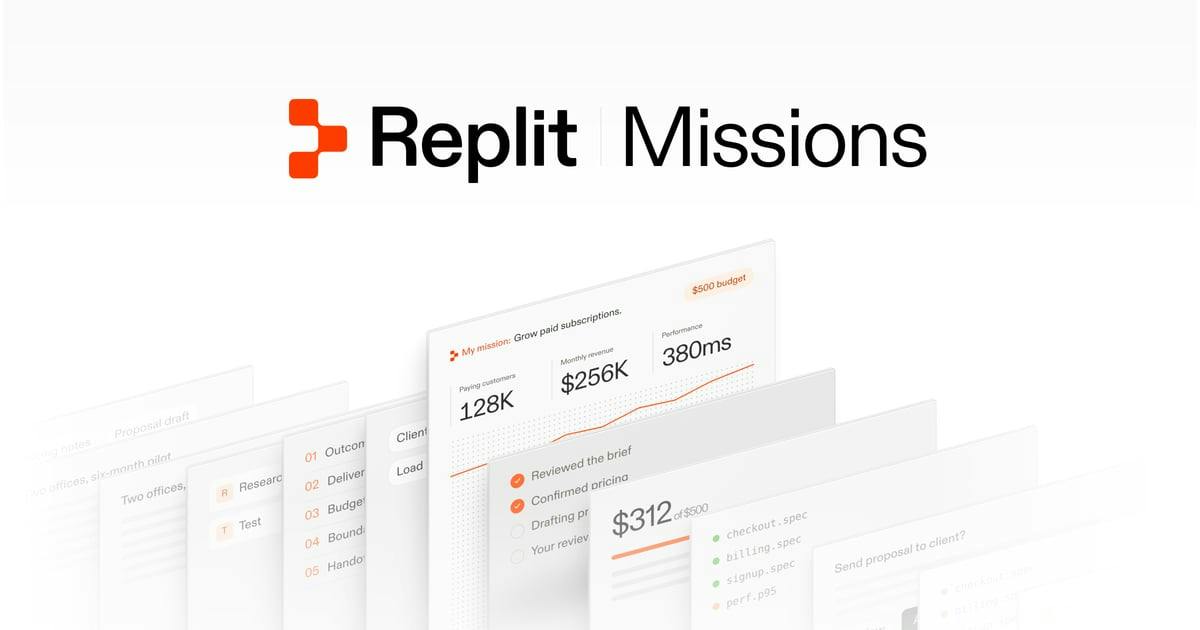
Replit Missions shifts programming interaction from conversation to task, constraining multi-agent team delivery with budget and success criteria.
Replit launched Missions on Product Hunt, packaging "set a budget, coordinate multiple AI agents, and accept results against success criteria" into a productized entry point, marking a shift in AI programming tools from enhancing single-turn dialogue to full task delivery. The key is the transfer of responsibility boundaries: task-based delivery has the tool judge completion against success criteria itself, moving acceptance forward into task definition. Budget is treated as a first-class constraint upfront to curb cost overruns from repeated multi-agent iteration. Suited to tasks with clear goals and boundaries; cannot replace requirements clarification. Still early (78 votes, 3 comments).
Replit has launched a new feature called Missions on Product Hunt, packaging the workflow of "set a budget, coordinate multiple AI agents, and accept results against success criteria" into a productized entry point. It's not aimed at having a single AI complete a few lines of code for you, but rather at handing an entire goal to a team of agents to accomplish, with humans constraining only the budget and acceptance criteria. This direction is worth unpacking.
From "conversational programming" to "task-based delivery"
Over the past two years, the main thread of AI programming tools has been enhancing single-turn interactions: completion, explanation, bug fixing. Replit Missions changes the unit of interaction from "a conversation" to "a task." Users set a budget and clear success criteria, the system dispatches a team of AI agents to work in parallel, and then reports progress against those criteria.
The key to this shift lies in the boundary of responsibility. With conversational tools, the person judging whether the code is correct is always the developer; with task-based delivery, the tool needs to answer for itself "how far along counts as done." Replit chooses to anchor this with "success criteria," which effectively moves the acceptance step forward into the task definition phase.
Multi-Agent System is a classic concept in distributed artificial intelligence, referring to multiple agents with a degree of autonomous decision-making capability collaborating to complete tasks that a single agent struggles to handle independently. Unlike traditional monolithic models, multi-agent systems emphasize task decomposition, role division, and result aggregation. After the widespread adoption of large language models, an Agent typically refers to a model instance capable of autonomously planning steps, invoking tools, and executing actions under a given goal. The benefit of multi-agent collaboration lies in parallel progress and specialized division of labor, but the cost is that coordination overhead and behavioral unpredictability rise with the number of agents. Therefore, in engineering practice, how to define task boundaries, set stopping conditions, and aggregate multi-party outputs becomes the key to system usability—and this is the core engineering problem that products like Replit Missions aim to solve.
Budget as a first-class constraint
Missions puts budget at the very front of its feature description—this is not a casual mention. The typical risk of multi-agent collaboration is that agents trigger each other and iterate repeatedly, making costs easy to spiral out of control. Treating budget as a hard constraint is like drawing a stop line for the agent team—when the money runs out, it stops, rather than infinitely approaching the goal.
For team users, this addresses the psychological barrier of "dare I hand off a big task." A multi-agent system without a budget cap feels more like an experiment; one with a budget cap is closer to a manageable production tool.
First-class Constraint borrows from the notion of "first-class citizens" in programming languages, meaning that an element is not an auxiliary configuration but a core object natively supported by the system design and permeating the whole. In AI agent systems, treating budget as a first-class constraint means the budget is not just an after-the-fact bill, but a runtime variable that participates in task scheduling, determines when agents stop, and influences subtask priorities. By contrast, most experimental multi-agent frameworks only provide token usage statistics and lack hard cutoff mechanisms. The root cause of runaway costs lies in the default tendency to "try again" in the agent loop: each iteration seems small, but cumulatively they can grow exponentially. A hard budget is equivalent to setting a termination condition for the entire agent team, giving its behavior a predictable cost ceiling.
What multi-agent coordination actually means
The phrase "coordinating a team" is easily interpreted as agents having free-form conversations with each other. From the product positioning, a more pragmatic interpretation is: the task is split into parallelizable sub-goals, advanced separately by different agents, and then aggregated by the system against the success criteria. This structure is friendlier to tasks where "the goal is big enough and the boundaries are clear enough," and may not be suitable for tasks whose requirements are still shifting.
This is also the shared applicable boundary of such tools—they can accelerate execution, but cannot replace requirements clarification.
Task Decomposition is the prerequisite step of multi-agent coordination: breaking a large goal into several independently executable sub-goals whose results can be merged. The quality of decomposition directly determines collaboration efficiency—the fewer dependencies between subtasks and the clearer the interfaces, the higher the parallel benefit; if subtasks are coupled with each other, agents need to synchronize frequently, and coordination costs offset the parallel benefit. This is also why tasks with "clear goals and clear boundaries" are better suited to multi-agent approaches: clear acceptance criteria inherently imply a decomposable structure. Conversely, when requirements are vague, the decomposed subtasks often contradict each other, making it hard to align with success criteria at the aggregation stage—in which case multi-agent systems not only fail to accelerate but may amplify directional deviation.
Who should try it now
From its category and positioning, Missions targets developer tool scenarios and suits tasks where you already know clearly "what it looks like when done": migrations, batch refactoring, building prototype skeletons, and the like. The voting data—only 3 comments and 78 votes—indicates it is still in an early exposure stage, and the actual multi-agent scheduling effectiveness and granularity of budget control will require more real-world testing before judgment can be made.
What's worth watching is not how mature it is now, but that Replit has combined the three elements of "budget + success criteria + agent team" into a product form. If this combination works, the competitive dimension of AI programming tools will shift from "how accurate is the completion" to "can tasks be kept under control."
One-line Summary
Replit Missions shifts the unit of programming interaction from conversation to task, constraining multi-agent team delivery with budget and success criteria.
Paragraph Summary
Replit launched the Missions feature on Product Hunt, packaging "set a budget, coordinate multiple AI agents, and accept results against success criteria" into a productized entry point, marking a shift in AI programming tools from enhancing single-turn dialogue to full task delivery. The key lies in the transfer of responsibility boundaries: with conversational tools, developers judge whether code is correct; with task-based delivery, the tool itself judges completion against success criteria—effectively moving acceptance forward into the task definition phase. Budget is placed upfront as a first-class constraint to curb cost overruns caused by repeated multi-agent iteration and to lower the psychological barrier for teams handing off big tasks. The article also notes its applicable boundaries—better suited to large tasks with clear goals and clear boundaries, and unable to replace requirements clarification. The product is still early (78 votes, 3 comments), and actual effectiveness awaits real-world testing.
Related articles

Why Learn Python in the AI Era? A Deep Dive with the Author of 'Python Crash Course'
Eric Matthes, author of 'Python Crash Course', discusses why Python remains essential in the AI era, the democratization and risks of AI coding tools, and the value of human creators.

Convex Skill Allegedly Uploads User App Ideas to Remote Servers Without Consent
Convex backend skill allegedly sends user app ideas to remote servers without disclosure, sparking Hacker News debate. We analyze the privacy risks and transparency issues.

The Coding Data Market Booms: How Frontier Labs Buy Training Data
The coding data market is rapidly expanding, with frontier labs as major buyers. This article analyzes the types of data traded, labs' procurement logic, and concerns such as licensing compliance and data contamination.