Replit Partners with Sumitomo Mitsui Finance and Leasing: AI Development Platform Lands in Japanese Enterprises

Replit partners with SMFL to let business users build enterprise apps in natural language with AI, targeting tenfold digital revenue growth.
Replit has partnered with Japan's Sumitomo Mitsui Finance and Leasing (SMFL) to integrate SMFL's AssetForce asset management cloud with Replit's AI development platform, enabling enterprise users to build customized applications via natural language without coding. SMFL estimates work previously requiring six people and six months can be done by one person in one week. AssetForce has over 200 paying enterprise customers, and SMFL aims to grow digital service revenue tenfold to 10 billion yen by 2031. For Replit, this is a substantive landing of its enterprise strategy in Japan. The partnership signals a shift from standardized software procurement to on-demand building, though efficiency and revenue targets still need verification.
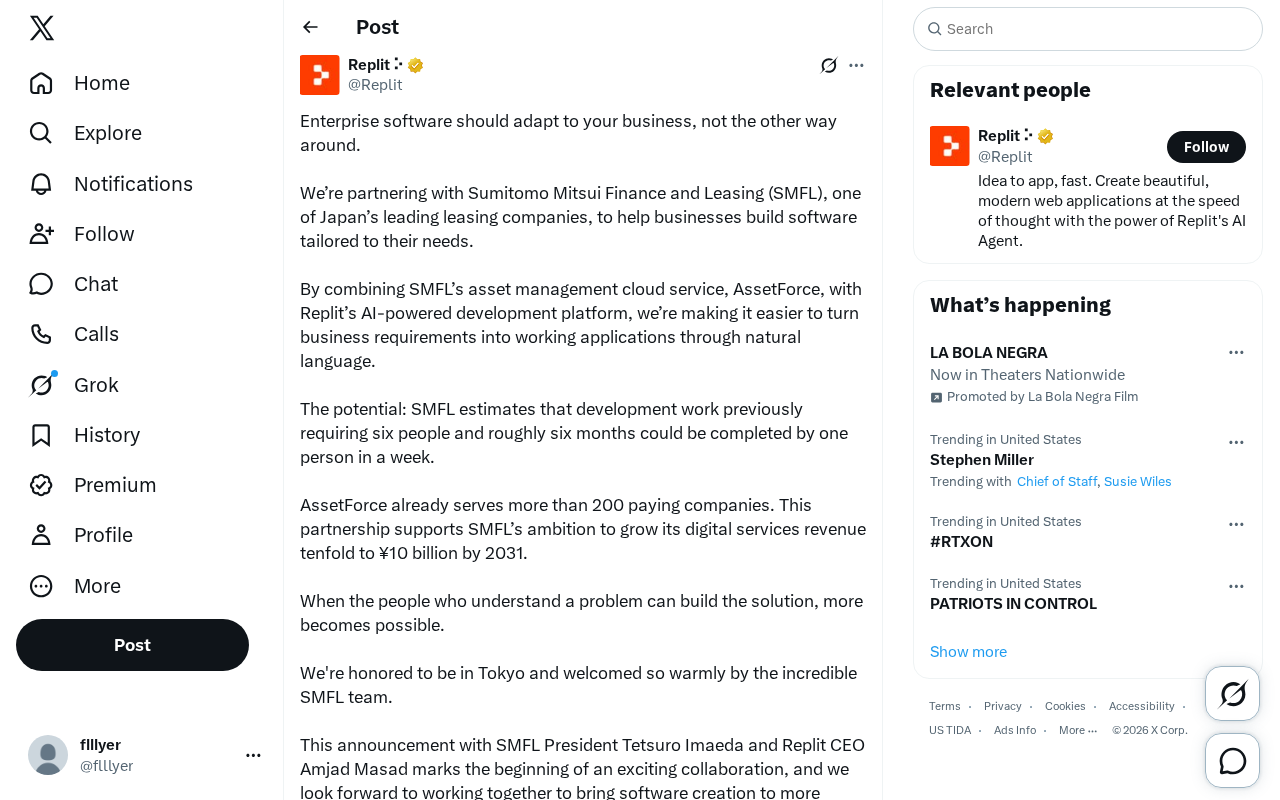
Enterprise software should adapt to your business, not force your business to adapt to software. This is the core logic behind Replit's partnership with Sumitomo Mitsui Finance and Leasing (SMFL), a leading Japanese leasing company. The two parties are combining SMFL's asset management cloud service AssetForce with Replit's AI-driven development platform, enabling business requirements to be transformed directly into runnable applications through natural language.
Partnership Details: How AssetForce and Replit Work Together
AssetForce is an asset management cloud service under SMFL, currently serving more than 200 paying enterprise customers. By integrating this platform with Replit's AI development capabilities, enterprise users can build customized software quickly by simply describing their requirements in natural language—no coding required.
SMFL President Tetsuro Imaeda and Replit CEO Amjad Masad jointly announced the partnership in Tokyo. Both parties stated that this marks the starting point for bringing software development capabilities to more Japanese enterprise users.
Natural Language Programming refers to a development approach in which developers or business users describe requirements in everyday language, and an AI system converts them into executable code or application configurations. Unlike traditional coding, it relies on large language models' ability to understand intent, generate code, and reason over context. Replit's AI development platform falls into this category: a user inputs "help me build a spreadsheet app that tracks maintenance records for leased equipment," and the platform automatically generates the front-end interface, data model, and business logic. This approach reduces dependence on programming syntax, but output quality still depends on the clarity of requirement descriptions, the platform's coverage of domain knowledge, and subsequent human verification. For enterprises, it shifts the development barrier from "knowing how to write code" to "knowing how to describe the business," enabling the people who understand processes best to participate directly in building.
Efficiency Leap: From Six People in Six Months to One Person in One Week
SMFL's estimate of the partnership's impact is noteworthy: development work that previously required six people and about six months could now be completed by one person in a week. Behind this order-of-magnitude efficiency gain is AI-assisted development's restructuring of traditional software engineering workflows.
Of course, this estimate is based on SMFL's assessment of its own business scenarios, and actual results will depend on the complexity of specific projects and how teams use the tools. But the direction is clear: when the people who understand business problems best can directly build solutions, software delivery cycles and barriers will drop significantly.
AI-assisted development's restructuring of software engineering workflows centers on compressing the serial stages of requirements analysis, coding, testing, and deployment in traditional development. In the traditional model, a six-person team must divide work across architecture design, front-end and back-end development, database modeling, and testing, with communication and rework consuming substantial time. AI development platforms partially automate these stages: requirement descriptions directly generate prototypes, code is completed by models, test cases can be generated automatically, and deployment processes are hosted by the platform. The one-person-one-week estimate essentially converts "team collaboration overhead" into "an individual's iterative loop with AI." However, this efficiency gain is sensitive to project complexity—standardized CRUD applications benefit most, while scenarios involving complex integrations, security compliance, or high-concurrency requirements still require professional engineers. Enterprises should view it as an accelerator rather than a complete replacement.
Strategic Intent: SMFL's Digital Revenue Ambitions
SMFL has set a clear business goal for this partnership: to grow digital service revenue tenfold to 10 billion yen by 2031. AssetForce's existing 200-plus paying customers form the base, while Replit's involvement provides the tools to rapidly expand service capabilities.
For Replit, this is a substantive landing of its enterprise market strategy in Japan. By partnering with a leading local enterprise, Replit gains entry into the Japanese enterprise software market and can validate its AI development platform's applicability in complex enterprise environments.
AssetForce is an asset management cloud service under SMFL, primarily serving enterprise customers in the leasing industry with functions such as equipment ledger management, contract tracking, maintenance records, and asset lifecycle management. More than 200 paying enterprise customers means it has already achieved a certain degree of product-market fit and revenue base. Integrating AssetForce with Replit is equivalent to layering an "on-demand customization" capability on top of an existing SaaS product: customers can quickly build extension applications that match their own business rules using natural language, based on AssetForce's data and processes, without waiting for the vendor's development schedule. This "standard SaaS + AI customization layer" model preserves the scale effects of cloud services while addressing the shortcoming that standardized products struggle to cover long-tail needs—a common path for SaaS vendors to increase average revenue per customer and customer stickiness.
Industry Signal: A Shift in the Enterprise Software Development Paradigm
This partnership sends a clear signal: enterprise software is migrating from "purchasing standardized products" to "building on demand." In the traditional model, enterprises either adapt to the functional limitations of general-purpose software or invest heavily in custom development. AI-driven development platforms are compressing the time and labor costs of customization, making "software adapting to business" an operational reality rather than just a concept.
Whether the Replit-SMFL partnership can deliver on its efficiency promises and whether SMFL can achieve its digital revenue targets will require time to verify. But both parties have already taken a step from concept to implementation.
One-line Summary
Replit partners with SMFL to let business users build enterprise applications in natural language with AI, targeting a tenfold increase in digital revenue.
Paragraph Summary
Replit has partnered with Sumitomo Mitsui Finance and Leasing (SMFL) of Japan to combine SMFL's asset management cloud service AssetForce with Replit's AI development platform, enabling enterprise users to build customized applications directly through natural language without writing code. SMFL estimates that development work previously requiring six people and six months can be completed by one person in one week. AssetForce already has more than 200 paying enterprise customers, and SMFL plans to grow digital service revenue tenfold to 10 billion yen by 2031. For Replit, this is a substantive landing of its enterprise market strategy in Japan. The partnership signals a shift in enterprise software from standardized procurement to on-demand building, though the efficiency promises and revenue targets still require time to verify.
Related articles
 Tech Frontiers
Coldframe: A Honeypot Disguised as a Supermarket Freezer Controller
Coldframe is a honeypot disguised as Danfoss AK-SM 800A and Dixell XWEB freezer controllers, built as a single Python file that detects CVE-2025-41450 attempts and is identified as real devices on Shodan.
 Tech Frontiers
GRFNet: A Lightweight PyTorch Model Designed for Multichannel Time-Series Classification
GRFNet is a lightweight PyTorch model for multichannel time-series classification, originating from EEG decoding research. With only 3,847 parameters, it is based on the ROCKET architecture, combining random convolution kernels with learnable spatial filters, supports arbitrary input lengths, and will soon be evaluated on the PhysioNet dataset.
 Tech Frontiers
CUDA-Accelerated Rocket League Simulator: A Player-Made Hardcore Experiment
A Reddit post shows a "100% Accurate" Rocket League simulator accelerated with CUDA. We analyze its technical context, CUDA's value in game physics simulation, and the significance and limitations of such community projects.