Replit's Three Major Updates: Windows Desktop App Debuts with Microsoft and NVIDIA

Replit launches Windows desktop app with Microsoft & NVIDIA, cross-project AI chat, and TikTok Ads MCP in one week.
Replit rolled out three major product updates this week. First, Replit Desktop for Windows entered private preview in partnership with Microsoft and NVIDIA, enabling local app development inside isolated sandboxes for lower latency and better security. Second, a new cross-project chat feature lets the AI assistant find, read, and act on code across all projects from a single interface. Third, a TikTok Ads MCP integration lets developers create and manage ad campaigns without leaving the platform. Together, these updates signal Replit's strategic push from a coding tool toward a full-cycle development and commercialization platform.
Replit's Three Major Updates at a Glance
AI coding platform Replit has announced three significant updates in its latest product roundup, spanning desktop expansion, cross-project collaboration, and marketing automation. These updates reinforce Replit's positioning as an all-in-one AI development platform that takes you from code to deployment — and hint at its broader ambitions in enterprise ecosystems and commercial use cases.
From cloud to local, from single projects to cross-project collaboration, from development to ad campaigns — behind these three updates lies Replit's push to close the loop on its AI development toolchain.

Replit Desktop Comes to Windows, in Partnership with Microsoft and NVIDIA
The most talked-about update is Replit Desktop for Windows entering private preview — launched in partnership with Microsoft and NVIDIA.
According to the official announcement, Replit Desktop lets users build and run applications directly on their PC, with each app executing inside its own isolated sandbox environment. This means developers are no longer entirely dependent on cloud resources, and can instead enjoy a lower-latency, higher-control development experience on local machines.
The Microsoft and NVIDIA partnership is worth noting. Microsoft's influence over the Windows ecosystem and developer toolchain speaks for itself, while NVIDIA's involvement suggests that local execution may leverage GPU compute in a meaningful way — a key advantage for developers who need local inference or run AI-intensive applications. Currently, the feature is only available via waitlist for early access and has not been widely released.
The sandboxed isolation design also addresses the biggest concern with local execution: security. Each app runs in its own isolated environment, preventing interference between applications and reducing potential system-level risks.
Technical Deep Dive: Sandbox Isolation
Sandbox isolation is one of the core mechanisms in modern development environments and security architectures. The basic principle is to create a restricted, independent execution space for each application or process — complete with its own filesystem view, network stack, and resource quota — with no arbitrary access to the host system or other sandboxes. In cloud-based development platforms, sandboxes are typically built on container (e.g., Docker) or virtual machine technology. On local desktops, however, the main technical challenge lies in efficiently creating and managing sandboxes on ordinary consumer PCs while fully utilizing local GPU compute. NVIDIA's involvement hints that Replit Desktop may have adopted a solution deeply integrated with CUDA or a local inference runtime, allowing AI model inference inside sandboxes to directly schedule GPU resources rather than being constrained by cloud-allocated compute quotas. For developers running larger models locally or handling real-time inference tasks, this can deliver a significant latency advantage.
A Single Chat Interface to Manage All Projects
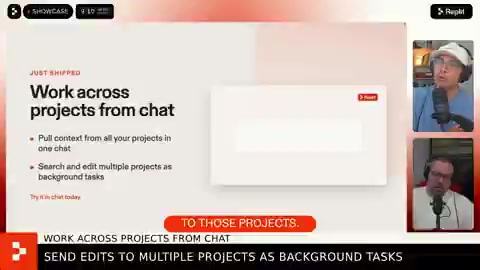
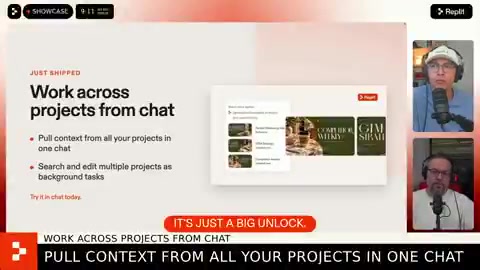
The second update focuses on cross-project collaboration. Previously, Replit's AI assistant operated primarily within a single project's scope. The new feature allows users to work across all their projects from a single chat window.
Specifically, users can ask Replit to locate a project, read its file contents, and assign it tasks. More practically, developers can "port" a feature from one application to another without switching back and forth between projects.
This change may seem like a minor UX improvement, but it actually addresses one of the core pain points of AI coding assistants: context fragmentation. When an AI can understand and operate across project boundaries, the efficiency of reusing existing functionality and maintaining multiple related applications improves significantly. For developers managing multiple microservices or multi-platform applications simultaneously, this is a genuinely useful productivity boost.
TikTok Ads MCP: Extending AI Development into Marketing
The third update reaches into the marketing space. With the new TikTok Ads MCP (Model Context Protocol) integration, users can create, launch, and track TikTok ad campaigns directly within Replit.
Replit can generate ad content and copy, and help optimize campaigns. The significance here is that it bridges the gap between "building a product" and "promoting a product" — indie developers or small teams can take an app they've built and run ad campaigns on the same platform, without jumping to external tools.
The adoption of the MCP protocol also reflects a broader industry trend. As a standardized interface connecting AI models with external tools and data sources, MCP is becoming a key piece of infrastructure for the AI application ecosystem. Replit's integration of a third-party marketing platform via TikTok Ads MCP demonstrates the protocol's real-world commercial viability.
Technical Deep Dive: Model Context Protocol (MCP)
MCP (Model Context Protocol) is a standardized, open-source protocol proposed by Anthropic in late 2024, designed to address the fragmented connectivity between large AI models and external tools and data sources. Before MCP, every AI application that needed to connect to an external service — such as a database, API, or file system — required developers to write custom integration code from scratch, leading to high maintenance costs and poor reusability. MCP defines a unified "host–client–server" communication specification, allowing AI models to call any compliant external tool through the same interface. TikTok Ads MCP essentially wraps the TikTok advertising platform as a standard MCP server; Replit's AI assistant acts as the client and can directly invoke ad creation, delivery, and analytics capabilities without any additional development. This architecture means that Replit could theoretically onboard any other MCP-compatible third-party platform in the same way going forward — a far more scalable approach than building one-off custom integrations.
The Ambition to Build an Ecosystem, Not Just a Tool
Taken together, these three updates reveal that Replit is evolving from "a place to write code" into a comprehensive platform covering development, collaboration, and commercialization. The local desktop app expands the boundaries of the execution environment, cross-project chat makes the AI assistant more practically useful, and TikTok Ads integration fills in the back half of the product lifecycle.
For those tracking the evolution of AI coding tools, these moves reflect a clear direction: AI development platforms are no longer content with assisting in coding — they're aiming to become the full-stack infrastructure for founders taking an idea all the way to growth. That said, the Windows desktop app remains in private preview, the technical specifics of the Microsoft and NVIDIA partnership have yet to be fully disclosed, and the actual experience will need to be validated once the features officially launch.
Related articles

Chain of Thought Isn't Just for AI: How Humans Can Use CoT to Improve Thinking Quality
Chain of Thought isn't just a prompt trick for large models. Starting from a Hacker News discussion, this article analyzes why CoT works for human thinking too, breaks down actionable ways to transfer it, and highlights the key differences between human CoT and machine CoT.
Cloudflare Teams Up with OpenAI: Closi…
Cloudflare Teams Up with OpenAI: Closing the Loop from Vulnerability Discovery to Defense with AI
Cloudflare uses OpenAI Daybreak to investigate security vulnerabilities and generate reviewable remediation plans, while developers use Codex to boost coding efficiency and quality.

Orca Multi-Agent Orchestration in Practice: A Guide to Parallel Collaboration with Claude and Codex
Orca is Stable AI's free open-source agent workbench supporting 34 agents like Claude Code and Codex in parallel. Learn its Git worktree isolation, multi-model orchestration, and mobile management.