RepoEviAgent: Mining High-Quality Code Q&A Data from 2.47M PRs
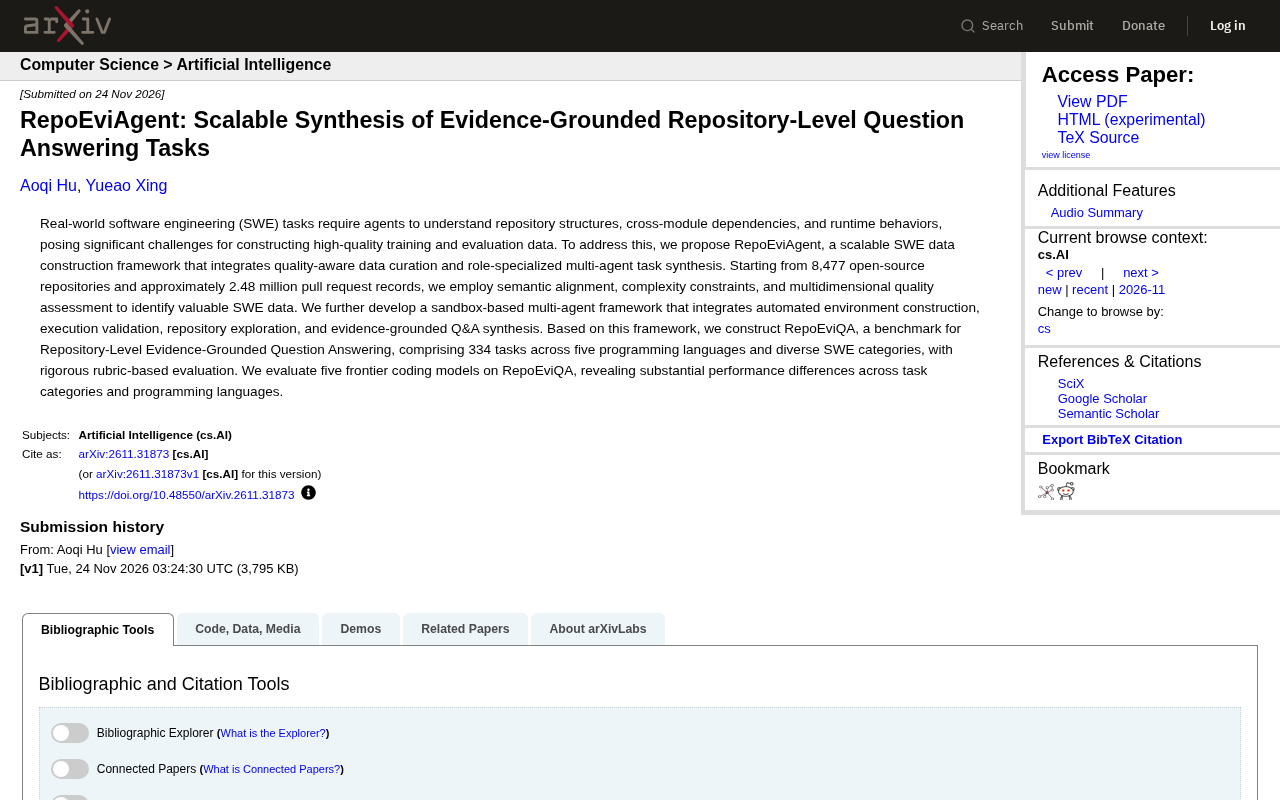
RepoEviAgent combines quality filtering with sandboxed multi-agent synthesis to build a traceable repository-level Q&A benchmark.
The article introduces RepoEviAgent, a scalable data construction framework for repository-level Q&A. Starting from 8,477 open-source repos and ~2.48M PRs, it filters high-value data via semantic alignment, complexity constraints, and multi-dimensional quality assessment, then uses a sandboxed multi-agent framework with role separation for environment construction, execution verification, repository exploration, and evidence-backed Q&A synthesis. The resulting RepoEviQA benchmark has 334 tasks across five languages, evaluated with strict rubrics.
Why Is Repository-Level Q&A Data So Hard to Build?
Real software engineering tasks require agents to understand repository structure, cross-module dependencies, and runtime behavior, which places high demands on the quality of training and evaluation data. Existing datasets either have limited scale or lack rigorous evidence traceability, making it difficult to support reliable evaluation of frontier coding models.
To address this pain point, researchers propose RepoEviAgent—a scalable software engineering data construction framework that combines quality-aware data curation with role-differentiated multi-agent task synthesis. Its core idea: first filter valuable data from massive open-source repositories and PR records, then generate evidence-backed repository-level Q&A tasks through multi-agent verification and synthesis in a sandboxed environment.
Data Pipeline: From 8,477 Repositories to High-Quality Samples
RepoEviAgent starts with 8,477 open-source repositories and approximately 2.48 million pull request records. This scale itself is not unusual—the key lies in the filtering mechanism.
The framework employs three constraints to identify valuable software engineering data:
- Semantic alignment: Ensures PR descriptions are genuinely semantically related to code changes, filtering out clickbait-style commits;
- Complexity constraints: Removes samples that are too trivial or too sprawling, retaining tasks that are challenging but verifiable for agents;
- Multi-dimensional quality assessment: Scores candidate data from multiple angles, and only data passing thresholds proceeds to the synthesis stage.
The significance of this pipeline is that it transforms "data quantity" into "data quality." For tasks like repository-level Q&A that require precise evidence localization, noise from low-quality samples is far more fatal than insufficient quantity.
Pull Request (PR) is a core mechanism for collaborative development in distributed version control systems (such as GitHub): a developer forks their own copy from the main repository, completes code modifications on an independent branch, then initiates a merge request to the original repository, accompanied by change descriptions, discussion records, and code diffs. Therefore, a PR record simultaneously contains three types of information—natural language descriptions, code changes, and review conversations—making it a natural "code–intent–result" alignment sample.
PR records are particularly important for repository-level Q&A data construction: they naturally carry a complete evidence chain of "why the change was made, what was changed, and how reviewers challenged it." But precisely because the source is open, PR quality varies widely—there are issues such as descriptions not matching changes, post-merge rollbacks, and trivial formatting commits, which is exactly why RepoEviAgent needs to perform semantic alignment and complexity filtering first.
Multi-Agent Synthesis: Evidence Loops in the Sandbox
Filtered data enters a sandbox-based multi-agent framework. This framework integrates four components: automated environment construction, execution verification, repository exploration, and evidence-backed Q&A synthesis.
Role differentiation is the design highlight here. Different agents are responsible for building runnable sandbox environments, retrieving relevant code and dependencies within repositories, verifying execution results, and ultimately generating Q&A pairs with evidence citations. This division ensures each stage has clear verification standards, avoiding the common problem of "plausible but evidence-lacking" outputs when a single model generates everything at once.
The execution verification stage is particularly critical: answers in Q&A pairs must actually run successfully in the sandbox, and evidence must point to specific locations in the repository. This gives synthesized data traceability, rather than explanations fabricated by the model out of thin air.
A sandbox is an isolated execution environment that provides controlled runtime resources (file system, dependencies, network with restricted permissions) for code, allowing programs to be installed, run, and observed without affecting the host system. In data synthesis scenarios, the role of the sandbox is to transform "model-claimed answers" into "verifiable behavior": whether tests actually pass, whether errors are reproduced, and whether dependencies can be resolved can all be objectively determined in the sandbox.
The sandbox is also the technical foundation of the evidence loop. Only in a reproducibly runnable environment can the answers and evidence citations in Q&A pairs be automatically verified, thereby turning model hallucinations from "hard to detect" into "interceptable by the pipeline." The cost is that environment construction itself is expensive, which is why the framework assigns automated environment setup to a dedicated agent role.
RepoEviQA Benchmark: 334 Tasks, 5 Languages
Based on the above framework, researchers constructed RepoEviQA—a repository-level evidence-backed Q&A benchmark containing 334 tasks, covering five programming languages and diverse software engineering categories. Evaluation uses a strict rubric-based approach rather than simple string matching.
Researchers evaluated five frontier coding models on RepoEviQA, and results show significant performance differences across task categories and programming languages. This finding indicates that repository-level understanding cannot be summarized by a single aggregate score—a model's weaknesses in certain languages or task types may be masked in aggregated metrics.
Rubric-based evaluation is a structured scoring method: first define several scoring dimensions and tiered criteria for a task (e.g., whether the correct file is located, whether evidence citations are sufficient, whether explanations are correct), then have evaluators (human or model judges) score each item according to the rubric, rather than directly comparing strings or running unit tests.
In repository-level Q&A, answers are often open-ended natural language explanations with no unique correct answer, and simple exact matching would severely underestimate model capabilities; rubric scoring can account for answer correctness, evidence traceability, and explanation completeness. The cost is higher evaluation expense and the need to control for evaluator bias. This also explains why the benchmark is kept at the scale of hundreds of tasks: quality and verifiability take priority over quantity.
What This Means for the Industry
The value of RepoEviAgent goes beyond a single benchmark. It provides a reusable data synthesis methodology: how to extract high-quality training and evaluation data at scale from public PR records, how to use sandbox execution to guarantee evidence authenticity, and how to use a role-differentiated multi-agent architecture to reduce hallucination rates in synthesized data.
For teams building coding agents, this kind of evidence-loop synthesis framework is worth attention. The difficulty of repository-level tasks has never been "getting the model to write code," but rather "getting the model to understand why the code is written this way and what changes will affect." RepoEviAgent decomposes this problem into an engineerable data pipeline—exactly the kind of progress most needed at the current stage.
One-line Summary
RepoEviAgent uses quality filtering and sandboxed multi-agent synthesis to build a traceable repository-level Q&A benchmark.
Paragraph Summary
This article introduces RepoEviAgent, a scalable data construction framework for repository-level Q&A. Starting from 8,477 open-source repositories and approximately 2.48 million PR records, it filters high-value software engineering data through three mechanisms—semantic alignment, complexity constraints, and multi-dimensional quality assessment—then feeds it into a sandbox-based multi-agent framework where different roles handle environment construction, execution verification, repository exploration, and evidence-backed Q&A synthesis, ensuring answers run successfully in the sandbox and evidence points to specific repository locations. The RepoEviQA benchmark built on this pipeline contains 334 tasks covering five programming languages, evaluated with strict rubrics. Results from five frontier coding models show significant performance differences across task categories and languages, indicating that repository-level understanding cannot be measured by a single aggregate score.
Related articles

MIT PhD Takes You from Scratch to Build DeepSeek: A 25-Hour Hardcore Course
MIT PhD Raj Dandekar launches a 25+ hour Bilibili course building DeepSeek from scratch—MoE, MLA, GRPO, hand-written code plus math derivations, aiming to reproduce mini R1.

DeepSeek Harness in Practice: From Installation to Plugin Ecosystem, Building a Fully Automated AI Workflow
Based on a hardcore Bilibili tutorial, this guide systematically covers DeepSeek Harness installation, three plugin installation methods, and real-world use cases to help developers quickly build customizable AI Agent workflows.
DeepSeek Harness in Practice: From Installation to Automated Workflows
Hands-on DeepSeek Harness tutorial covering Mac/Windows installation, login, workspace binding, model & permission setup, and minimal closed-loop verification for AI automation workflows.