Report Alleges China's Four Major AI Labs Trained New Models on Banned Blackwell Chips

A forensics firm claims China's four major AI labs trained their latest models on banned NVIDIA Blackwell chips.
A Reddit post citing Checkpoint Forensics claims China's top four AI labs trained their latest models on NVIDIA Blackwell chips banned from export to China. The conclusion is based on model fingerprint forensics rather than procurement records, comes from a single source, and lacks independent reproduction. The community is divided on the method's reliability, NVIDIA and the labs have not responded, and many questions remain.
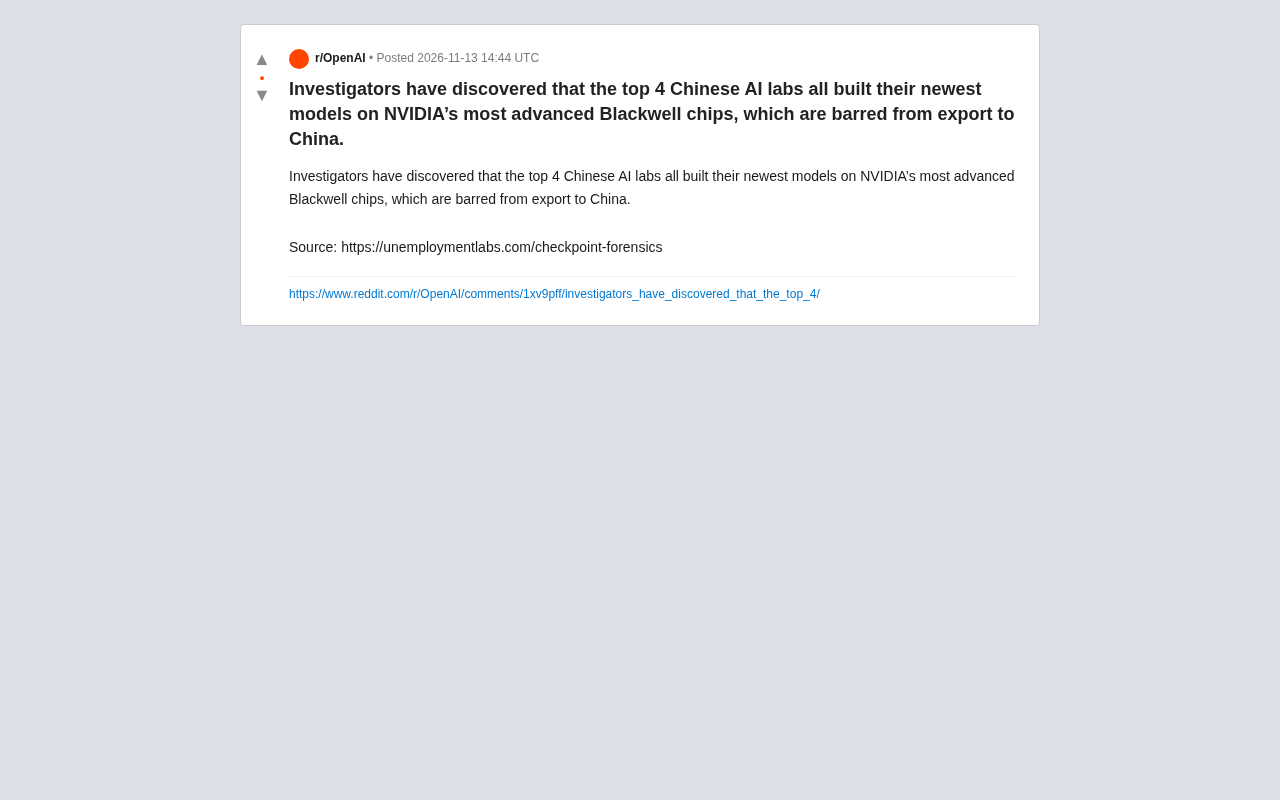
A post from Reddit, citing a report by investigative firm Checkpoint Forensics, claims that China's top four AI labs all used NVIDIA's most advanced Blackwell chips—currently banned from export to China—to train their latest models. The news immediately sparked widespread discussion in technical communities, as it touches the most sensitive nerve in the geopolitics of AI compute today.
The Core: Four Labs, One Chip
According to Checkpoint Forensics, a unit under Unemployment Labs, the latest product lines of four leading Chinese AI research institutions all point to NVIDIA's Blackwell architecture at the underlying compute level. Blackwell is NVIDIA's most advanced GPU product line, and U.S. export controls explicitly exclude it from licenses for sale to China.
The key words here are "all" and "latest." If the investigation holds, it means this is not an isolated case by individual teams, but a collective choice of the same restricted hardware by the top tier in the new-generation model race. For anyone following the AI compute supply chain, this is far more intriguing than any single model's benchmark scores.
Blackwell architecture is NVIDIA's GPU product line released in 2024, succeeding the Hopper architecture (H100/H200). Its flagship product B200 uses a dual-die packaging design with 208 billion transistors, and its inference performance at FP4 precision can reach several times that of Hopper. The U.S. Department of Commerce's Bureau of Industry and Security (BIS), in its October 2023 and subsequent rounds of revisions, set export red lines to China based on Total Processing Performance (TPP) and performance density. The Blackwell series, with performance metrics far exceeding the thresholds, was explicitly placed on the prohibited list. This is why any claim about Chinese labs obtaining these chips directly challenges the effectiveness of export control policy.
Investigation Method: How Chip Fingerprints Are Identified
Checkpoint Forensics' entry point is not hardware procurement records, but the "fingerprints" of the models themselves. Its report page shows that investigators inferred the hardware architecture underlying training by conducting forensic analysis of model outputs. The logic of this technical path is that different GPU architectures have subtle differences in floating-point operation behavior, numerical precision handling, and other low-level characteristics, and these differences remain in model weights and inference performance as statistical features.
This methodology also explains why the news comes from a forensics firm rather than traditional media—it relies on technical inference rather than supply chain documents. That said, the conclusion currently comes from a single source, with no public response yet from NVIDIA or the labs involved, and no independent third-party reproduction.
Model fingerprinting is a class of techniques that infers the training or runtime environment of a model by analyzing its behavioral characteristics. The basic principle is that different GPU architectures differ in floating-point rounding modes, non-deterministic reduction orders, and implementation details of specific mathematical functions. These differences propagate into model weights and output distributions as extremely subtle numerical deviations. Researchers can infer hardware generations by constructing specific inputs, statistically analyzing anomalous patterns in outputs, or analyzing quantization features of weight matrices. However, such methods typically have a low signal-to-noise ratio and are easily confounded by training frameworks, mixed-precision strategies, and random seeds. Therefore, fingerprint conclusions from a single source usually require independent reproduction before being accepted in academia.
Why This Matters
The policy context of the Blackwell ban means that any claim about Chinese labs using these chips carries implications beyond technology. On one hand, it suggests restricted hardware may be flowing in through informal channels; on the other, it reflects the intensity of Chinese AI teams' demand for the most advanced compute—even under controls, they still tend to use the most cutting-edge hardware for flagship models.
From an engineering perspective, the top labs' collective bet on the same architecture shows that in ultra-large-scale training scenarios, the maturity of the hardware ecosystem and the compatibility of the software stack remain decisive factors. Compute alternatives are advancing rapidly on the inference side, but for the most frontier training tasks, options remain limited.
Community Reaction and Open Questions
Voices in the Reddit discussion roughly split into two camps. One camp holds that the reliability of forensic inference is questionable—whether model fingerprints are sufficient to uniquely point to a specific hardware generation requires more rigorous methodological disclosure. The other camp believes this precisely confirms that export controls have limited practical effect, and that hardware flows are more complex than policymakers anticipated.
Currently unresolved questions include: whether the investigation covered the full training pipeline or was based only on inference-side features; whether the specific identities of the four labs will be disclosed in follow-up reports; and whether NVIDIA will comment on chip flows. Before these questions are answered, it is premature to treat the conclusion as definitive, but it undoubtedly provides a concrete case for discussions about transparency in the AI compute supply chain.
For developers and researchers, the practical takeaway is that attributing model capabilities is becoming increasingly complex, and the boundaries between hardware, data, and training methods are blurring at the forensic level. Understanding a model may require simultaneously understanding what chip it runs on.
One-line Summary
A forensics firm claims the latest models from China's four major AI labs were all trained on banned NVIDIA Blackwell chips, sparking debate over the effectiveness of compute controls.
Paragraph Summary
A Reddit post citing a Checkpoint Forensics report claims that China's top four AI labs all used NVIDIA Blackwell chips—banned from export to China—to train their latest models. The conclusion is based on fingerprint forensic analysis of model outputs rather than hardware procurement records, comes from a single source, and has not been independently reproduced. The incident touches a sensitive nerve in AI compute geopolitics: on one hand it suggests restricted hardware may flow through informal channels; on the other it reflects top labs' reliance on the most advanced compute. The community is divided on the reliability of the forensic method, neither NVIDIA nor the labs involved have responded, and many questions remain unresolved.
Related articles

GPT-6.2 Astra and Sol Released: Dual-Model Architecture and Community Buzz
OpenAI releases GPT-6.2 with Astra and Sol models. This article summarizes the official announcement and Hacker News discussion, analyzing the potential impact of the dual-model architecture on developers and offering selection advice.

Gmod TTT Egyptian-Themed Map: Space Capitalism vs. the Pharaoh
Explore the fun of a Gmod TTT Egyptian-themed map: players pick roles like pharaoh, teleport to space via a cube, and engage in a humorous capitalism vs. communism showdown with chaotic prop fighting.

GraphRAG: Beyond Search, Toward Global Knowledge Discovery
GraphRAG is a knowledge-graph-enhanced retrieval technology from Microsoft Research that goes beyond local search in traditional RAG to enable global knowledge discovery. This article introduces its core ideas, generational evolution, and healthcare use cases.