ReRoute Framework: A New Approach to Scientific Counterfactual Prediction Without Controlled Experiments

ReRoute enables trustworthy scientific counterfactual predictions by combining observational data with partial mechanistic knowledge — no controlled experiments required.
Scientific emulators excel on training data but fail at counterfactual queries because ML models capture correlational structure, not causal mechanisms. ReRoute fixes the queried variable at a reference value in a pretrained backbone, re-introduces its variation through a known mechanistic pathway, and fine-tunes on real factual data — requiring no controlled intervention data at all. Core causal identifiability results are machine-verified in Lean. In climate emulation experiments under severe CO₂ distribution shift, ReRoute reduces total error by 18.2%–31.8% at a fraction of the cost of retraining on controlled simulations, and shows clear advantages on ERA5 historical data where no counterfactual reference exists.
Why Scientific Emulators Fail at "What-If" Questions
A large class of scientific questions concerns situations that have never been observed: what would have happened if the initial conditions, interventions, or historical trajectory had been different? These "counterfactual" or "what-if" questions are central to fields like climate simulation and physical modeling. Yet a model that performs brilliantly on observational data often falls apart when faced with such hypothetical queries — the moment you vary input variables independently that are correlated in reality, the model's reliability breaks down.
The reason is that machine learning models learn the correlational structure between variables in the data, not the underlying causal mechanisms. When we forcibly change one variable while holding others fixed, the model encounters input combinations that never appeared in its training distribution, and predictions go awry.
The Cost of Conventional Solutions
The standard fix is to bring in controlled simulation data where individual factors are explicitly decoupled. But this path comes with three costs: first, it requires access to a working simulator; second, running controlled simulations is often computationally prohibitive; and third, such data inevitably inherits the modeling assumptions baked into the simulator itself, potentially importing its biases wholesale.
In other words, generating large volumes of controlled, counterfactual data to answer hypothetical questions is expensive and not necessarily reliable. Researchers need a lighter-weight approach with fewer demands on data provenance.
The Core Idea Behind ReRoute
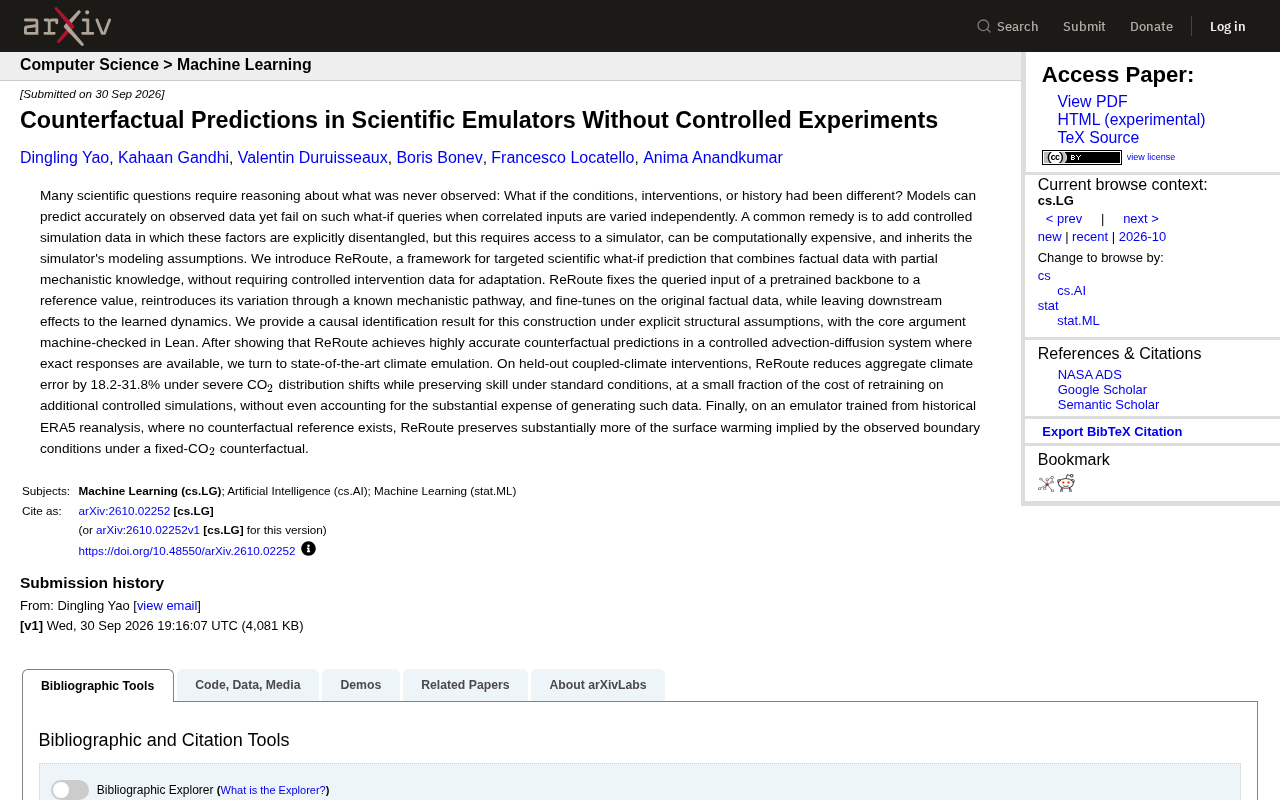
The ReRoute framework, proposed in a recent arXiv paper, targets exactly this pain point. It is designed for focused scientific what-if predictions by combining factual data with partial mechanistic knowledge — and requires no controlled intervention data for adaptation whatsoever.
Its operational logic can be broken down into a few steps:
- Fix the queried input in a pretrained backbone model at a reference value;
- Re-introduce the variation of that input through a known mechanistic pathway;
- Fine-tune on the original factual data, leaving downstream effects to the already-learned dynamics.
The elegance of this design lies in what it avoids: rather than reconstructing the entire causal system, it injects known physical mechanisms only at the critical query variable, relying on the model's existing data-driven knowledge for everything else. This harnesses the expressive power of data-driven models while using mechanistic knowledge to correct bias in counterfactual scenarios.
The paper also provides theoretical causal identification results that hold under explicit structural assumptions, with the core argument machine-verified using Lean — a formal proof assistant — which is relatively rare in machine learning papers and lends the conclusions additional rigor.
Causal identification is a central concept in causal inference, referring to whether a causal quantity (such as an intervention effect) can be uniquely estimated from the observed distribution given available data and assumptions. When confounders or unobserved common causes are present, statistical correlation alone cannot distinguish "A causes B" from "A and B are both driven by C," making the causal effect mathematically unidentifiable. ReRoute addresses this by introducing structural assumptions — explicitly specifying which mechanistic pathway transmits the query variable's influence — thereby guaranteeing the validity of counterfactual predictions in theory, even without randomized controlled trial data. Lean is an interactive theorem prover based on dependent type theory; it translates mathematical arguments into a formal language that can be checked step-by-step by a computer, eliminating logical gaps that might slip through manual derivation.
Experimental Validation: From Toy Systems to Climate Simulation
ReRoute's validation follows a path from simple to complex.
A Controlled Advection-Diffusion System
Researchers first tested on an advection-diffusion system, where exact responses can be derived analytically, making it an ideal testbed for verifying counterfactual prediction accuracy. ReRoute achieved highly accurate counterfactual predictions in this setting.
State-of-the-Art Climate Emulation
The team then turned to a genuinely hard problem: state-of-the-art climate emulation. On held-out coupled-climate intervention tests, under severe CO₂ distribution shift, ReRoute reduced total climate error by 18.2% to 31.8%, while maintaining predictive capability under standard conditions.
Critically, the cost of achieving this was only a fraction of the expense of retraining on additional controlled simulations — and that figure doesn't even account for the enormous cost of generating that controlled data in the first place.
Coupled-climate interventions refer to climate simulation scenarios in which multiple mutually coupled variables (such as atmospheric CO₂ concentration, sea surface temperatures, and radiative forcing) are changed simultaneously, rather than manipulating a single factor in isolation. Because real-world climate system components are highly coupled, such tests more closely mirror realistic policy scenarios (e.g., evaluating temperature responses to different emissions pathways), but they also make counterfactual prediction extremely difficult — the model must simultaneously handle multiple variables deviating from the training distribution. ERA5 reanalysis data is a global atmospheric reanalysis dataset produced by the European Centre for Medium-Range Weather Forecasts (ECMWF). By assimilating historical observations (radiosondes, satellites, surface stations, etc.) with numerical weather models, it provides hourly three-dimensional atmospheric state estimates from 1940 to the present, and is one of the most widely used benchmark datasets for climate research and emulator training. Its key limitation is that it is fundamentally an optimal reconstruction of a single historical trajectory, and cannot provide any "counterfactual history" as a validation reference.
Real Observations With No Ground-Truth Reference
The most challenging scenario involves an emulator trained on historical ERA5 reanalysis data, where no counterfactual reference exists at all — in reality, there is no parallel world in which CO₂ was held constant for us to observe. Under a fixed-CO₂ counterfactual setting, ReRoute retains significantly more of the surface warming signal implied by the observed boundary conditions, outperforming baselines by a clear margin.
Why This Work Deserves Attention
ReRoute represents a pragmatic methodological stance: bridging causal inference and deep learning emulators without demanding the expensive price of controlled experiments. For fields like climate science — where true controlled experiments are impossible and simulation costs are prohibitive — this approach of "leveraging partial mechanistic knowledge to unlock large volumes of observational data" is particularly valuable.
The inclusion of a formal proof (machine-verified in Lean) also reflects a growing emphasis in the field on trustworthy reasoning. When models are intended to guide high-stakes decisions like climate policy, identification guarantees are not a luxury — they are a necessity.
Of course, ReRoute's effectiveness depends on the availability of "known mechanistic pathways" and well-specified structural assumptions. Where mechanistic knowledge is incomplete or assumptions are violated, the boundaries of the method remain to be clarified by future work. But as a framework that achieves double-digit error reductions on real climate emulation tasks, it offers a compelling proof-of-concept for scientific counterfactual prediction without controlled experiments.
Related articles

Chain of Thought Isn't Just for AI: How Humans Can Use CoT to Improve Thinking Quality
Chain of Thought isn't just a prompt trick for large models. Starting from a Hacker News discussion, this article analyzes why CoT works for human thinking too, breaks down actionable ways to transfer it, and highlights the key differences between human CoT and machine CoT.
Cloudflare Teams Up with OpenAI: Closi…
Cloudflare Teams Up with OpenAI: Closing the Loop from Vulnerability Discovery to Defense with AI
Cloudflare uses OpenAI Daybreak to investigate security vulnerabilities and generate reviewable remediation plans, while developers use Codex to boost coding efficiency and quality.

Orca Multi-Agent Orchestration in Practice: A Guide to Parallel Collaboration with Claude and Codex
Orca is Stable AI's free open-source agent workbench supporting 34 agents like Claude Code and Codex in parallel. Learn its Git worktree isolation, multi-model orchestration, and mobile management.