Residential Proxies Detected on White House Network: A Cybersecurity Wake-Up Call

Layer3 Intel detected residential proxies on the White House network, sparking security community debate over covert threats and false positives.
Security research firm Layer3 Intel disclosed detecting residential proxy activity on the White House network; the Hacker News post earned 292 points and 78 comments, drawing intense security community attention. Residential proxies relay traffic through ISP dynamic IPs of real home devices, making them hard to identify via traditional IP blacklists, and attackers can use them to disguise malicious traffic as ordinary user visits. The article analyzes two major risks exposed: proxy software implanted on internal devices forming covert channels, and third-party access by contractors and guests expanding the attack surface. The community is divided—some see it as a sign of covert APT C2 communications, others as a false positive from legitimate remote work tools or testing. The article recommends replacing static rule defenses with machine learning traffic detection, zero trust architecture, residential proxy IP intelligence comparison, and managed device admission.
Event Overview
According to a blog post published by security research firm Layer3 Intel, activity from residential proxies was detected on the White House network. The finding was quickly shared by a Hacker News user and sparked heated discussion, with the post earning 292 points and 78 comments—indicating the security community's intense interest in such incidents.
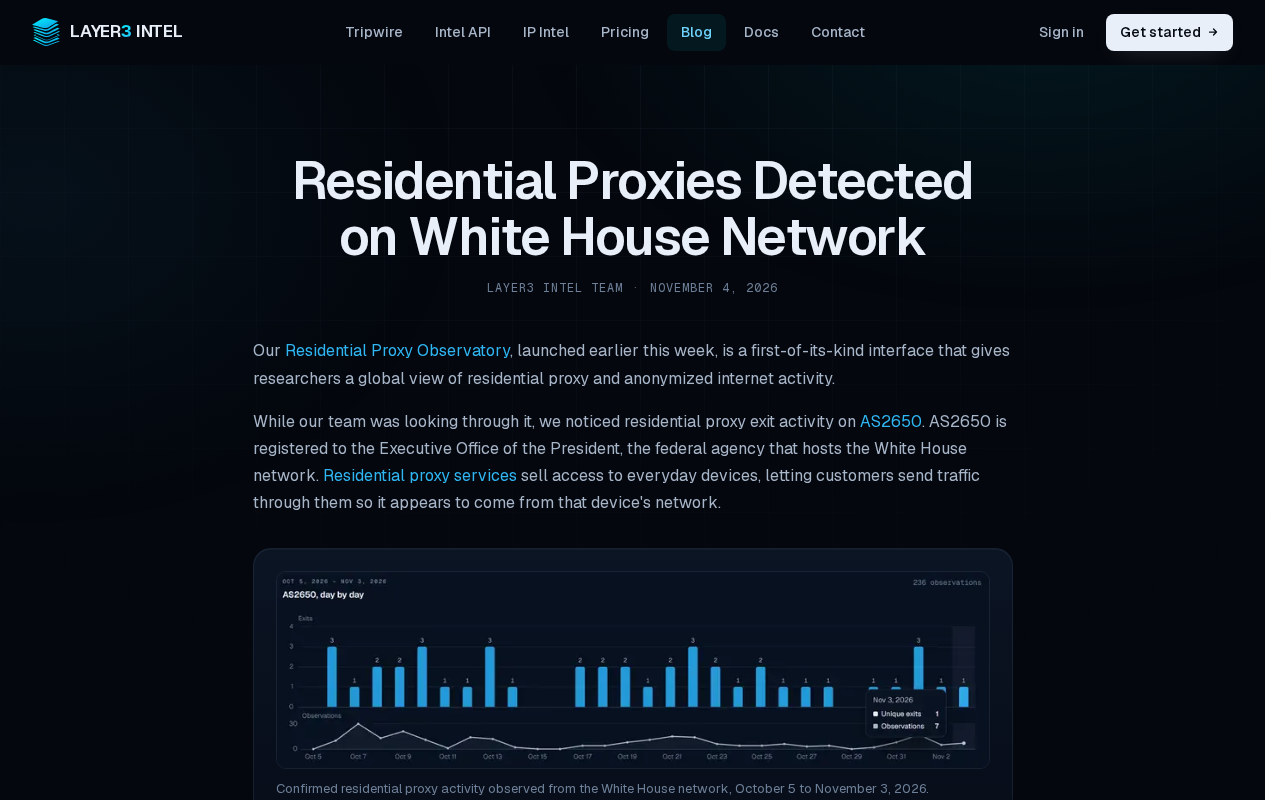
Residential proxies typically refer to proxy services relayed through real user devices (such as home routers and smart home devices). Because their IP addresses originate from residential networks, they are difficult to identify through traditional blacklist mechanisms. The appearance of such proxies in the White House network—a high-security environment—means attackers may have used compromised endpoints or insider devices as a springboard to bypass IP-based access controls.
Why Residential Proxies Are Hard to Defend Against
Unlike data center proxies, residential proxy IP addresses belong to dynamic address ranges assigned by Internet Service Providers (ISPs) to home users. These addresses make up the vast majority of normal network traffic, and security systems cannot simply block them without causing collateral damage to a large number of legitimate users. Attackers exploit this very characteristic to disguise malicious traffic as ordinary home-user visits.
Layer3 Intel's detection method may involve traffic behavior analysis, proxy fingerprinting, or threat intelligence comparison. Although the original article did not disclose specific technical details, the ability to identify residential proxies on the White House network indicates that the detecting party possesses strong traffic monitoring capabilities.
The residential proxy ecosystem typically consists of three layers of actors: proxy service providers build control platforms and sell access entry points externally; SDKs/proxy clients are implanted into ordinary user devices under the guise of "free VPNs," "accelerators," or "cashback plugins," or silently reside by infecting always-on terminals such as routers and smart TVs; residential nodes are these exploited real home network exit points. Users are often unaware, and their bandwidth and IPs are resold to paying customers billed by traffic or by IP. Precisely because nodes are scattered across thousands of households, IPs belong to real ISPs, and they rotate constantly, residential proxies form a vast "legitimate IP pool"—this is their core distinguishing feature from data center proxies. For enterprise and government networks, this means any access from a residential IP could be a malicious springboard or a legitimate employee working from home; IP attributes alone cannot distinguish them, and judgment must combine multi-dimensional signals such as device identity, access time, and request patterns.
Impact on Government Network Security
The presence of residential proxies on the White House network exposes risks at two levels:
Compromised internal devices: Residential proxy software may be implanted on employees' personal devices or office terminals, through which attackers establish covert channels. Because proxy traffic blends with normal browsing behavior, traditional perimeter defenses easily fail.
Supply chain and third-party access: Government networks often involve complex access scenarios such as contractors and guest networks. Residential proxies may be introduced through third-party devices, expanding the attack surface.
In the Hacker News comments, some users discussed whether residential IP ranges should be comprehensively banned, but most views held that this is infeasible—residential IPs constitute the bulk of internet traffic, and a blanket ban would disrupt normal services. A more practical approach is dynamic determination combining behavioral baselines, device fingerprints, and zero trust architecture.
Zero Trust Architecture is a mainstream approach in recent years for dealing with such boundary-blurring threats. Its core principle is "never trust, always verify": no longer defaulting to trusting the internal network or specific IP ranges, but dynamically authorizing every access request based on identity, device health status, and contextual environment. In residential proxy scenarios, the value of zero trust is particularly prominent—even if an attacker obtains a "seemingly normal" residential IP through a compromised home device, they cannot pass device compliance checks, multi-factor authentication, and least-privilege policies. Supporting technologies typically include device fingerprinting, continuous risk assessment, micro-segmentation, and conditional access control. It should be noted that zero trust is not a single product but a set of architectures and processes; implementation costs are high, and government networks often adopt a phased approach, prioritizing sensitive systems.
Focus of Security Community Discussion
The 78 comments on the Hacker News post reflect divisions among security practitioners. Some believe this is a sign of an advanced persistent threat (APT), as residential proxies are often used for covert C2 communications; others point out that detecting a proxy does not equal confirming a breach—it could also be a false positive from legitimate remote work tools or testing activity.
This division itself demonstrates that detection and attribution of residential proxies remain industry challenges. Layer3 Intel's blog provides an observation point but lacks full context; security teams should treat it as an early warning signal rather than a definitive conclusion.
Advanced Persistent Threat (APT) typically refers to long-term, targeted cyber intrusion activities launched by state-backed or highly organized attack groups, characterized by clear objectives, long dwell times, and proficiency in using covert channels to evade detection. Residential proxies are often used in APT operations as relays for command-and-control (C2) communications: attackers relay traffic through compromised home devices so that the source IPs of malicious communications blend into massive normal residential traffic, thereby bypassing IP-reputation-based blocking. However, equating "residential proxy detected" directly with "APT intrusion" is not rigorous—remote work, privacy tools, software testing, or even employee-installed accelerators can all produce similar traffic characteristics. Therefore, security analysis typically needs to combine evidence chains such as proxy connection frequency, destination addresses, data exfiltration volume, and whether associated terminals are compromised to make a more reliable judgment about the nature of the incident.
Recommendations
For high-security networks, the following measures can be considered:
- Deploy machine learning-based traffic anomaly detection to identify proxy protocol characteristics rather than relying solely on IP reputation
- Implement strict admission control and continuous verification for internal devices to prevent silent installation of proxy software
- Build a residential proxy IP intelligence database for offline comparison and retrospective analysis against access logs
- Restrict sensitive systems to managed devices only, reducing the risk of introduction through third-party devices
The White House network incident reminds us that residential proxies have become a common means of bypassing traditional defenses, and security protection needs to shift from static rules to dynamic behavior analysis.
Related articles

WorkBuddy in Practice: How Tencent's AI Agent Is Reshaping Office Workflows
An in-depth analysis of Tencent WorkBuddy AI agent: it reads local files, executes multi-step tasks, runs on schedules, and supports remote control—how is it fundamentally different from conversational AI? This article combines practical cases to help you understand its core capabilities and use cases.

Codex App Complete Guide: From Installation to Hands-On Practice — AI Automatically Organizes Files and Builds Reports
Codex App complete guide: install from the app store, configure everyday work mode, and use real coffee shop data to practice file organization, Excel reports, and visual dashboards. Learn Plan Mode and the little pet feature — master Codex's AI automation workflow in one episode.

Getting Started with Langfuse: Building a Financial Analysis Agent and Evaluation Platform
A Langfuse tutorial: explore the core capabilities and boundaries of this open-source AI Engineer platform, and learn how to build an enterprise-grade log tracing, evaluation, and observability platform for a Harness-architecture financial analysis multi-agent system, covering prompt management, token cost analysis, and integration with frameworks like LangChain.