Ressa's New Book: Why Tech Oligarchs Are a Threat on Par With Dictators

Ressa pairs Duterte and Zuckerberg as two kinds of dictators, calling for design-based accountability for tech oligarchs.
Based on Maria Ressa's interview on the Vox podcast, the article recounts how her 2019 arrest in Manila led to her new book *The Fight Back*. Ressa makes a controversial claim: in 2016 the Philippines had two 'dictators'—Duterte and Zuckerberg. She distinguishes 'traditional dictators,' who still face international accountability systems, from 'tech oligarchs,' who wield power while evading accountability through 'self-regulation' rhetoric. Using Facebook's 97% penetration in the Philippines, she shows how platform design changes information incentives and amplifies violent content, rejects the 'free speech' framing, and argues regulation should target algorithmic design rather than content. She sees litigation as the breakthrough, urges ordinary people to treat feeds as information sources needing auditing, and expresses optimism about global citizen action through open-source tech, collective governance, and offline organizing.
Starting From the Arrest in Manila: A Conversation That Redefines "Dictator"
In 2019, Philippine journalist Maria Ressa was arrested by plainclothes police at her Manila office. Her news organization, Rappler, had been persistently criticizing President Duterte's "war on drugs." In an interview on Vox's podcast The Gray Area, Ressa recalled what happened that evening: 24-year-old reporter Aika Rey pulled out her phone and began livestreaming the arrest, while another reporter, Sofia Tomacruz, captured on camera plainclothes officers threatening the young journalists.
"Courage isn't the absence of fear; it's having something more important than fear," Ressa said. That moment made her realize she needed to protect her team, and it completed a kind of "radicalization" in her—not toward extremism, but toward a clearer understanding of what she was up against.
This experience became the starting point for her new book, The Fight Back: A Citizen's Guide to Standing Up to Dictators. In it, she makes a controversial claim: in 2016, the Philippines had two "dictators"—one was Duterte, the other was Meta CEO Mark Zuckerberg.
What "Traditional Dictators" and "Tech Oligarchs" Have in Common
Ressa distinguishes between two types of power. Duterte is a "traditional dictator"—relying on state machinery, but at least there exists a "creaking" accountability system like the United Nations and the International Criminal Court. Duterte's arrest in March 2025 and transfer to The Hague to face crimes against humanity charges is, in her view, evidence that traditional accountability systems still work.
Tech oligarchs are different. Ressa prefers "tech oligarch" over "broligarch" because the latter downplays their real power. "The common thread is power without accountability." She points out that tech companies have refused from the start to place themselves within a regulatory framework, instead "appropriating the term self-regulation"—a term that originated in journalism, but journalism has public ethical standards and is legally accountable, whereas tech platforms have neither.
In her view, this asymmetry is the most dangerous institutional gap of our time: we have built accountability systems for national-level dictators, but have yet to build any equivalent mechanism for tech oligarchs.
The term "broligarch" is a portmanteau of "bro" and "oligarch," popularized in recent years in U.S. tech-politics discourse, often referring to tech giants like Musk, Bezos, and Zuckerberg, with a mocking connotation of bro culture and male-club dynamics. Ressa rejects the term because it personalizes and entertains the problem, making it easy to reduce structural power issues to the personalities or social styles of a few individuals. She insists on "tech oligarch" to emphasize that this is a form of oligarchy: a small number of private actors control public information infrastructure without being constrained by constitutions, elections, or judicial review as state institutions are. The choice of terminology is itself a political judgment—about whether we take the institutional nature of tech power seriously.
How Facebook Became "the Internet Itself"
Ressa's relationship with Facebook was not adversarial from the start. Rappler was once a Facebook fact-checking partner, and she herself had invited Zuckerberg to visit the Philippines to see how the platform could be a force for good. "I thought Facebook would bring bottom-up civic engagement," she said, citing ABS-CBN's 2010 "Voto Mo, Patrol Mo" campaign, where listeners photographed and reported government vehicles used for election campaigning, and the first on-site photos of the 2009 Ampatuan massacre that reached the media via Facebook.
The turning point came in a conversation with Zuckerberg. She told him that by 2017, 97% of the Philippines' internet population was using Facebook—"Facebook is our internet." Zuckerberg listened with a frown and asked, "Maria, where are the other 3%?"
"In that moment I realized we weren't children, weren't women, weren't men—we were users," Ressa said. That detail captures the essence of platform logic: human experience distilled into quantifiable numbers, with an arrogance journalism has never matched.
She further argues that it was precisely this design logic that turned the Philippines' drug war from a policy into a spectacle to be watched. Facebook didn't create the killings, but it changed the incentive structure of information dissemination, giving violent content faster spread.
"This Isn't a Free Speech Issue, It's a Safety Issue"
Throughout the interview, Ressa repeatedly rebuts the "free speech" framing habitually used by tech lobbying groups. "This isn't a free speech issue, it's a safety issue, and it's only going to get worse—we're now dealing with AI slop."
She cites Myanmar as an example: in 2018, both Meta and the United Nations sent teams to Myanmar to investigate Facebook's role in the genocide. The conclusion was that the platform "contributed" to the violence, but no one was held accountable afterward.
"We've built systems for national-level dictators, but no accountability system for tech oligarchs. Who profits? Tech companies. Who pays the price? People and governments."
In her view, the key to regulation is not content but design—algorithmic incentive structures. "If it is in fact a public information ecosystem, then deliberately making lies spread faster than facts should be illegal."
When asked whether government regulation would harm free speech, Ressa's response is direct: such concerns are "the talking points of Big Tech lobbying." She supports child protection legislation advancing in the UK and also mentions the bipartisan COSA bill once pushed in the U.S.

COSA (Kids Online Safety Act) is legislation jointly promoted by both parties in the U.S. Congress, requiring social platforms to provide default highest privacy and safety settings for minors and to bear a "duty of reasonable care" to prevent their products from causing addiction, depression, sexual exploitation, and other harms. The bill passed the Senate overwhelmingly in 2024 but stalled in the House, with opposition mainly from the tech industry and some civil rights organizations, citing concerns about age verification and censorship. Ressa mentions COSA to show that regulation is not without feasible options—it's a lack of political will. The UK's Online Safety Act adopts a stricter "duty of care" framework, requiring platforms to assess and mitigate systemic risks, consistent with her主张 of "regulating design, not content."
The Breakthrough for Design Accountability: Pressure From the Courts
Ressa believes that what actually drives change is often not legislation but litigation. She mentions Megan Garcia's lawsuit against the two founders of Character AI and Google—her son had long interacted with a chatbot named "Danny," and Garcia cited sexually suggestive content in the lawsuit. The case was eventually settled; the company did not admit fault but was required to implement safeguards that should have existed from the start.
"Regulation is a matter of time—it should have been there from the beginning. Just as seatbelts were needed after the Model T, and cocaine was once in Coca-Cola."
The Megan Garcia v. Character AI case is one of the first U.S. lawsuits targeting AI companion products for harm to minors. Character AI allows users to create and converse with virtual characters; its two founders were former Google engineers, and the company's core team was later absorbed by Google through a licensing agreement. Garcia alleged that the product constituted sexual grooming and emotional manipulation of minors, and that her son had long been immersed in conversations with "Danny" before taking his own life. The case was settled in 2025; the company did not admit fault but committed to strengthening age verification and safety measures. The significance of such lawsuits lies in bypassing legislative gridlock—using tort liability, product liability, and consumer protection law to force AI companies to build safety by design into their products, providing precedent and factual basis for subsequent regulation.
How Ordinary People Can Fight Back: Treat Social Media as an Information Source That Needs Auditing
One of the book's most actionable suggestions is to "treat your social media feed as an information source that needs auditing, not a window you can trust."
During Duterte's six years in power, Ressa's team treated attacks against Rappler as a data stream to analyze, thereby identifying coordinated information manipulation—what later became known as "information operations." They also split their tech and data department into an independent company, which now contributes about 40% of Rappler's revenue—"crisis is also opportunity."
She offers a three-tier path: first, build your own technology—open source, digital sovereignty; second, collective governance—she co-chairs the UN Secretary-General's Independent International Scientific Panel on AI with Yoshua Bengio, hoping to push for mandatory transparency and multilateral arrangements; third, define the world we want—profit motive cannot be the only reason for building technology.
"If a human did what AI does, it would be illegal. We need a set of laws that applies to everyone," Bengio said at the UN Security Council AI meeting—a line Ressa quotes.
The Basis for Optimism: People Are Moving From the Virtual World Into the Physical World
Ressa says she is "unexpectedly optimistic." The basis comes from Rappler's survival experience: under dual attacks in the virtual and physical worlds, they turned offline, organizing mask meetings in 25 communities in the late pandemic period to discuss face-to-face what people were going through.
"Fear spreads, but so does courage." She notes that each arrest in 2019 brought a surge in crowdfunding—the sales team was delighted, but she constantly reminded them this was not a sustainable business model.
She extends the same logic to Hungary and Brazil: the end of Orbán's 16-year rule came from a candidate stepping into the physical world to shake voters' hands; in Brazil's runoff election, people organized on WhatsApp and then took to the streets to vote, with turnout unseen in two decades.
"When you become a target, you have power," Ressa says. "The window for action is closing. We need to make technology serve humanity, not the other way around."

Related articles
OpenAI Doubles Down on Healthcare: Cha…
OpenAI Doubles Down on Healthcare: ChatGPT Healthcare Adds Computer-Use Agents and Clinical Plugins
OpenAI updates ChatGPT for Healthcare with computer-use agents, improved clinical answers, and cross-software plugins—moving AI from answering questions to completing real clinical workflows.
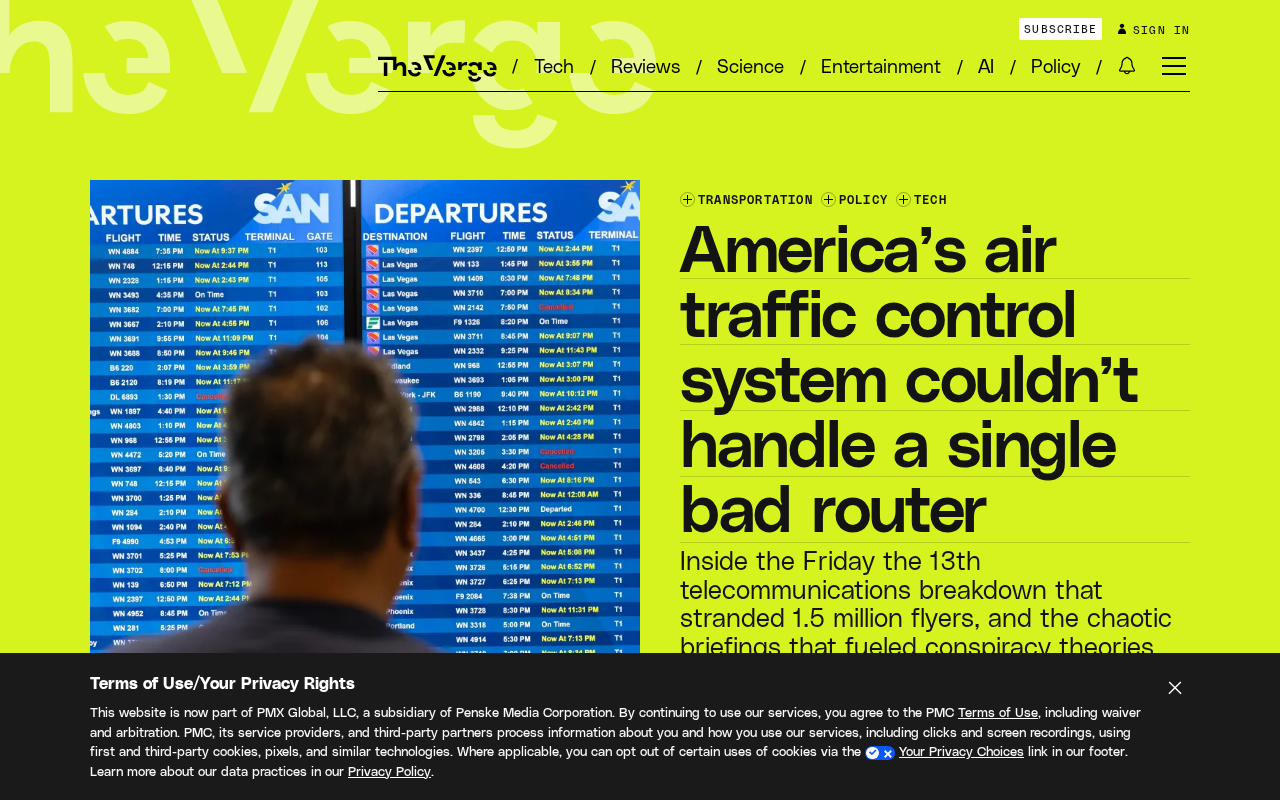
How Could a Single Router Failure Cripple US Air Traffic Control?
A single router failure caused a nationwide FAA communications outage, exposing the fragility of air traffic control redundancy. We analyze the failure chain, aging systems, and what resilience really means.

Google Maps New Feature: Real-Time Itinerary Generation Turns Navigation into a Travel Assistant
Google Maps launches Ask Maps, which auto-generates multi-day itineraries from natural-language descriptions with real-time info for each stop. This article analyzes the shift from navigation to itinerary planning and its impact on travel planning products.