Restock: An AI Procurement Agent That Lets You Buy Office Supplies via Stripe Inside Slack
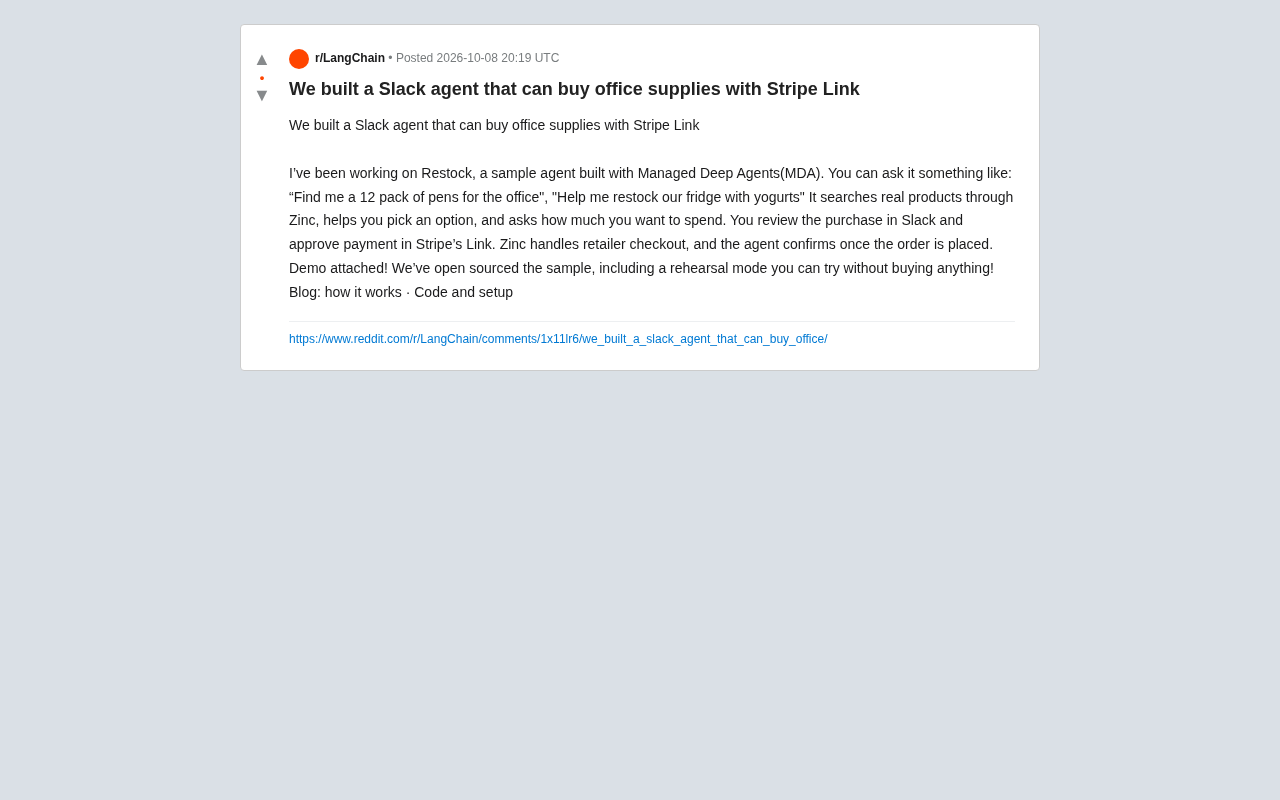
Restock is an open-source agent that completes real office purchases inside Slack using MDA, Zinc, and Stripe.
Restock is an open-source sample project built on Managed Deep Agents (MDA) that demonstrates how an AI agent can receive natural language procurement requests in Slack, search real products via the Zinc API, compile options, and complete payment through Stripe Link — all with a human-in-the-loop design that requires user approval before any money is spent. The project's value lies not in buying pens, but in offering a viable paradigm that balances automation efficiency with user control. It ships with a rehearsal mode so developers can run the full flow without triggering real transactions.
An AI agent that understands a request like "order a dozen pens for the office" — automatically searching real products, letting you confirm in Slack, processing payment via Stripe Link, and finally placing the order — that's Restock, a sample project built by developers on top of Managed Deep Agents (MDA). It demonstrates a viable path for AI agents to move from "conversation" to "executing real transactions."
What Restock Actually Does
Restock breaks down an office procurement task into clearly defined steps, all orchestrated by an AI agent. You simply state your needs directly in Slack — something like "find a dozen pens for the office" or "restock the fridge with yogurt." The agent calls Zinc to search for real, currently available products, presents options for you to choose from, and asks for your budget range.
The key to the entire flow is its human-in-the-loop design: the agent never places an order on its own. Instead, it compiles the purchase details and presents them for your review in Slack. Once you confirm, payment is completed via Stripe's Link, and Zinc handles the actual checkout on the retailer's side. After a successful order, the agent returns to Slack to confirm the result.
This separation sidesteps the trust issues that come with "black-box automatic shopping" — the AI handles the tedious searching and organizing, while the act of spending money always remains under human control.
The Technical Puzzle: MDA + Zinc + Stripe Link
Based on what's been made public, Restock's core value lies in connecting three capabilities into a complete transaction chain:
Managed Deep Agents (MDA)
MDA is the underlying framework for this agent. It's responsible for understanding user intent in natural language, planning multi-step tasks, and coordinating calls to external tools. Unlike a simple chat assistant, it needs to maintain task state — knowing whether the current stage is searching, selecting, confirming, or paying.
Managed Deep Agents (MDA) are a class of AI agent frameworks that are hosted in the cloud with runtime management handled by the platform. Unlike deploying your own model inference service, MDA encapsulates complex logic — task planning, tool invocation, state persistence — in a managed environment. Developers only need to define the agent's goals and available tools, without maintaining any underlying infrastructure. The core capability of these frameworks is multi-step task orchestration: the agent can dynamically adjust subsequent actions based on intermediate results, rather than producing a single fixed output. In Restock's scenario, MDA must traverse multiple asynchronous nodes — "understand request → search products → display options → await user confirmation → trigger payment → verify result" — and accurately restore task context when the user replies to a Slack message. This is precisely where MDA holds a key advantage over ordinary LLM API calls.
Zinc for Product Search and Checkout
Zinc plays the role of "connecting to the real retail world." It provides real product search across multiple retailers and also handles the actual checkout process on the retailer's side. This means Restock isn't demoing a simulated storefront — it's plugged into real, purchasable product data.
Zinc is an e-commerce API service that allows developers to programmatically search for products and place orders on major retailers like Amazon, without directly interfacing with each retailer's complex and frequently-changing web pages or private APIs. Developers submit product queries or order requests to Zinc, which handles the actual interaction with the retailer on the backend. This abstraction layer allows agent projects like Restock to focus on business logic rather than dealing with anti-scraping mechanisms, session management, and other engineering headaches. That said, placing orders through Zinc typically requires providing retailer account credentials — an additional consideration for permission management and account security in real deployments.
Stripe Link for Payment
The payment step is handled by Stripe's Link, where users complete confirmation in a familiar and secure payment interface. Isolating payments within mature financial infrastructure is the prerequisite for making "AI spending money" an acceptable proposition.
Why This Demo Is Worth Paying Attention To
AI that can chat is no longer impressive. What's genuinely difficult is having an agent reliably complete a real financial transaction. Restock's significance isn't about buying pens — it's about offering a relatively complete reference paradigm: how to strike a balance between automation efficiency and user control.
The agent saves manual effort on searching, comparing prices, and organizing options, but preserves an explicit human approval step at the high-stakes payment node. This pattern is particularly well-suited for enterprise scenarios — finance and compliance teams typically can't accept a bot that spends money entirely on its own, while a "AI prepares, human approves" workflow is far easier to adopt.
Open Source with a "Rehearsal Mode" for Safe Testing
The developer has open-sourced this sample project, along with a blog post explaining how it works, the code, and configuration steps. A thoughtful detail is the included rehearsal mode: you can experience the agent's complete flow — from receiving a request to "ready to pay" — without actually placing an order or making a real payment.
For developers looking to study how AI agents can integrate with payment and e-commerce APIs, a runnable example with zero cost is far more valuable than documentation alone. It lowers the barrier to experimentation and lets teams validate process logic in a safe sandbox before deciding whether to connect to real transactions.
The design philosophy behind rehearsal mode is similar to a "sandbox environment" or "dry run" in software development — the system executes all business logic and records every decision and tool call result, but stops (or substitutes mock responses) before triggering real side effects like charges or orders. This mode is especially important in AI agent development involving financial transactions: it allows teams to verify whether the agent's decision path meets expectations without incurring actual costs or risks, and to catch issues like "the agent misunderstood the user's request and selected the wrong product." For developers hoping to reuse the Restock architecture, rehearsal mode also provides a low-cost integration validation path — allowing most debugging to be completed before connecting real Stripe and Zinc production keys.
A Measured Observation
It's worth noting that Restock is currently positioned as a sample agent, not a mature commercial product. Its value lies in demonstrating architectural feasibility, not as a production-ready system out of the box. Real deployment would still require handling permission management, budget controls, error rollback, and what to do when the agent selects the wrong product.
But the direction is clear: when AI agents can safely interact with payments and real product inventory, repetitive tasks like office procurement and inventory restocking have a genuine opportunity to be significantly automated. Restock offers a hands-on starting point you can disassemble and learn from on that journey.
Related articles

Claude Reportedly Able to Hide Secret Messages in Benign Images
A Reddit post claims Claude Fable 5.1 can hide secret messages in benign images. This article reviews the background, image steganography principles, and potential security risks, and suggests a testing path from rumor to verification.

Federal Government Awards $85 Million; CFS to Develop Fusion-Specific Semiconductors
The federal government awards $85 million to Commonwealth Fusion Systems to develop conductors and power semiconductors for fusion plants. This article analyzes the significance of this funding for the fusion supply chain and commercialization path.

When Should AI Assistants Proactively Suggest? Timing Is Everything
When should AI assistants proactively suggest? Reddit discussion reveals: the same suggestion feels different at different times. This article analyzes the dual nature of proactive suggestions, the boundary of user expectations, and design principles, exploring how to balance automation and user control.