Retrieved-Span Training: A 406M Small Model Matches 1.2B Systems on Meeting Summarization

Retrieved-Span Training lets a 406M FiD model statistically match a 1.2B system on QMSum.
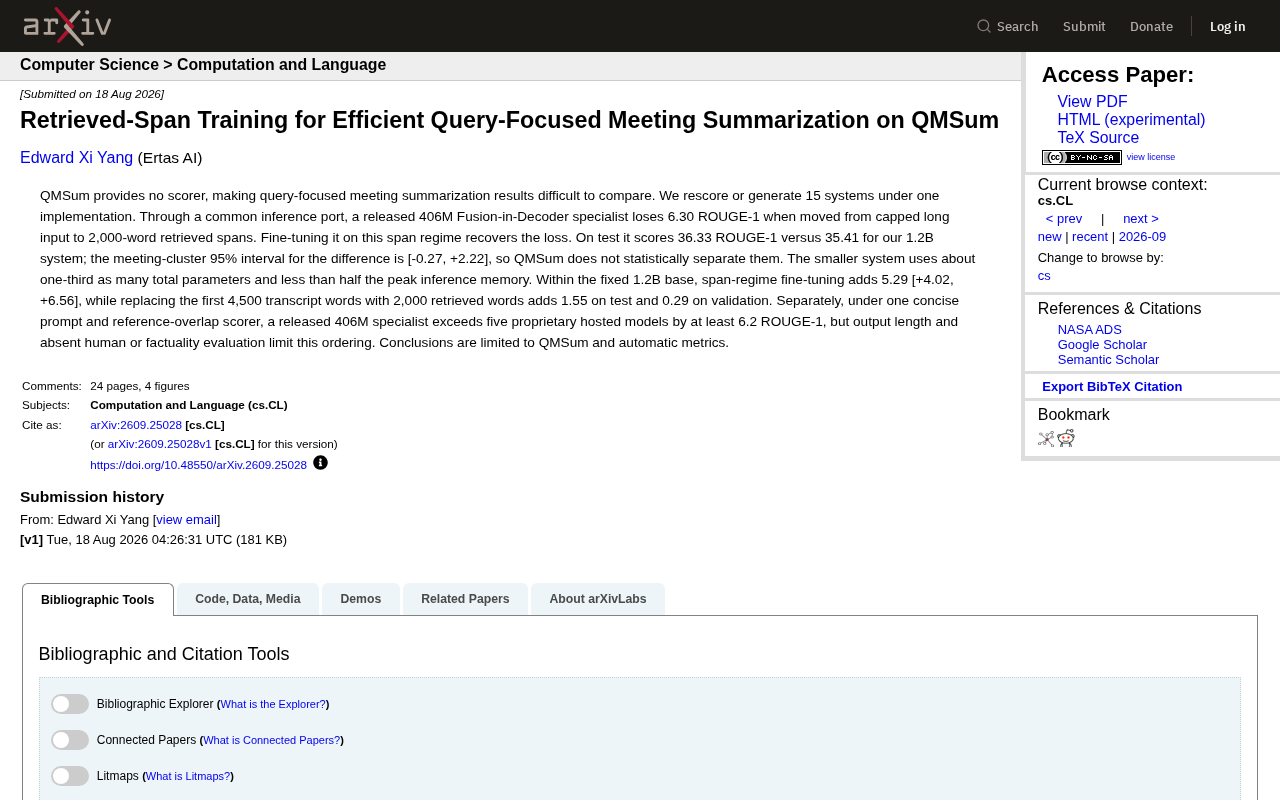
This paper addresses QMSum's lack of a unified scorer by re-evaluating 15 systems under a consistent framework, revealing input format alone can shift ROUGE-1 by over 6 points. The key contribution — Retrieved-Span Training — fine-tunes a 406M FiD model on 2000-word retrieved spans, achieving 36.33 ROUGE-1 vs. the authors' 1.2B system's 35.41, a statistically indistinguishable difference despite one-third the parameters and less than half the peak inference memory. Ablation shows span-paradigm fine-tuning contributes ~5.29 points, far outweighing a simple input swap (+1.55), underscoring that teaching models to consume retrieved results is the real performance driver.
An Overlooked Evaluation Problem
Query-focused meeting summarization has long been one of the toughest challenges in natural language processing. A user poses a question, and the system must locate relevant content within lengthy meeting transcripts and generate a targeted summary. QMSum is the dominant benchmark dataset for this task, but it has a long-standing pain point: no unified scorer is provided.
This means results reported by different research teams are often difficult to compare directly — evaluation implementations, input preprocessing, and inference configurations all vary, making the so-called "best system" rankings unreliable. This new arXiv paper takes this methodological problem as its starting point, aiming to establish a reliable comparison baseline for the field.
The QMSum (Query-based Meeting Summarization) dataset was released by Zhong et al. in 2021 and contains approximately 230 meeting transcripts across three domains — academic meetings, product meetings, and parliamentary debates — each annotated with query-summary pairs. Unlike general summarization, the core challenge is that queries can target any sub-topic within the meeting, requiring the system to first "locate" and then "generate" — essentially a joint retrieval and generation task. ROUGE (Recall-Oriented Understudy for Gisting Evaluation) is the most widely used automatic metric, quantifying similarity between candidate and reference summaries via n-gram overlap: ROUGE-1 measures unigram overlap, ROUGE-2 measures bigram overlap, and ROUGE-L is based on the longest common subsequence. These metrics are easy to compute and reproducible, but highly sensitive to text preprocessing in the evaluation pipeline (tokenization, lowercasing, punctuation handling) — even the same model can produce differences of 1–2 points under different preprocessing implementations. This is the real harm caused by the lack of a unified scorer.
Re-evaluation Under a Unified Implementation
The researchers did something fundamental yet highly valuable: they re-scored or re-generated outputs from 15 systems under a single unified implementation framework. Through a common inference port, they were able to observe the true performance of each system under fully consistent conditions.
The results revealed a critical phenomenon: a published 406M-parameter Fusion-in-Decoder (FiD) specialized model saw its ROUGE-1 score drop by 6.30 points when the input was switched from "truncated long text" to "2000-word retrieved spans." This shows that the model is highly sensitive to input format, and that a significant portion of previously reported evaluation discrepancies likely stemmed from such implementation details rather than actual model capability differences.
Retrieved-Span Fine-Tuning: The Small Model's Comeback
The paper's core contribution is Retrieved-Span Training. When the researchers fine-tuned the 406M model specifically for the "2000-word retrieved span" input format, all 6.30 previously lost points were recovered.
Even more interesting is the final comparison:
- The fine-tuned 406M model achieves 36.33 ROUGE-1 on the test set
- The authors' own 1.2B system achieves only 35.41 ROUGE-1
Given that the 95% confidence interval at the meeting-cluster level is [-0.27, +2.22], this means the two systems cannot be statistically distinguished on QMSum. In other words, the smaller model — with roughly one-third the parameters and less than half the peak inference memory — performs on par with a system three times its size.
This is a strong signal for teams pursuing deployment efficiency: blindly scaling up parameters doesn't necessarily yield measurable gains.
Fusion-in-Decoder (FiD) is an open-domain QA architecture proposed by Izacard and Grave in 2021. Its core idea is to independently encode each retrieved text span concatenated with the question (encoder stage), then concatenate all span encodings and feed them into a unified decoder to generate the answer. This design allows the model to process large amounts of context in parallel while avoiding the attention dilution that occurs when all spans are directly concatenated for the encoder. In meeting summarization, FiD is used to handle transcripts that typically exceed tens of thousands of words — the model first retrieves the most query-relevant spans, then uses the FiD architecture to fuse them and generate a summary. The 406M parameter scale corresponds to a T5-Large backbone, far smaller than today's mainstream billion-parameter large language models, but the architectural advantage of being purpose-built for structured retrieval-generation pipelines gives it competitive strength beyond what its parameter count would suggest.
Decomposing the Performance Gains: Fine-Tuning vs. Retrieval
To clarify where the performance improvements actually come from, the researchers conducted ablation analysis on a fixed 1.2B base model. The results are quite revealing:
| Intervention | Test Set Gain | Validation Set Gain |
|---|---|---|
| Span-paradigm fine-tuning | +5.29 [+4.02, +6.56] | — |
| Replacing first 4500 transcript words with 2000 retrieved words | +1.55 | +0.29 |
Clearly, span-paradigm fine-tuning contributes the vast majority of the gain (~5.29 points), while simply swapping the input (replacing the original transcript head with retrieved spans) yields comparatively modest improvement. This decomposition is important: it suggests that while retrieval itself is useful, teaching the model to consume retrieved results is the key to performance leaps.
A Comparison That Requires Careful Interpretation
The paper also reports an eye-catching result: under the same concise prompt and reference-overlap scorer, the published 406M specialized model outperforms five commercial hosted large language models by at least 6.2 ROUGE-1 points.
However, the authors themselves remain measured about this finding, explicitly noting its limitations:
- Output length differences may affect ROUGE scores
- Human evaluation and factuality assessment are absent
- Rankings are based solely on automatic metrics
This self-restraint is commendable. N-gram overlap metrics like ROUGE are inherently limited in capturing summarization quality, especially when comparing against commercial models with very different generation styles. Leading by 6.2 points does not mean "better" — it only indicates a performance difference under this specific evaluation protocol.
ROUGE metrics exhibit systematic length bias: models generating shorter summaries tend to score higher on Precision, while those generating longer summaries advantage on Recall, with F1 balancing between the two. Commercial large language models (such as GPT-4, Claude, etc.) tend to generate smoother, more structurally complete but longer summaries when no explicit length constraints are given, whereas specialized small models fine-tuned on training data more closely match the length distribution of reference summaries. This systematic length difference introduces an irremovable bias in n-gram overlap ROUGE scores, making comparisons between the two model types fundamentally unequal. Furthermore, ROUGE cannot measure factual consistency — a model may generate summaries with high lexical overlap with the reference while containing hallucinations, which is particularly concerning in meeting transcript scenarios where accuracy is critical.
Practical Takeaways
The value of this work lies not in setting a new SOTA, but in rigorously answering several practical questions with sound methodology:
First, evaluation consistency is critical. On benchmarks lacking a unified scorer, any cross-paper score comparison should be taken with a grain of salt. The researchers' unified re-evaluation of 15 systems is itself a valuable contribution to the community.
Second, specialized small models + targeted fine-tuning is a cost-effective path. A 406M model, properly trained, can match a 1.2B system while significantly reducing memory and inference costs — highly meaningful for resource-constrained deployment scenarios.
Third, retrieval must be co-designed with training. Simply plugging in a retrieval module yields limited gains; adapting the model to the input distribution of retrieved spans is what unlocks its potential.
The authors also honestly delineate their boundaries: all conclusions are limited to the QMSum dataset and automatic evaluation metrics. This measured framing is exactly what empirical research of this kind should look like.
Related articles

Chain of Thought Isn't Just for AI: How Humans Can Use CoT to Improve Thinking Quality
Chain of Thought isn't just a prompt trick for large models. Starting from a Hacker News discussion, this article analyzes why CoT works for human thinking too, breaks down actionable ways to transfer it, and highlights the key differences between human CoT and machine CoT.
Cloudflare Teams Up with OpenAI: Closi…
Cloudflare Teams Up with OpenAI: Closing the Loop from Vulnerability Discovery to Defense with AI
Cloudflare uses OpenAI Daybreak to investigate security vulnerabilities and generate reviewable remediation plans, while developers use Codex to boost coding efficiency and quality.

Orca Multi-Agent Orchestration in Practice: A Guide to Parallel Collaboration with Claude and Codex
Orca is Stable AI's free open-source agent workbench supporting 34 agents like Claude Code and Codex in parallel. Learn its Git worktree isolation, multi-model orchestration, and mobile management.