Retro Font Project Recreated from Photographs of C64 Keycaps

A developer vectorized Commodore 64 keycap photos to recreate a retro font preserving the hardware's original industrial design.
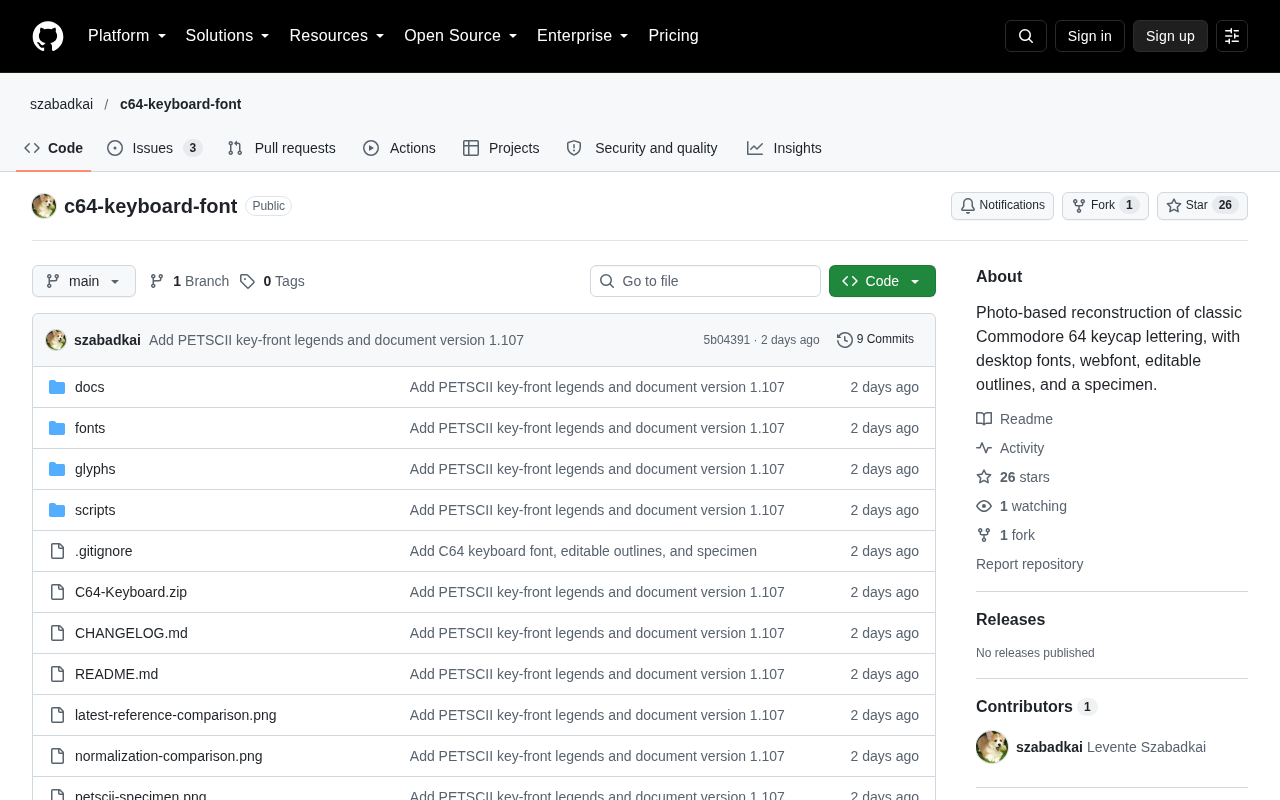
A developer used photographs of Commodore 64 keyboard keycaps as the source material to digitally recreate a retro font. Unlike the common approach of extracting glyphs directly from ROM bitmap data, this project captures letterform details from photos and manually vectorizes them, preserving the printed keycap typeface's distinctive stroke curves and weight — details that differ from the on-screen bitmap rendering. The results can be applied to retro game development, nostalgic brand visuals, hardware cloning, and computing history archival work.
A Font Revival Rooted in Nostalgic Hardware
An interesting project surfaced on Hacker News, catching the attention of retro computing enthusiasts: someone recreated a font based on photographs of keycaps from the classic Commodore 64 keyboard. The core idea is straightforward — use real hardware as a reference, capture letterform details through photography, then digitize them into usable font files.
The Commodore 64, one of the best-selling personal computer models in computing history, carries the memories of an entire generation. Its keyboard font, industrial design, and boot screen have all become recurring symbols of tribute in retro computing culture. This font project is a continuation of that cultural spirit.
The Commodore 64 (C64) was released in 1982 by Commodore Business Machines at a price of $595. Its impressive graphics and audio chips — the VIC-II and SID respectively — quickly helped it dominate the home computer market. Estimated total sales range from 10 to 17 million units, and it still holds the Guinness World Record for the highest-selling single personal computer model of all time. The C64's iconic beige chassis, blue boot screen, and the distinctive "PETSCII" graphic character set on its keyboard are defining symbols of 1980s home computing aesthetics. Thanks to its massive user base and deep cultural influence, the retro computing community surrounding the C64 remains quite active today, with new emulators, hardware clones, and design homages continuing to emerge.
Why Recreate from Photos Instead of Bitmaps
Most retro font revivals extract letterforms directly from the original system's bitmap font data stored in ROM chips, producing a pixel-perfect restoration. This project took a different path — working from photographs of the physical keycaps.
This approach has its own unique value. The typeface printed on keycaps often differs from the bitmap font displayed on screen: keycap lettering is typically designed for print and human legibility, with stroke shapes, curves, and weight potentially adjusted independently. In other words, recreating the keycap font preserves traces of the hardware's industrial design, rather than the result of screen rendering. For collectors and designers seeking a tactile, physical authenticity, this is a perspective worth exploring.
However, this method comes with challenges: photographs are affected by lighting, angle, lens distortion, and wear. Extracting clean letterforms requires extensive manual correction and vectorization work before usable, clean outlines can be produced.
A bitmap font is a set of dot-matrix glyph data stored in early computer ROM chips, where each character is defined by a fixed pixel grid — for example, the Commodore 64's system font uses an 8×8 pixel grid. These glyphs are legible on low-resolution screens but show obvious jagged edges when scaled up. Vectorization is the process of converting these discrete pixel points into smooth outlines described by Bézier curves, allowing fonts to remain crisp at any size — modern font formats such as TrueType (.ttf) and OpenType (.otf) are both vector-based. Recreating a font from keycap photographs means bypassing the bitmap layer entirely and constructing vector outlines directly from analog physical images. The technical path is longer, but the end result can capture curve details and weight variations that simply don't exist in bitmap font data.
Practical Use Cases for Retro Fonts
These recreated fonts aren't just display pieces. They have real-world applications across several domains:
- Retro game development: Indie developers making pixel-art or 8-bit style games can use these fonts directly to evoke a sense of era.
- UI design and brand visuals: Nostalgia-themed websites, posters, and album artwork often rely on fonts like these to convey a specific period atmosphere.
- Hardware restoration and cloning: Hobbyists 3D-printing keycaps or building replica keyboards need accurate letterform references.
- Digital preservation: Digitizing the visual elements of physical hardware is itself a form of archival work in computing history.
Community Reception and Discussion
Based on Hacker News data, the post received 14 upvotes but no comments at the time of writing. This is a fairly typical response pattern for retro computing projects in technical communities — they resonate with a small group of enthusiasts but don't necessarily spark widespread discussion. The value of projects like this often lies not in technical breakthroughs, but in the dedication to detail and respect for cultural heritage.
It's worth noting that font recreation around vintage computers has developed into a fairly active subculture. From the Apple II and ZX Spectrum to various arcade machines, nearly every influential retro hardware platform has had enthusiasts create corresponding digital font resources for it.
Conclusion
This font revival project based on Commodore 64 keycap photographs is a microcosm of retro computing enthusiast culture. It reminds us that the history of technology lives not only in chips and code, but also in the ink on keycaps and the curves of a chassis — physical details that are easy to overlook. For designers, developers, and history enthusiasts alike, projects like this serve as both practical tools and a gentle tribute to a golden era of computing.
Due to limited information available, details about the font's licensing, character coverage, and download links remain to be made public by the project author.
Related articles

Workbuddy for Absolute Beginners: How a Desktop AI Agent Fits Into Real Workflows
A beginner's guide to the Workbuddy desktop AI agent: installation, claiming credits, file management, and building automated workflows—compared with CodeX for fit and cost, helping professionals shift from AI question-askers to AI managers.

OpenAI's New Agent Stack: Computer Use, Decisions API, and Ultra-Fast Workflows
OpenAI Dev Day unveiled a new agent stack: Computer Use outperforms humans, Decisions API delivers ultra-low-latency classification via Luna, Agents API opens the same Computer Use capabilities, and GPT-6.1 Sol costs only one-seventh of Astra. Core updates, benchmark data, and developer insights.

Liang Wenfeng Open-Sources DeepInfo Inference Framework, Takes On U.S. Ban
DeepSeek open-sources its DeepInfo inference framework after its models, featuring GPU/CPU cross-pipelining, small-model prediction with large-model verification, and full Huawei Ascend and NVIDIA chip support—facing the U.S. federal ban head-on. This article analyzes its significance for AI deployment and open-source strategy.