Reverse-Engineering CUDA-checkpoint: The Technical Principles and Practice of Cracking GPU Cold Starts

Reverse-engineering Nvidia CUDA-checkpoint to crack GPU cold starts and accelerate Serverless AI inference.
This article dives into reverse-engineering Nvidia's CUDA-checkpoint tool to accelerate GPU cold starts. It explains why cold starts bottleneck Serverless AI inference, how checkpoint/restore bridges the CRIU-GPU gap, and how differential snapshots plus GPUDirect Storage enable sub-second recovery—along with key challenges like driver-version coupling.
GPU Cold Starts: The Underestimated Killer of Inference Latency
In cloud-based AI inference and training scenarios, the cold start problem of GPUs is becoming increasingly prominent. A cold start refers to the long wait between a GPU task loading a model from scratch, initializing the CUDA context, allocating VRAM, and the service actually becoming available. For Serverless architectures and elastic inference services that allocate resources on demand, this wait directly determines the upper bound of response latency and resource utilization.
This problem has become even more pronounced against the backdrop of large-scale commercialization of AI inference. According to publicly available industry data, cold start times for mainstream LLM inference services range from tens of seconds to several minutes: the complete initialization process of a GPT-4-class model on an A100 cluster typically takes 60–120 seconds, with model weight loading accounting for over 60% of that. This directly causes the P99 latency of Serverless GPU platforms to be tens of times higher than P50, making it the number one bottleneck affecting user experience and SLA compliance. For consumer-facing AI applications, a first response exceeding 5 seconds often leads directly to user churn — which is also the most direct manifestation of the commercial value of snapshot technology.
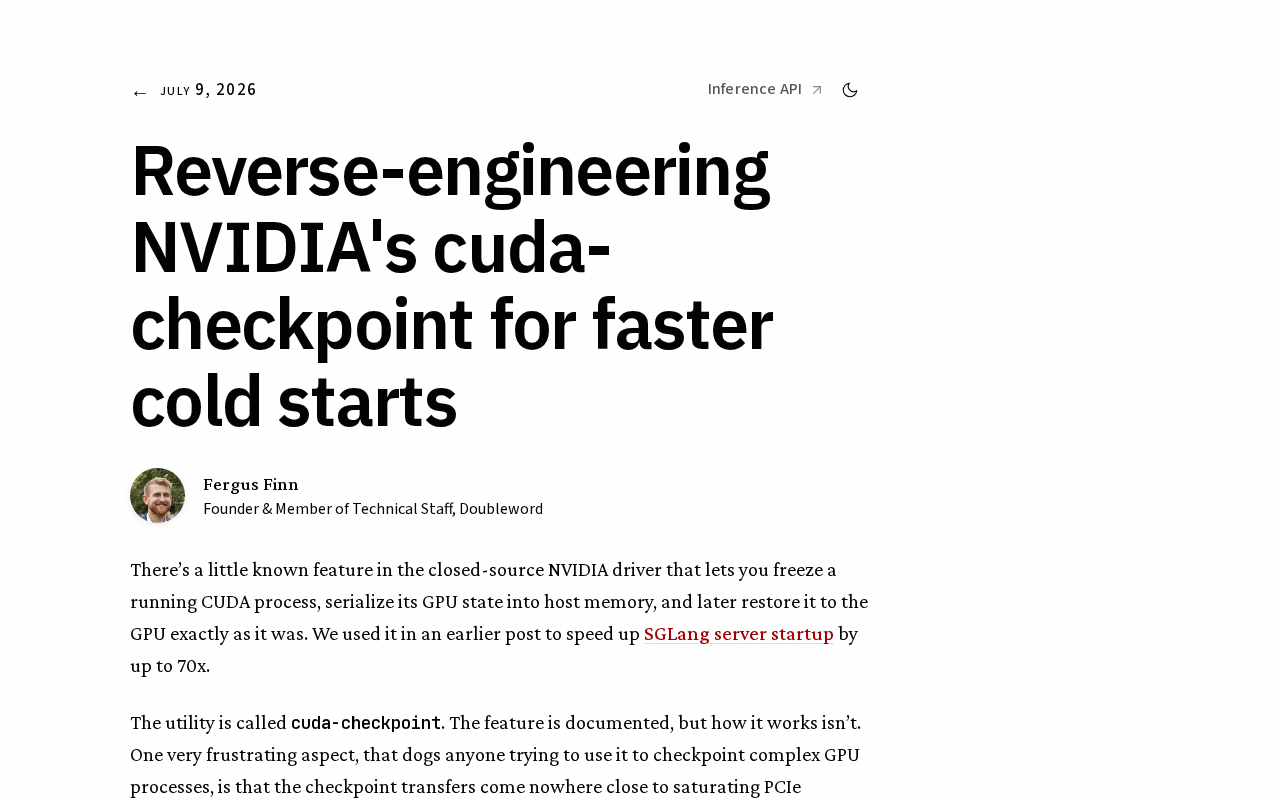
Recently, a technical article published on Hacker News titled "Reverse-engineering Nvidia's CUDA-checkpoint for faster cold starts" drew widespread attention. By reverse-engineering Nvidia's official cuda-checkpoint tool, the author explores viable paths to accelerate GPU cold starts — a topic that precisely touches the core pain point of current AI infrastructure optimization.
What Is CUDA-checkpoint
Tool Positioning and Working Principles
cuda-checkpoint is an experimental tool released by Nvidia. Its core capability is to perform state checkpointing and restoration on running CUDA processes. In simple terms, it can serialize and save the complete state of a process running on the GPU — including VRAM data, CUDA context, device handles, etc. — to disk, and rapidly restore it back to the GPU when needed, seamlessly continuing execution.
This mechanism complements the operating-system-level CRIU (Checkpoint/Restore In Userspace) technology. CRIU was initiated in 2012 by the Virtuozzo (formerly OpenVZ) team, originally serving live migration scenarios for Linux containers. It has since been widely integrated into container runtimes such as Kubernetes and Podman for live migration and fast startup. Its core mechanism relies on the kernel-exposed /proc interface and the ptrace system call, capturing a complete userspace snapshot of a process — serializing CPU-side resources such as memory pages, file descriptors, network sockets, and signal states. Since the release of CRIU 1.0, it has been iterated for over 10 years, supporting complex scenarios such as TCP connection keep-alive and file lock state capture, and is widely used by enterprise users like Red Hat and Google for highly available container orchestration.
However, GPU device state inherently lies outside this system: VRAM content is stored in device-side DRAM (such as GDDR6X or HBM3), the driver manages context using opaque proprietary data structures, and the kernel module (nvidia.ko) maintains an independent state machine internally. The complexity of GPU state far exceeds that of ordinary PCIe peripherals: the device state tree of a single H100 SXM contains thousands of CUDA object handles, and the kernel-mode data structures maintained by the nvidia.ko driver can reach several GB in size. This means that even if CRIU can completely freeze the CPU-side process, the compute state on the GPU side — including executing Kernels, Stream queues, and the internal handles of cuBLAS/cuDNN — still cannot be captured, and the restored process will face crashes or silent errors caused by GPU-side state inconsistency.
Why is GPU state management so complex? Unlike traditional PCIe peripherals such as network cards and disk controllers — whose state can usually be fully captured through standard register reads and writes — GPUs run independent microcontroller firmware (such as Nvidia's FECS/GPCCS scheduling engines), which maintain state tables that are shared with the driver but highly coupled in semantics. Take CUDA Streams as an example: an active Stream corresponds to a hardware work queue at the driver level, and its state includes not only the list of submitted but unexecuted Kernels, but also the dependency graph with other Streams — the serialization of this graph-shaped dependency relationship requires deep cooperation from the driver layer and cannot be inferred from external observation. This is also why a dedicated GPU checkpoint tool only appeared a full decade after CRIU matured; Nvidia had to implement it as a driver-level feature rather than a userspace tool.
This means that GPU workloads cannot enjoy the migration and fast recovery capabilities already mature in the container domain. This fundamental architectural gap explains why a dedicated GPU checkpoint tool only appeared a decade after CRIU matured, and also why GPU workloads have been unable to benefit from the mature migration and fast recovery capabilities of the container world. cuda-checkpoint fills exactly this gap, making complete migration and recovery of GPU workloads possible.
Why It Can Significantly Accelerate Cold Starts
The fundamental reason for cold start latency lies in the need to re-run the complete initialization process. The CUDA Context is a core abstraction layer in Nvidia's GPU programming model, similar to the concept of an operating system process, maintaining an independent VRAM space, kernel compilation cache (Kernel Cache), device handle mappings, and Stream management structures.
The initialization overhead of a CUDA context far exceeds the visible time consumption, involving multiple serialized low-level operation chains: first is the device enumeration and firmware handshake at the driver layer (taking about 50–200ms), followed by PCIe configuration space negotiation and BAR (Base Address Register) memory mapping, then UVM (Unified Virtual Memory) subsystem initialization, and finally the application-layer visible return of the cudaSetDevice() call. In containerized environments, this overhead is further amplified due to the additional indirection layers brought by cgroups device isolation and namespaces. In addition, the initialization of distributed communication libraries such as NCCL (Nvidia Collective Communications Library) involves inter-process handshake protocols, which introduce additional blocking waits in multi-GPU scenarios — this is why the cold start latency of distributed LLM inference is often several times that of single-card scenarios.
It is worth particularly noting that a CUDA context not only manages VRAM allocation but also maintains a binary cache of compiled GPU kernels. Nvidia's GPU instruction system adopts a two-level abstraction design: PTX (Parallel Thread Execution) is an intermediate representation language targeting virtual GPU architectures, with a design philosophy similar to Java bytecode — the same PTX code can run on different generations of GPUs from Kepler to Hopper, being translated at runtime by the JIT compiler in the driver into machine code for the target architecture, providing binary compatibility across GPU generations; SASS (Shader Assembly) is the actual machine code targeting a specific microarchitecture (such as Ampere's SM80 or Hopper's SM90), directly controlling the pipeline execution units.
The Engineering Significance of the PTX/SASS Two-Level System The existence of PTX serves not only cross-generation compatibility but is also an important moat in Nvidia's ecosystem: Independent Software Vendors (ISVs) can ship GPU programs in PTX form without binding to a specific GPU architecture at release time, and the driver on the user side completes the final optimizing compilation at installation/first run. This design allows Nvidia to continuously iterate its microarchitecture (such as adding the Transformer Engine and FP8 support from Ampere to Hopper) without breaking the software ecosystem, and also explains why the CUDA driver installation package is so large — it contains a complete PTX-to-SASS compilation toolchain for each generation of architecture. For AI frameworks, PyTorch's CUDA extensions typically bundle both PTX and pre-compiled SASS: the former for unforeseen new architectures, the latter for zero-latency startup on known architectures. This dual-track strategy manifests as hundreds of MB of bloat in the wheels package.
This means that on first run, deep learning frameworks such as PyTorch or TensorFlow need to just-in-time compile the PTX intermediate code of operators into SASS machine code for the target GPU architecture via the NVCC/PTXAS compiler, and cache the results to the ~/.nv/ComputeCache directory. This disk cache mechanism can already avoid repeated compilation in regular restart scenarios, but in ephemeral container filesystems (such as Kubernetes' emptyDir mounts) or brand-new instance scenarios, the cache is completely invalidated. The inductor backend introduced by torch.compile pushes the compilation overhead to new heights — it generates dedicated fused Triton kernels for each unique input tensor shape, sacrificing flexibility for extreme computational efficiency. In actual LLM inference deployments, due to the dynamic variation of sequence lengths, dozens of kernel compilations for different shapes may be triggered, with cumulative overhead easily exceeding 30 seconds. This is why inference frameworks like vLLM provide parameters such as --max-model-len to limit the shape space and reduce compilation explosion. One of the values of cuda-checkpoint is precisely that it saves this completed compilation result together with the VRAM state, completely eliminating the overhead of repeated compilation.
For large language model inference scenarios, one must additionally wait for several GB to tens of GB of model weights to be transferred from host memory to VRAM over the PCIe bus — this process is limited by the physical bandwidth ceiling of PCIe Gen4/Gen5 (about 64GB/s) and is often the primary source of cold start latency.
If the fully initialized process state can be directly saved as a snapshot, then on the next startup one only needs to restore from the snapshot to skip the vast majority of initialization overhead, turning what was traditionally a cold start into a near-"warm start" experience.
The Technical Value of Reverse Engineering
Breaking Beyond the Boundaries of Official Documentation
Nvidia's official documentation for cuda-checkpoint is quite limited, with many internal implementation details never disclosed. Through reverse engineering, the author deeply dissects how this tool interacts with the low-level CUDA driver — including how it suspends GPU activity, how it serializes VRAM content, and how it rebuilds the device context during restoration.
Such analysis has real value for infrastructure engineers: only by thoroughly understanding a tool's internal mechanisms can one accurately judge its applicability boundaries, performance characteristics, and compatibility risks in production environments. For teams building Serverless GPU platforms or AI inference services, this low-level understanding directly influences architecture selection.
Application Prospects in Serverless GPU Scenarios
Currently, pay-per-second Serverless GPU services (such as Modal, Replicate, RunPod Serverless, etc.) are rapidly emerging, providing GPU compute in a Function-as-a-Service (FaaS) model. Users don't need to pre-provision instances and pay only for actual compute time. The biggest technical challenge of this model lies in the unpredictability of cold start latency: when a request arrives, the platform needs to temporarily allocate a GPU instance, pull the container image, and load the model weights. For large models, this entire process may take 30 seconds or even several minutes, which is nearly unacceptable for real-time inference scenarios facing end users.
The Serverless GPU market entered a phase of rapid differentiation in 2023–2024. Beyond the platforms mentioned above, AWS Lambda already supports limited GPU instances, and Google Cloud Run GPU functionality is also in public beta. The technical paths of various platforms in cold start optimization have shown clear divergence: Modal's content-addressed image layer caching and Nix-style deterministic build system enable extremely fine-grained reuse of image layers, achieving sub-second image mounting; Replicate maintains a resident pre-warmed instance pool for popular models (trading continuous GPU occupancy cost for zero cold start); RunPod Serverless promotes Network Volume as a model cache layer, using high-performance distributed storage to shorten weight loading time; Baseten smooths P99 spikes through predictive scaling (waking instances in advance based on historical traffic models).
The Billing Model of Serverless GPU and the Economics of Cold Starts Serverless GPU platform pricing is usually denominated in "GPU seconds," and the wait time during cold starts is handled differently by different platforms: some platforms don't bill for the initialization phase (but the platform itself bears the GPU idle cost), while others count the full end-to-end time into the bill. For long-tail applications called less than once per minute, cold start costs may account for 30%–60% of the total GPU bill, which makes choosing the "cheapest" on-demand pricing plan potentially more expensive than reserved instances. The introduction of snapshot technology changes this economics: when recovery time is compressed from 60 seconds to 2 seconds, the Serverless model becomes truly economically viable for B2B AI applications with fewer monthly active users (MAU) but higher per-session value.
The core KPI that these platforms commonly face is P99 cold start latency (the 99th percentile response time) — it measures the time consumed by the slowest 1 out of 100 requests. The huge gap between P99 and P50 (median) is almost entirely caused by cold start events. If cuda-checkpoint-class technology matures, it will provide a disruptive dimension in this competition — it doesn't do local speedups on the existing pipeline, but completely removes the entire initialization overhead from the critical path.
To this end, the industry has already developed various mitigation strategies: pre-warmed instance pools (keep-alive), model weight pre-caching (using ultra-low-latency storage services), and snapshot-based instance cloning (Firecracker microVM snapshot). The core advantage of snapshot technology is that it optimizes both storage cost and response latency simultaneously — pre-warmed instance pools require continuous GPU compute consumption, whereas instances in a snapshot pool can stand by in a state that completely avoids occupying the GPU, and only restore to the GPU when a request arrives. Leveraging the snapshot restoration mechanism of cuda-checkpoint, a platform can theoretically pre-build a pool of fully initialized process snapshots, waking up instances at second-level speed when requests arrive, solving this problem at a finer granularity — enabling the platform to achieve second-level responses without keeping full instances running, greatly compressing tail latency.
This is the real reason the technology has sparked wide discussion in the community — it is not an academic reverse-engineering exercise, but precisely addresses real needs in the practical productionization of AI.
Technical Challenges and Real-World Limitations
State Consistency Is the Primary Challenge
Despite the exciting approach, checkpointing and restoring GPU state still faces severe challenges. GPU device state is extremely complex, deeply dependent on the precise matching of driver version, hardware model, and CUDA runtime version. Whether a snapshot generated in a specific environment can be correctly restored on another machine or a different driver version requires rigorous verification and cannot be casually assumed.
The Deep Reason Behind Driver Version Coupling The strong coupling between CUDA driver version and snapshot compatibility stems from the binary instability of the internal data structures of the nvidia.ko kernel module. Unlike the Linux kernel's stable ABI commitment, the internal data structures of Nvidia's driver may undergo forward-incompatible layout changes between each major version (such as 535.x to 545.x), and these changes usually don't appear in the public release notes. When
cuda-checkpointserializes state, it must directly operate on these internal structures, meaning the snapshot file is deeply bound to the driver version that generated it. In actual Serverless platform deployments, this constraint means the snapshot management system needs to additionally maintain a "snapshot–driver version" mapping table and ensure recovery operations are executed on instances with the same driver version — this increases cluster management complexity but is not an insurmountable engineering obstacle.
Storage and I/O Overhead of VRAM Snapshots
Saving a snapshot requires writing large amounts of VRAM data to disk. Taking the Llama-3 70B model as an example, when loaded to the GPU at BF16 precision it occupies about 140GB of VRAM. If snapshotted in raw format, the storage and I/O overhead would be considerable.
Differential/Incremental Checkpoint technology borrows a mature approach from the virtual machine domain: using a base snapshot (usually the state after the model is loaded but before processing any requests) as a baseline, subsequently only recording the memory pages that changed relative to the baseline. Access tracking of GPU VRAM can be implemented through two mechanisms: one is to use the page migration records of CUDA Unified Memory (UVM provides dirty page tracking capability); the other is to record write operations at the driver call layer through cuda-checkpoint's interception layer. In practice, the amount of runtime state change (KV Cache, intermediate activations, etc.) of an inference service after model loading is often far smaller than the full VRAM size, and differential snapshots can compress the storage overhead to 5%–20% of the original size. In addition to differential snapshots, optimization strategies such as compression (low-latency compression algorithms like LZ4/Zstd can trade throughput for volume reduction) can also be introduced.
It is worth noting that Nvidia's GPUDirect Storage (GDS) technology provides an important hardware acceleration path for this problem. GDS is a direct I/O technology introduced by Nvidia with CUDA 11.4 in 2020, and its core innovation lies in establishing a P2P (Peer-to-Peer) DMA channel between the NVMe controller and the GPU memory controller at the PCIe fabric level. The traditional snapshot recovery path has a double bandwidth bottleneck: NVMe to CPU memory is limited by PCIe upstream bandwidth, and CPU memory to GPU VRAM is limited by PCIe downstream bandwidth, and the two stack serially — taking a typical PCIe 4.0 x16 configuration as an example, the actual effective throughput is about 25GB/s, and restoring a 140GB snapshot takes about 5.6 seconds. GDS compresses this into a single DMA direct transfer from storage to VRAM, with the CPU only needing to issue operation instructions without participating in data movement, and the theoretical bandwidth can approach the PCIe physical limit (PCIe 5.0 x16 is about 128GB/s bidirectional bandwidth).
Practical Deployment Experience of GDS in AI Workloads The benefits of GDS in actual production deployment vary significantly by workload type. For random small IO (such as gradient checkpointing in distributed training, where a single write is typically a tensor slice of a few MB), GDS shows no obvious latency improvement over the traditional path, because the fixed overhead of establishing a PCIe P2P connection accounts for a relatively large proportion in small IO scenarios. The marginal benefit of GDS is most prominent in large-block sequential IO scenarios (such as complete model weight loading and whole snapshot recovery). In addition, GDS has strong requirements for system topology: the GPU and NVMe controller need to be connected to the same PCIe Root Complex, and cross-NUMA P2P DMA on some server platforms will fall back to a CPU relay path, resulting in degraded performance. When planning to use GDS to accelerate snapshot recovery, you need to verify the GPU-NVMe topology via the nvidia-smi topo -m command to confirm P2P link availability.
In actual deployment, GDS needs to work with NVMe drivers that support P2P DMA as well as the cuFile API, and has requirements for hardware topology — the GPU and NVMe controller need to share the same PCIe root node to avoid latency degradation caused by cross-NUMA-domain transfers. Combined with LZ4 compression (typical compression ratio of 3:1, decompression speed >10GB/s) and differential snapshots, the complete recovery time is expected to be compressed to the sub-second level. For Serverless platforms that need to frequently restore large-volume snapshots, the collaborative use of GDS and cuda-checkpoint may be the key engineering combination to achieve second-level recovery.
How to find the optimal balance among snapshot size, recovery speed, and disk I/O is an engineering challenge that must be carefully weighed in actual deployment. As an experimental tool, the stability and production readiness of cuda-checkpoint still await more practical validation.
Conclusion: Why Low-Level Exploration Is Worth Attention
The reverse-engineering research on Nvidia cuda-checkpoint reflects an increasingly clear trend in the AI infrastructure field: as GPU resources become increasingly expensive and demand continues to become elastic, efficiently managing the GPU process lifecycle is becoming a core competitive advantage for platforms. Checkpoint/restore technology opens up new possibilities for migration, preemptive scheduling, and cold start optimization of GPU workloads.
The tool is still in its early stages, lacking documentation and with an immature ecosystem, but such low-level exploration points the direction for the entire industry. As Serverless GPU and elastic inference continue to gain popularity, GPU state snapshot technology is expected to gradually move from experimentation to production, becoming an indispensable layer in the AI infrastructure stack. For developers and platform teams focused on AI productionization, understanding and mastering such low-level mechanisms in advance will confer a hard-to-replicate first-mover advantage in future architectural competition.
Key Takeaways
- GPU cold starts are the core bottleneck of Serverless AI inference, with P99 latency potentially tens of times higher than P50, fundamentally caused by the triple serial overhead of CUDA context initialization, PTX-to-SASS JIT compilation, and model weight loading stacking together
- cuda-checkpoint bridges the architectural gap between CRIU and GPU device state management, making complete snapshotting and restoration of GPU workloads possible, and theoretically capable of turning cold starts into sub-second warm recoveries
- The combination of differential snapshots and GPUDirect Storage is the key engineering path to achieve production-grade snapshot recovery, compressing the recovery time of 140GB-scale model snapshots from minutes to under seconds
- The technical competition among Serverless GPU platforms has entered deep waters, and cuda-checkpoint represents a disruptive optimization direction — not doing local acceleration on the existing cold start pipeline, but removing the entire initialization overhead from the request's critical path
- Mastering low-level mechanisms in advance is an effective path to building a competitive moat; as the Serverlessification of GPU compute continues to deepen, GPU state management capabilities will become one of the core dimensions of platform differentiation
Related articles

Osprey: General-Purpose Pretraining Makes Speculative Decoding Draft Models More Efficient
Osprey treats pretraining as a reusable, target-agnostic asset. Through pruning and lightweight adaptation, a single draft model transfers across multiple LLMs, boosting mean acceptance length by 16%-22%.
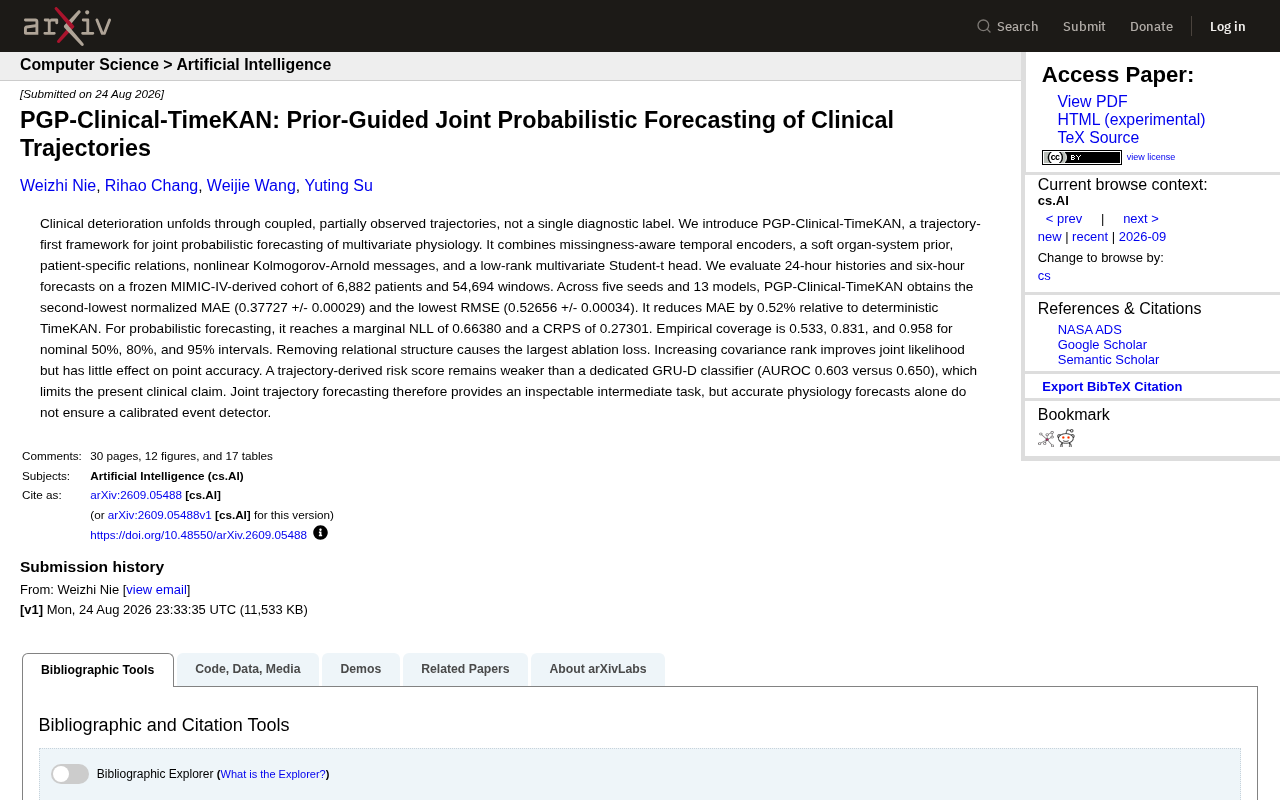
PGP-Clinical-TimeKAN: A Detailed Guide to the Multivariate Physiological Indicator Joint Prediction Framework
An in-depth analysis of the PGP-Clinical-TimeKAN framework for joint probabilistic prediction of multivariate physiological indicators, covering trajectory-first paradigm, KAN message passing, MIMIC-IV validation, and ablation studies.
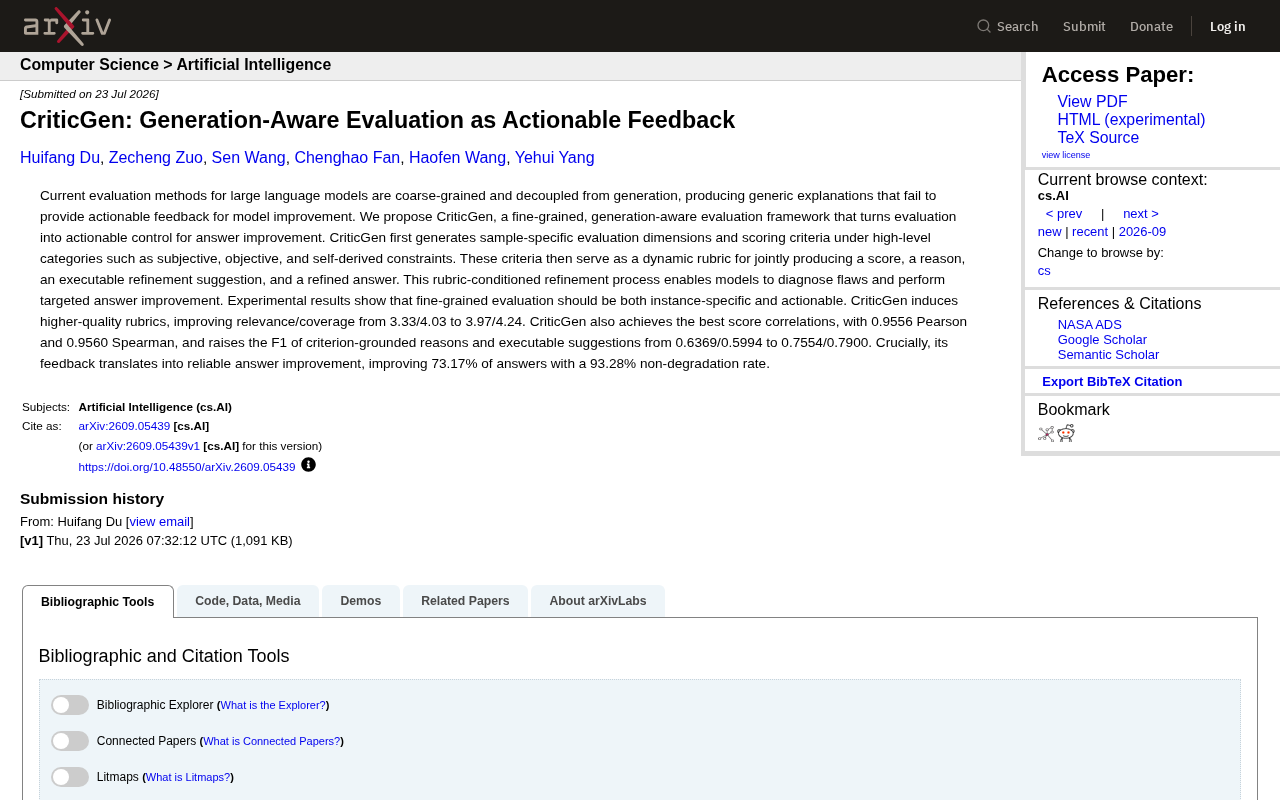
CriticGen: A New Framework That Transforms AI Evaluation into Actionable Improvement Feedback
CriticGen proposes a generation-aware evaluation framework that transforms AI assessment from passive scoring to an active optimization loop, achieving 73.17% answer improvement and 93.28% non-degradation rate.