Reverse Engineering Sudden Strike 2 with GPT-6: A Methodology for Understanding and Replacing n2Game_Dll

A 7-phase reverse engineering methodology for Sudden Strike 2's n2Game_Dll: from understanding to verified replacement.
Bilibili creator "Mujiezhi" uses the reverse engineering of Sudden Strike 2's core library n2Game_Dll as a case study to present a rigorous, 7-phase methodology for large-scale reverse engineering projects. The framework spans groundwork, version identification, structural indexing, deep analysis, cross-reference diffing, dynamic verification, and deliverable packaging — repeatedly drawing critical distinctions between indexing and analysis, self-written tests and original verification, and phase outputs versus true compatible replacement. Hard acceptance gates replace linear progress percentages.
In the world of software reverse engineering, there's a common misconception: that translating disassembly code line by line is the same as completing a crack. Bilibili creator "Mujiezhi" uses a hardcore project in the first episode of the "Yuanma Reverse Engineering Log" series — reverse engineering the core library n2Game_Dll of the 20-year-old real-time tactics game Sudden Strike 2 — to demonstrate a completely different approach: don't rush to report progress; lay out the methodology first.
The value of this episode isn't in showing off technical skills, but in breaking down a long-term reverse engineering project into verifiable, handoff-ready phases. For anyone looking to systematically approach reverse engineering or large-scale code reconstruction, this "establish the rules before you start" mindset is well worth adopting.
The Real Goals: Understand, Rebuild, Verify
The creator makes a clear distinction upfront between "goals" and "what has already been accomplished." The long-term objective of the entire project follows three steps: understand the core logic of Sudden Strike 2, rebuild a evidence-backed implementation (which the author calls "Yuanma"), and ultimately produce a verified replacement library.
Worth emphasizing is a line the author repeats throughout — "this is the goal, not something we've already achieved." This kind of statement is rare in technical content, yet critically important. The most common pitfall in reverse engineering is treating "I understood a piece of code" as "reconstruction is complete," or treating "function documentation" as "analysis finished." The author uses the analogy of "drawing a city map — marking the streets doesn't mean you've walked through every room" to precisely illustrate the gap between indexing and deep analysis.
A "replacement library" here refers to a self-developed dynamic link library with the same exported interface as the original DLL, which can be directly loaded and called by the host program (the game's main process) with behavior identical to the original. This type of work is known in the old game preservation and porting space as "compatible reimplementation" — famous examples include Wine (reimplementing the Windows API to run Windows programs on Linux) and various game engine reverse engineering projects (such as OpenMW for The Elder Scrolls III: Morrowind). The difficulty lies not in reproducing individual functions, but in guaranteeing behavioral equivalence across all host call paths — including edge cases, memory layouts, error handling, and even the "coincidental reproduction" of undefined behavior. This is the fundamental reason the author repeatedly emphasizes the gap between "goal" and "what's been accomplished."
Seven Phases: From Laying the Foundation to Deliverable Results
The project is divided into seven phases, numbered zero through six, each with clearly defined boundaries and outputs.
Phase Zero — Laying the Foundation: Inventory files, record hashes, separate read-only originals from the working directory, and leave readable handoff documentation. This step may seem tedious, but it's the prerequisite for all serious reverse engineering work — ensuring the original samples remain uncontaminated and every operation is traceable.
Phase One — Identifying the Sample: Compare versions, confirm file structure, bitness, and import/export tables. The author specifically warns against "treating files as the same version just because they share a name or similar size" — a classic trap in version management.
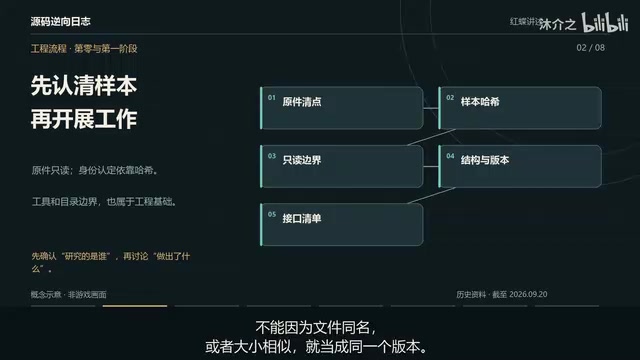
Phase Two — Drawing the Big Picture: Build an index of functions and strings, and trace cross-references to understand how entry points connect to various subsystems. This is the phase that corresponds to the "city map" analogy — establishing structural understanding, but not equating that to completed analysis.
The "import/export table" is a key data structure in the Windows PE (Portable Executable) format. The export table lists the function names and addresses that a DLL exposes externally, allowing the host program to bind them at load time; the import table records the other libraries and functions that the DLL itself depends on. In the early stages of reverse engineering, comparing the export tables of different versions of a file can quickly reveal added, removed, or renamed functions, helping to pinpoint version differences. A "hash" (such as MD5 or SHA-256) is a digital fingerprint of a file's content — any single byte change in the binary will produce a completely different hash. Recording hashes is therefore the rigorous method for determining whether two same-named files are truly identical, and is the technical basis behind the author's warning not to assume sameness based on filename alone.
Deep Diving the Main Thread: From Raw Instructions to Self-Written Tests
Phase Three is the current engineering backbone, and the part that best demonstrates methodological rigor. The author chooses to focus on core chains such as "hit points" and the "death lifecycle."
The workflow is: first examine the raw instructions to clarify fields, branches, and call sequences; then write the implementation and self-authored tests; once results match, check whether any edge conditions were missed. Here another key reminder appears — "passing self-written tests does not mean the original behavior has been verified against."
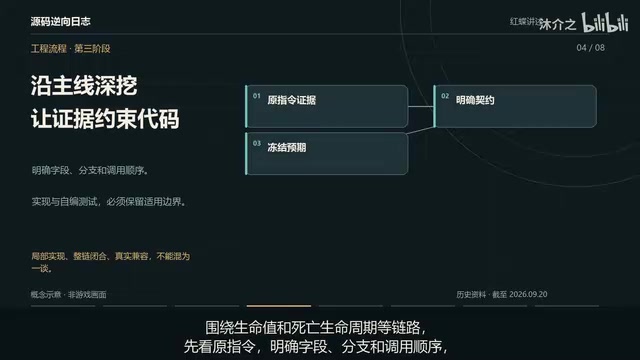
This distinction is highly professional. Self-written tests can only verify that the logic you understand is internally consistent — they cannot guarantee that it behaves identically to the original game in all scenarios. True verification requires comparing against actual runtime results from the original version. Many reverse engineering projects fail precisely because of this self-satisfied step.
Cross-Reference Diffing and Dynamic Verification
Phase Four deals with the interface relationships between the core library and external components. n2Game_Dll is not an island — it also interacts with the menu library, text library, file maps, and the host program. The author points out that even "knowing what an interface is called" doesn't mean the "parameters, memory layout, and allocation/deallocation responsibilities" are fully understood — an interface signature is just the tip of the iceberg.
Phase Five involves dynamic verification against the original game or a real host. The author emphasizes that the isolation environment, execution authorization, and rollback procedures must be clearly established before conducting these high-risk operations.
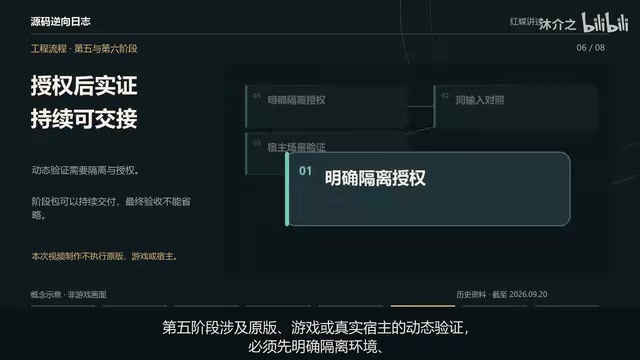
This emphasis on isolation and authorization reflects mature engineering ethics — dynamic verification can affect real systems, so safety nets are essential.
"Diff" in this context refers to performing a byte-by-byte or instruction-by-instruction comparison of two versions of a binary or disassembly result to locate points of change. The core challenge of Phase Four's "cross-reference diffing" is that the calling conventions, parameter stack order, and memory ownership (who allocates, who frees) between n2Game_Dll and other libraries must be perfectly consistent. Otherwise, even if function signatures appear identical, actual execution can produce memory corruption or crashes. "Allocation/deallocation responsibility" is a classic pain point in C/C++ era DLL interoperability — if an object is allocated by library A but freed by library B, and they use different heaps, it leads to crashes that are nearly impossible to reproduce. These issues are often only exposed during dynamic execution and are very difficult to fully cover through static analysis alone.
Delivery Acceptance Gates: Rejecting False Progress
Phase Six involves organizing source evidence, scripts, and known limitations into deliverable results. But the author is explicit: "producing a phase package does not mean the project is finished" — if the goal is still a compatible replacement, the real-world comparison and host verification steps cannot be skipped.
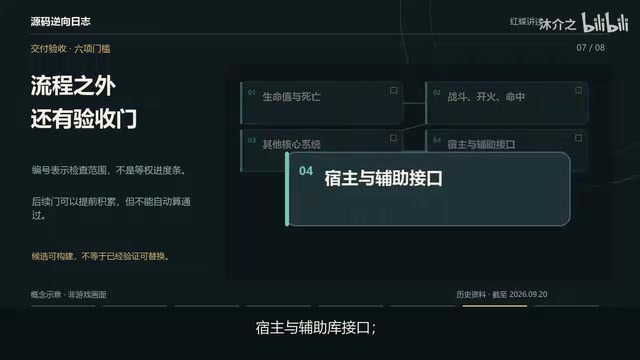
Beyond the engineering workflow, the author establishes a set of acceptance gates: hit points and the death lifecycle, combat firing and hit detection, other core systems, host and auxiliary library interfaces, candidate replacement library assembly, and finally authorization isolation, host integration comparison, and regression testing. Each item must be satisfied one by one.
The author summarizes the entire project's philosophy in one line: "You can't treat being in the middle of the first gate as having completed one-sixth of the project." In other words, progress is not a linear accumulation — acceptance gates are hard thresholds, not percentages you can discount.
"Regression testing" refers to re-running the full suite of known test cases after every code change to confirm that previously passing behaviors have not been broken by the new modifications. In reverse reconstruction projects, regression testing is especially critical — because every correction to the understanding of a function can potentially affect the higher-level logic that calls it. The author lists "authorization isolation, host integration comparison, and regression testing" as the final acceptance gate, meaning that unit-level self-written tests alone are insufficient to close out the project. It must be proven that the replacement library can drive the host program end-to-end through typical gameplay flows under conditions as close to a real runtime environment as possible. This requirement is fully consistent with the modern software engineering principle of "acceptance testing under production-equivalent conditions."
The Universal Value of This Methodology
Setting aside Sudden Strike 2 as the specific subject, this framework has reference value for any large-scale reverse engineering or code reconstruction project. Its core principle is to continuously connect "evidence, implementation, and acceptance" — not to declare the job done after translating disassembly. Phase outputs have value, but they cannot be passed off as full compatibility.
According to the creator's preview, the next episode will summarize and present the actual progress made since work began (as of September 20th). Judging by the methodological groundwork laid in this episode, the series is taking a "slow and steady wins the race" approach — set up the measuring stick first, then talk about how fast you're running. For audiences interested in reverse engineering, old game preservation, and code reconstruction, this kind of honest and systematic sharing is itself a rare resource.
Related articles

JobRunner MCP Server: AI Agents Can Now Fix Failed Java Jobs
JobRunner launches an open-source MCP server enabling AI agents to view cluster status, diagnose failures, and recover Java jobs—incident response from any cloud coding environment or existing agent.

MLAI Digital Launches 9 Security Agents: MCP Server Safeguards the Full Lifecycle of Agentic AI
MLAI Digital launches Security MCP Server with nine built-in specialized security agents covering vulnerability discovery, attack simulation, prompt injection detection, API and infrastructure assessment, and accelerated remediation—embedding security validation across the full Agentic AI lifecycle from development to production.

Running Isaac Lab on H100 GPUs: Exploring Better Approaches
Exploring optimization methods for running Isaac Lab on NVIDIA H100 GPUs, including MIG configuration, mixed precision, TensorRT acceleration, and community experience to improve robotics simulation and reinforcement learning efficiency.