Reverse-Engineering Windows Loudness Equalization and Porting It to PipeWire

Developer reverse-engineers Windows Loudness Equalization and ports it to PipeWire, filling a Linux audio gap.
Developer xoxorwr reverse-analyzed Windows' Loudness Equalization and ported it to PipeWire, the Linux audio server. The project pw-loudness-eq drew nearly 300 upvotes and 168 comments on Hacker News. Loudness Equalization uses dynamic range compression to balance audio loudness across sources; the port infers compression parameters from observed behavior and uses PipeWire's modular graph. Community reactions mix praise for practicality with concerns about sound quality.
From Windows to Linux: A Reverse-Engineering Journey of an Audio Algorithm
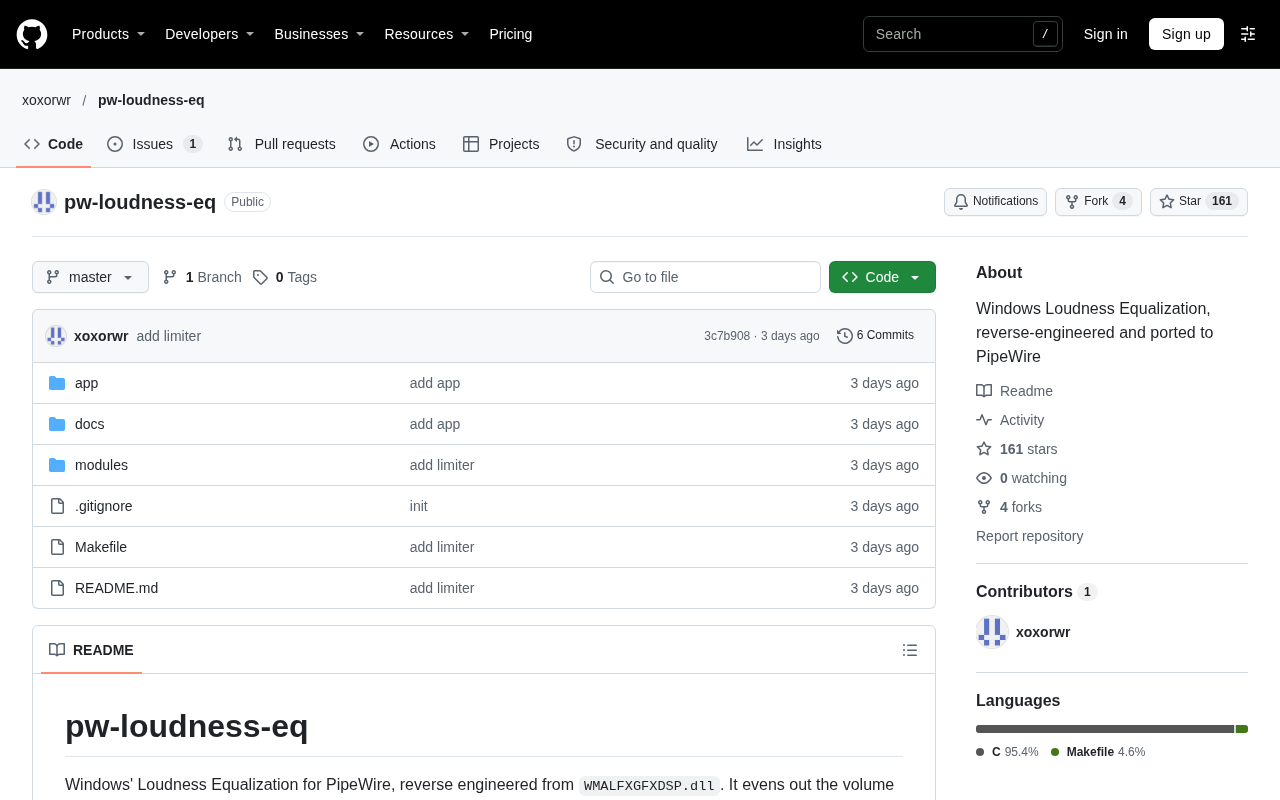
A project that sparked heated discussion on Hacker News (299 upvotes, 168 comments) showcases a classic case of the open-source community reverse-engineering proprietary technology. Developer xoxorwr reverse-analyzed Windows' Loudness Equalization feature and ported it to Linux's PipeWire audio server, naming the project pw-loudness-eq.
What Is Loudness Equalization?
Loudness Equalization is a feature in Windows audio enhancements that attempts to dynamically adjust the volume of audio signals so that audio from different sources with different dynamic ranges sounds more consistent in loudness. For example, when watching a movie, explosions won't be deafening while dialogue won't be too quiet to hear. This feature is common in consumer audio devices, but the Linux ecosystem has long lacked an official equivalent.
Dynamic range compression is the core signal processing technology behind loudness equalization. Dynamic range refers to the amplitude difference between the loudest and quietest signals in audio. A compressor narrows this gap through gain control: when the signal exceeds a set threshold, gain is reduced according to a certain compression ratio, smoothing out the loudness. Attack time determines how quickly the compressor responds to sudden peaks, while release time controls how quickly gain recovers after the signal falls back. These parameters together determine the perceived sound of compression—too fast an attack may weaken the punch of drum hits, while too slow a release can make overall volume "breathe" unnaturally. Windows' Loudness Equalization is essentially a dynamic range compressor with a specific set of preset parameters, tuned to bring the subjective loudness of movie dialogue and explosions, game sound effects and background music closer together without introducing obvious distortion.
Why Is It Worth Attention?
The value of this project lies not only in filling a functional gap in the Linux audio stack, but also in demonstrating how reverse engineering can bridge the experience gap between proprietary and open-source platforms. By understanding the logic of Windows' implementation, developers can replicate similar dynamic range compression behavior on PipeWire, thereby improving the audio experience for Linux users when watching videos, playing games, or listening to music.
Technical Implementation and Community Response
According to discussions in the Hacker News comment section, this port is not a simple copy of Windows' algorithm but a reimplementation within PipeWire's module framework based on reverse analysis of the original behavior. PipeWire, as a modern Linux audio server, has a modular design that allows developers to insert custom audio processing nodes, which facilitates porting loudness equalization.
The Challenges of Reverse Engineering
The implementation details of Windows' Loudness Equalization are not public, so reverse engineering requires inferring algorithm parameters from binary code or behavioral observation. Some commenters noted that such dynamic range compression algorithms involve tuning parameters such as threshold, compression ratio, and attack/release times, and that Windows' specific settings were fitted through experimentation. The project's author provides configuration options in the GitHub repository that allow users to adjust these parameters.
Reverse engineering in this context mainly refers to inferring algorithm logic through behavioral observation and black-box testing rather than directly decompiling binaries. For audio algorithms, common methods include: feeding test signals of known amplitude and frequency (such as steps, sine sweeps, and pulse trains) into Windows Loudness Equalization and measuring the gain change curve of the output signal to fit parameters such as threshold, compression ratio, and attack/release times; one can also infer whether multi-band compression or feedforward/feedback control structures exist by comparing steady-state output at different input levels. Such methods do not copy any proprietary code—they only replicate observable input-output behavior—so they are generally considered to carry low legal risk when the purpose is interoperability. However, the fitted parameters are only approximations; the original implementation may include undisclosed perceptual models or frequency-domain processing, which is precisely why the port needs to offer adjustable parameters.
Diverse Voices in the Community
Among the 168 comments, there was both affirmation of the project's practicality and discussion of its impact on sound quality. Some users worried that loudness equalization would destroy audio dynamic range, especially in high-fidelity listening scenarios. Others pointed out that for desktop users and gamers, the benefits of this feature outweigh the drawbacks. This divergence reflects the eternal trade-off in audio processing between "convenience" and "fidelity."
PipeWire is a new-generation Linux multimedia server designed to unify the previously fragmented ecosystems of PulseAudio (audio) and JACK (professional low-latency audio). It uses a graph-based node architecture: every audio source, processing module, and output device is a node in the graph, connected through ports to form processing chains. Developers can write SPA (Simple Plugin API) plugins or PipeWire modules to insert custom processing nodes into the audio stream without modifying applications or kernel drivers. This design allows pw-loudness-eq to be mounted as a module in the audio graph, applying dynamic range compression to the output of any application. Compared with PulseAudio's module mechanism, PipeWire's graph model is more flexible, supporting per-stream, per-device, or global processing, and it natively supports the PulseAudio client protocol, lowering the cost of migration.
Significance for Linux Desktop Audio
For a long time, Linux desktop audio has often been criticized as "feature-complete but lacking in detail." The rise of PipeWire is changing this situation, and community projects like pw-loudness-eq are a manifestation of a thriving ecosystem. It does not need to wait for upstream vendor support; instead, developers spontaneously fill the gaps.
For ordinary users, this means that a Windows-like audio experience is now available on Linux; for developers, it provides a reference case for studying dynamic range compression and PipeWire module development. The project's open-source nature also means it can be integrated into distributions or audio tools, further lowering the barrier to use.
Conclusion
Reverse engineering often walks a gray area between law and ethics, but porting projects like this—aimed at interoperability and not involving pirated code—are generally regarded as reasonable contributions to the open-source community. The emergence of pw-loudness-eq is not only a technical achievement but also an embodiment of the spirit of open-source collaboration—using code to bridge the experience gap between platforms.
One-line Summary
A developer reverse-engineered Windows Loudness Equalization and ported it to PipeWire, filling a gap in Linux audio features.
Paragraph Summary
Developer xoxorwr reverse-analyzed Windows' Loudness Equalization feature and ported it to Linux's PipeWire audio server. The project pw-loudness-eq received nearly 300 upvotes and 168 comments on Hacker News. Loudness Equalization balances the loudness of audio from different sources through dynamic range compression, and Linux has long lacked an equivalent implementation. The project is not a simple copy but infers compression parameters based on behavioral observation and uses PipeWire's modular graph architecture to insert custom processing nodes. The community affirms its practicality but also has divergent views on its impact on sound quality, reflecting the trade-off between convenience and fidelity. The project demonstrates a typical pattern of the open-source community filling proprietary platform feature gaps for interoperability purposes.
Related articles

Michael Nielsen Takes Down His Classic Neural Network Textbook, Sparking Community Discussion
Michael Nielsen's classic free textbook Neural Networks and Deep Learning has been taken offline, sparking discussion on Hacker News about the reasons and impact.

Inside the AI Training Data Market: The Trade-off Between Exclusivity and Discounts
G2i founder Gabe Greenberg reveals the dual-track pricing of the AI training data market: labs pay a premium for exclusive data or accept discounts that allow others to buy it.

SessionGraph: Unifying All Coding Agent Sessions in One Interactive Graph
SessionGraph aggregates coding agent sessions into an interactive graph, helping developers review, debug, and manage AI coding workflows across sessions. This article examines its positioning, value, and open questions.