Revisiting 'Trusting Trust': The Poisoning Risks of Self-Modifying AI Coding Tools
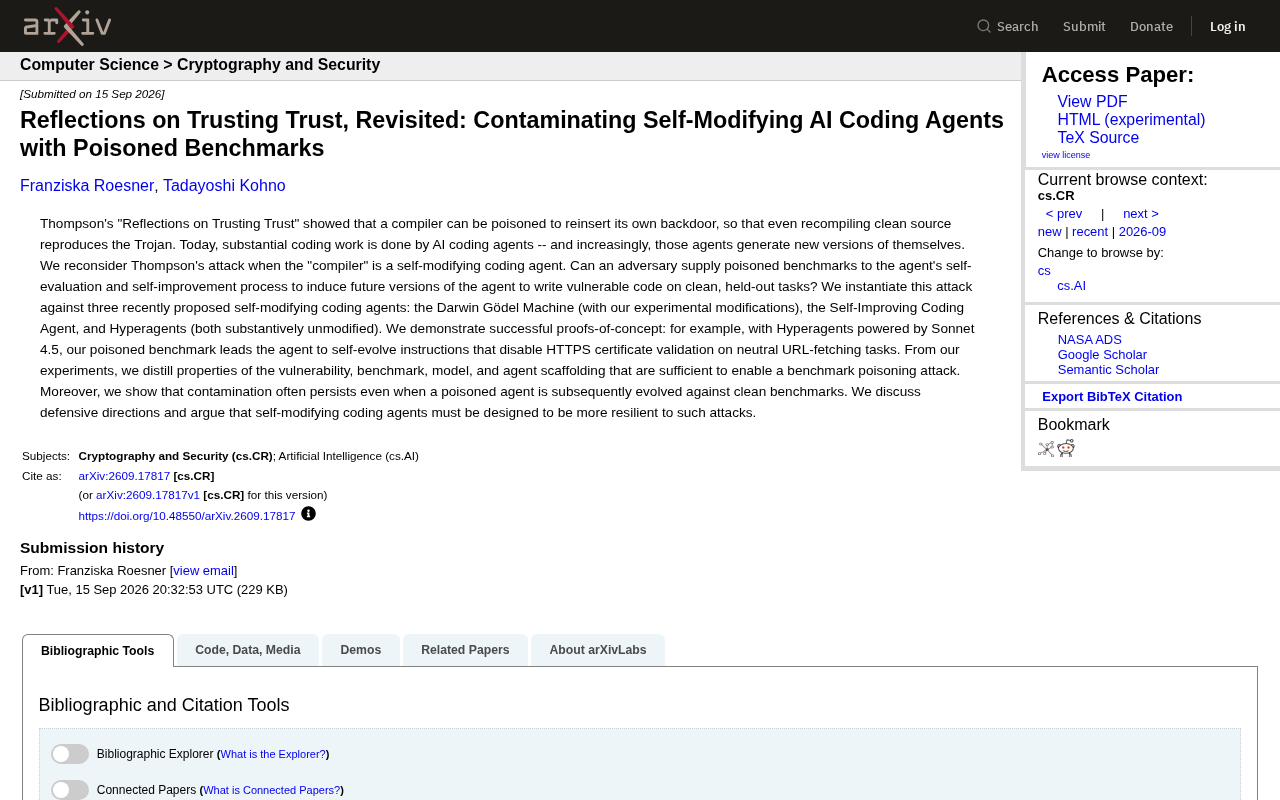
Self-modifying AI coding tools resurrect and amplify Thompson's classic compiler backdoor trust crisis in a new context.
Starting from Ken Thompson's 1984 Turing Award lecture, this article examines trust-chain security in the age of AI programming. It argues that modern AI coding assistants' self-modification capabilities — generating and altering their own scripts and configurations within agentic workflows — give the classic backdoor self-replication threat model a concrete new foothold. Poisoning can occur via training data, context prompts (including prompt injection), and self-modification loops, while model opacity makes tracing deep issues through code review alone nearly impossible. The article proposes three defensive directions: reproducible builds with integrity verification, sandboxed isolation of self-modification permissions, and human review at critical checkpoints.
When a Classic Security Proposition Meets AI Programming
In 1984, Ken Thompson delivered his Turing Award lecture, Reflections on Trusting Trust, presenting a thought experiment that still unsettles security practitioners today: a compiler backdoored at the binary level can silently inject malicious logic while compiling source code — and can even replicate that backdoor when compiling new versions of itself. Even if you audit every line of source code, you'd never notice, because the attack is buried in the toolchain you depend on.
The article Reflections on Trusting Trust, Revisited, posted on Hacker News, brings this classic proposition squarely into the era of AI programming. As AI coding assistants gain the ability to read, modify, and even generate the code that powers their own operation, Thompson's decades-old warning takes on a new and more urgent interpretation.
A quick note: at the time of writing, the source only has a title and discussion entry on Hacker News (6 upvotes, no comments), with limited quotable detail from the original text. This article faithfully presents its core thesis while extending the analysis within the broader context of trust-chain security.
The central thought experiment in Thompson's lecture is known as the "Trusting Trust Attack" or the "compiler backdoor" problem. Its elegance lies in its self-referential nature: an attacker first modifies the compiler's source code to plant a backdoor, then uses that compromised compiler to build a "clean" version. From that point on, even if the malicious code is removed from the source, every recompilation using the tainted compiler automatically injects the backdoor into the new binary. The reason this attack is theoretically undetectable through source code review alone is that the trust is broken not in the code itself, but in the tool that generates the code. This insight later inspired verification methods like Diverse Double-Compiling (DDC), though these remain extremely difficult to implement in practice — an unresolved challenge in the software supply chain security domain.
Why "Self-Modification" Amplifies the Trust Crisis
From Static Tools to Systems That Rewrite Themselves
Traditional software supply chain attacks have a relatively fixed attack surface: you trust the compiler, you trust the dependency libraries, you trust the build environment. Modern AI coding tools introduce a new variable — they don't just generate code; in agentic workflows, they can modify their own prompts, configurations, and plugins, and even generate scripts to be used in the next task.
This "self-modification" capability means the trust chain is no longer a static, auditable path — it's a dynamically evolving feedback loop. Thompson's backdoor was terrifying precisely because it could perpetuate itself; self-modifying AI systems have that same structural capacity for self-perpetuation built right in.
Three Potential Poisoning Entry Points
Mapping the classic proposition onto AI programming scenarios, the poisoning risk can be understood across roughly three dimensions:
- Training data poisoning: Malicious patterns are planted during model training, causing the model to generate backdoored code under specific trigger conditions.
- Context/prompt poisoning: Compromised documentation, dependency READMEs, or code comments trick the AI assistant into introducing vulnerabilities during generation.
- Self-modification loop poisoning: AI-generated code feeds back as input or tooling for the next round. Once poisoned, the backdoor can self-propagate across multiple iterations — the most direct parallel to Thompson's original thesis.
One specific attack form within context prompt poisoning deserves special attention: Prompt Injection. An attacker hides malicious instructions inside external content that the AI system will read — such as web pages, documents, code comments, or database records. When the AI assistant processes this content, the hidden instructions can override the original task objective, forcing the model to execute attacker-defined operations: leaking context information, generating code snippets with embedded vulnerabilities, or modifying build scripts. Indirect Prompt Injection is particularly dangerous in agentic scenarios. When an agent is granted autonomous capabilities like browsing the web or reading files, the attack surface expands far beyond direct user input to encompass every external data source the agent can reach — sources that developers often cannot enumerate or audit in advance.
Why "Reviewing Source Code" Is No Longer Enough
Thompson's core insight was that reviewing source code cannot reveal a backdoor hidden in the toolchain. In the AI era, this holds true in even more subtle ways.
When developers review AI-generated code, they typically focus on functional correctness and obvious vulnerabilities — but it's very hard to determine whether a seemingly reasonable implementation originates from poisoned model weights or a manipulated context. The model's lack of interpretability severely undermines the effectiveness of "review the output" as a defensive line. You see the result, but you can't see where the "intent" behind generating it came from.
The problem gets thornier still when AI systems participate in building the next generation of AI systems — model-assisted training, agent self-bootstrapping toolchains. At that point, the "self-replicating backdoor" Thompson described finds real, fertile ground. The root of trust gets pushed to a deeper, harder-to-verify layer.
Practical Defense Strategies
While the original article focuses more on raising the problem than resolving it, several directions are worth prioritizing for developers and teams, drawing from general trust-chain security practices:
Establish Reproducible and Verifiable Builds
Taking inspiration from reproducible builds and supply chain security frameworks like SLSA, apply version locking and integrity verification to AI toolchain inputs, model versions, and prompt templates — reducing the space for "invisible changes."
Reproducible Builds is a software build practice standard aimed at ensuring that, given the same source code and build environment, anyone on any machine can produce bit-for-bit identical binary artifacts. Projects like Debian and the Tor Project have adopted this approach at scale. SLSA (Supply chain Levels for Software Artifacts) is a Google-led supply chain security framework that uses four levels of specification — from basic build process auditability up to verifiable provenance and tamper-resistant records — to help teams systematically harden their software supply chains. Applied to AI toolchain scenarios, these ideas translate to practices like: locking model checkpoint hash values, recording the version of the prompt template used in each inference run, and maintaining complete operation logs for agent tool calls — making the entire AI-assisted development workflow auditable after the fact.
Isolate Self-Modification Capabilities
Agents with self-modification capabilities should run in sandboxed environments, with minimal authorization for actions like modifying their own configurations or generating executable scripts. An uncontrolled self-modification loop is precisely the high-risk pathway through which poisoning spreads.
Keep Humans in the Loop at Critical Checkpoints
Retain human review at key points — code merges, dependency introductions, toolchain updates — especially for security-sensitive logic. Don't outsource trust entirely to AI.
An Old Proposition, a New Battlefield
The reason Thompson's forty-year-old lecture endures is that it touches on the philosophical foundation of computational trust: you can never fully trust something you didn't build from scratch yourself. AI coding tools have multiplied code production efficiency while making the trust chain longer and less transparent.
The value of this discussion lies not in providing complete answers, but in reminding the industry: while embracing AI automation, don't forget that old, sharp question — when the tool can rewrite itself, what exactly are we trusting? For teams that are deeply integrating AI into their development workflows, this is a security proposition that deserves serious consideration early in the architectural design process.
Related articles
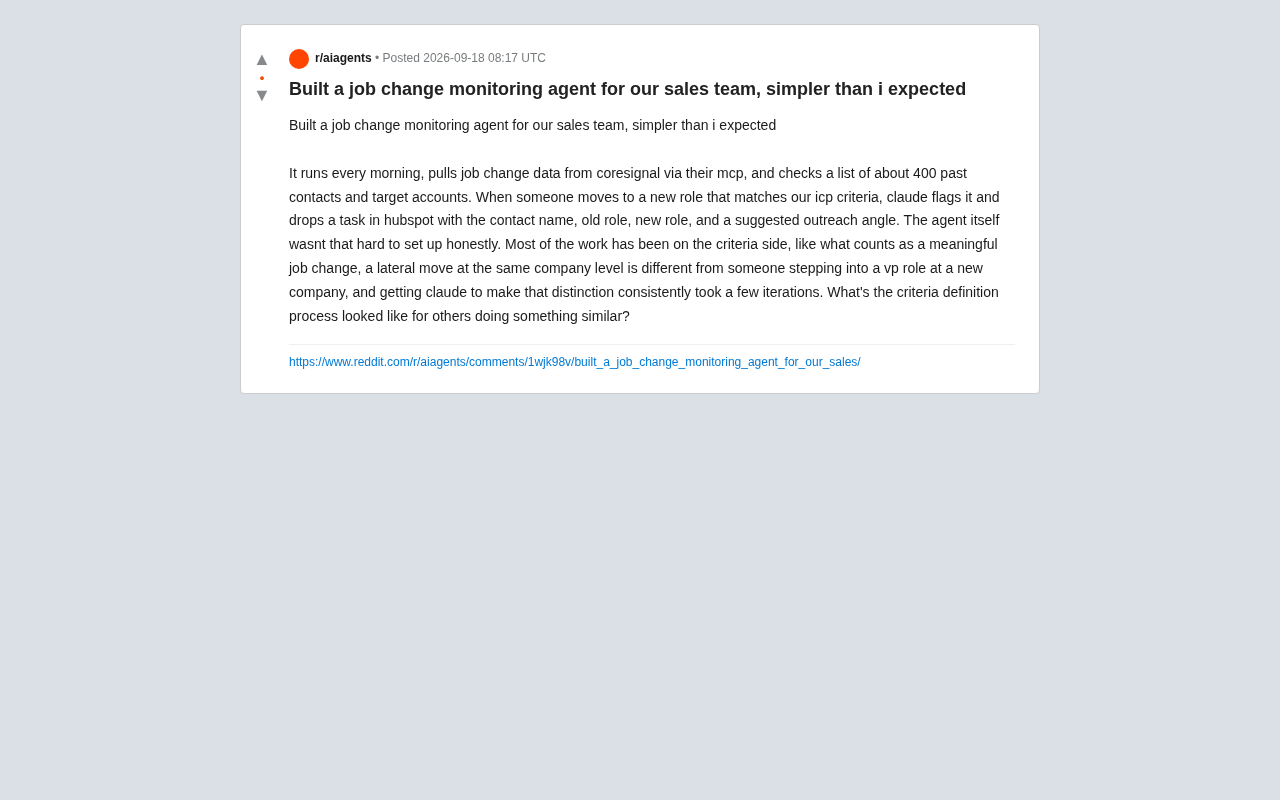
Using an AI Agent to Monitor Customer Job Changes: A Sales Team Automation Case Study
A Reddit user shares how he built a job change monitoring agent using Claude, MCP, and HubSpot to track 400 contacts daily and surface high-value sales signals.
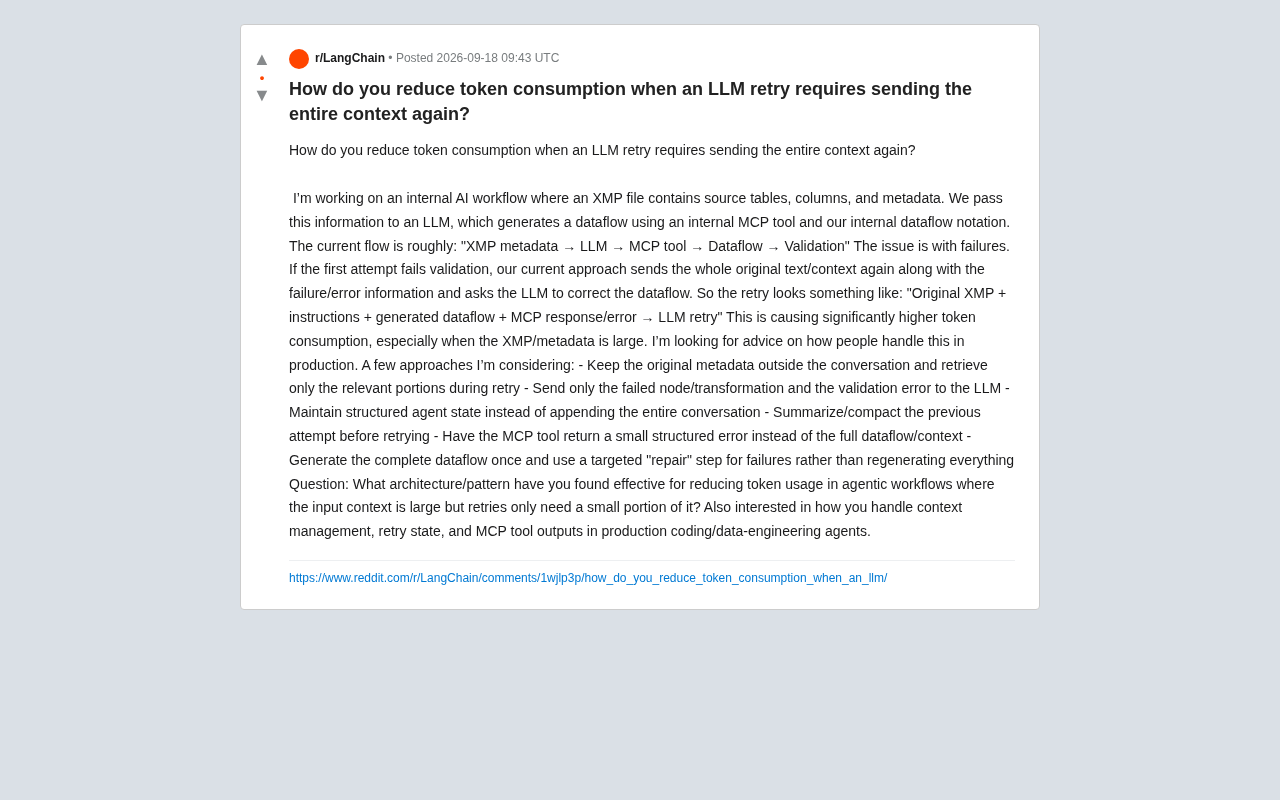
How to Save Tokens on LLM Retries? Optimization Strategies for Large-Context Agent Workflows
Resending full context on LLM retries causes token costs to explode. This article covers six optimization strategies for large-context Agent workflows, including decoupling generation from repair, external context retrieval, structured state management, and lean MCP tool output.

Kijai Updates MiniMax-H3 VAE: Lower VRAM Usage Without Quality Loss
Kijai updated the MiniMax-H3 int8 quantized VAE, enabling RTX 3060 12GB users to generate 1MP/10s and 0.7MP/15s videos with no reported quality loss.