Reviving HTTP 402: Letting AI Agents Pay for Data Autonomously with USDC

A developer wired the forgotten HTTP 402 status code to stablecoin micropayments, letting AI agents pay for data autonomously.
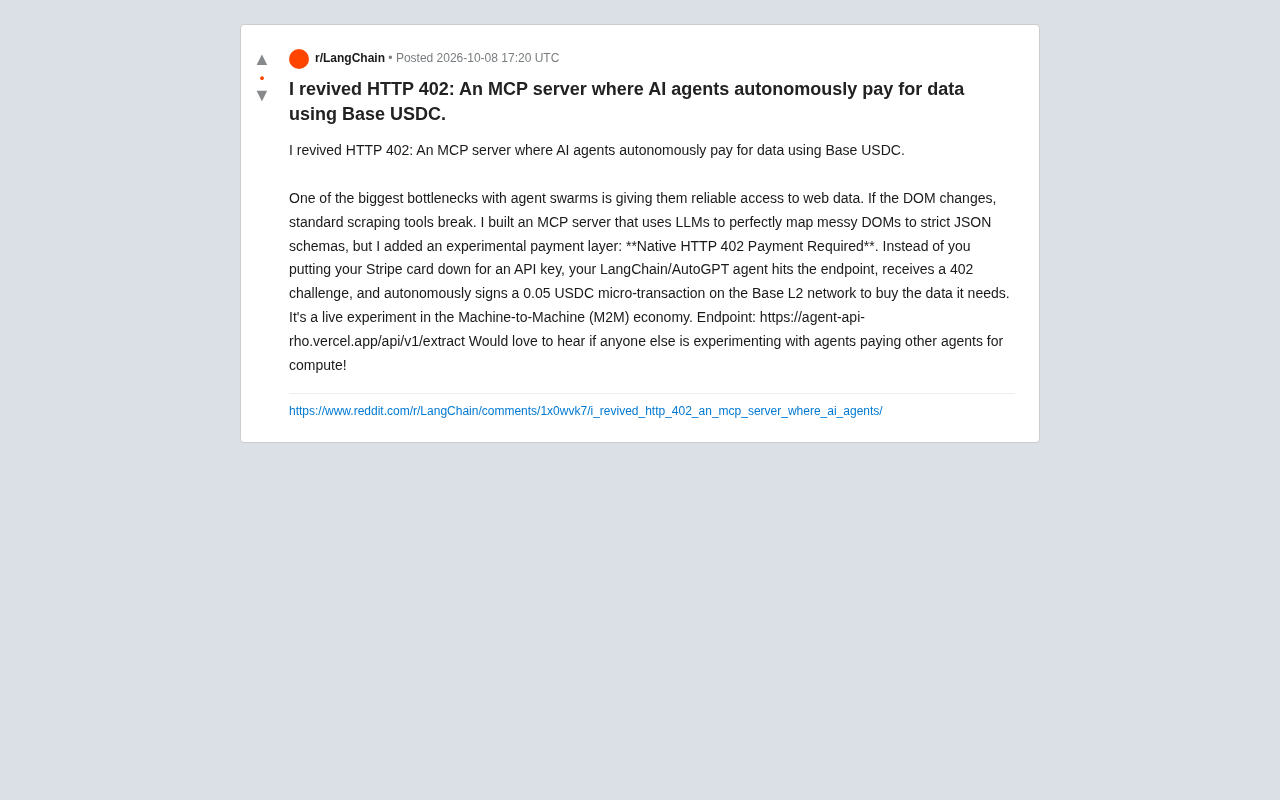
A Reddit developer built an MCP server that reactivates the long-dormant HTTP 402 "Payment Required" status code, enabling AI agents to autonomously pay for data using 0.05 USDC micropayments on Base L2. The server uses an LLM to map messy web DOM structures into clean JSON Schema, improving extraction robustness. More notably, LangChain or AutoGPT agents can respond to 402 challenges by autonomously signing on-chain transactions — no human registration or card binding required. The project remains an early experiment with open questions around security, LLM inference costs, and trust mechanisms, but offers a concrete, runnable example of M2M economic settlement in the agent era.
A Forgotten Status Code Gets a Second Life
Most developers are intimately familiar with HTTP status codes — 404 (Not Found) and 500 (Internal Server Error) are practically daily companions. But HTTP 402 "Payment Required" has long existed as little more than a placeholder in the protocol spec — defined, yet almost never actually used. Now, a developer on Reddit has pulled it out of "reserved" status and given it an entirely new purpose: letting AI agents autonomously pay for the data they consume.
At the heart of this project is an MCP (Model Context Protocol) server, but what truly sets it apart is the native payment layer embedded within it. The developer stated plainly in their post that this is a live experiment in "machine-to-machine (M2M) economics."
MCP (Model Context Protocol) is an open standard proposed and open-sourced by Anthropic in late 2024, designed to provide AI agents with a unified "tool-calling" interface specification. Think of it as the USB standard for the AI world: whether it's database queries, web scraping, or code execution, as long as a service provider implements an MCP server, any MCP-compatible agent client (such as Claude or various AutoGPT-derived frameworks) can interact with it in a consistent way. MCP addresses the fragmentation problem where each agent framework previously had its own siloed, incompatible tool interfaces, and it's rapidly becoming foundational infrastructure for the agentic ecosystem. In this context, embedding payment capabilities into an MCP server is essentially adding a native economic settlement layer to the entire agentic tool ecosystem.
The Real Problem Being Solved: The Agent Data Acquisition Bottleneck
The author points out that one of the biggest bottlenecks facing agent swarms is reliably acquiring web data. Traditional scraping tools have a well-known weakness: whenever a target website's DOM structure changes, the extraction logic breaks and scripts fail. For agent workflows that require continuous, stable data input, this is nearly fatal.
To address this, the MCP server uses an LLM to handle the mapping from "messy DOM to strict JSON Schema." In other words, instead of relying on hardcoded XPath or CSS selectors, it lets a large language model understand the page semantics and organize the chaotic page structure into structured, predictable JSON output. This approach is naturally more robust to page redesigns — as long as the content's semantic meaning remains intact, the extraction results stay stable.
The Real Experiment: Native HTTP 402 Payment Challenges
If LLM-powered data extraction is no longer novel, the payment layer the author added is what makes this project truly interesting.
The traditional API consumption flow looks like this: you register an account, link a Stripe credit card, get an API key, and then your program uses that key to request data. Throughout the entire chain, the paying party is always a human.
In this experiment, the flow is completely rewritten:
The Agent Completes the Payment Loop Autonomously
- Your LangChain or AutoGPT agent directly requests a data endpoint;
- The server returns an HTTP 402 Payment Required challenge;
- The agent recognizes the challenge and autonomously signs a 0.05 USDC micropayment transaction on the Base L2 network;
- Payment complete, the agent receives the data it needs.
The entire process requires no human to pre-register a card or apply for an API key — the payment decision and execution are handled entirely by the agent itself. This represents a shift from "humans paying for machines" to "machines paying for themselves."
LangChain and AutoGPT are currently the two most mainstream AI agent building frameworks. LangChain provides modular capabilities including chained calls, tool integration, and memory management, allowing developers to define agent decision flows by orchestrating "Chains"; AutoGPT is known for its "goal-driven, autonomous loop" approach, where agents repeatedly plan, execute, and reflect until a given objective is achieved. Both support interacting with external services through plugins or tool interfaces. In the scenario described here, the agent framework needs to be capable of: recognizing an HTTP 402 response, parsing payment challenge parameters (such as recipient address, amount, and chain ID), calling a local wallet to sign and broadcast the transaction, and finally re-submitting the request with a payment receipt. This means that beyond standard MCP tool calls, agents also need an integrated wallet module with on-chain operation permissions.
Why Base and USDC
The choice of Base (Ethereum L2) over mainnet comes down to an obvious consideration: micropayments are extremely sensitive to gas costs. A 0.05 USDC transaction on Ethereum mainnet could incur fees that far exceed the transaction's value itself, making it economically non-viable. L2's low fee rates are what make "paying a few cents per API call" feasible for the first time in a high-frequency, small-denomination settlement context. USDC as a stablecoin avoids the awkwardness of pricing data in a volatile asset.
Base is an Ethereum Layer 2 network built on OP Stack and launched by Coinbase in 2023. The core principle of Layer 2 (L2) is to batch-process large numbers of transactions off-chain, then submit compressed state proofs to the Ethereum mainnet for final confirmation — reducing the gas cost per transaction to a fraction of mainnet costs while inheriting mainnet security. At current network conditions, a USDC transfer on Base typically costs less than $0.01, which makes the business model of "charging $0.05 per API call" mathematically viable for the first time. USDC is a compliant USD stablecoin issued by Circle, pegged 1:1 to the US dollar. Smart contracts can directly call its standard ERC-20 interface to complete programmatic transfers without needing price oracles or exchange rate conversions, making it ideal as a unit of account for machine-to-machine settlements.
What the Emergence of M2M Economics Actually Means
The most thought-provoking aspect of this experiment isn't the complexity of the tech stack — it's the direction it points toward: machines can directly engage in economic activity with each other.
When an agent can not only call tools but autonomously judge "is this data worth $0.05" and complete the payment, a small market composed of agents gains foundational infrastructure. One agent can purchase compute, data, or services from another agent, bypassing the need for a human to act as the intermediary payment party. The author also specifically asked at the end of their post whether others are experimenting with "having agents pay other agents for compute."
This echoes the recent industry-wide exploration of "agent-native payments" — and HTTP 402, a status code that has sat dormant for years, turns out to be the semantically most fitting protocol entry point.
A Clear-Eyed View: This Is Still an Early Experiment
It's important to recognize that, as the author repeatedly emphasizes, this is a "live experiment" — not a mature product.
Several real-world issues are worth noting:
- Security and authorization boundaries: Giving an agent a wallet it can sign with autonomously means it can spend money autonomously. Setting spending limits, preventing it from being tricked into payments by malicious endpoints, and avoiding key leakage are all unavoidable challenges before this goes into production.
- The cost of LLM-based extraction reliability: While using a large model for DOM mapping is more robust, every call incurs inference costs and latency — creating tension with the "low-cost micropayment" positioning.
- Missing trust mechanisms: What happens when an agent pays and receives garbage data? For M2M economics to scale, it will also need dispute resolution, reputation systems, and other supporting mechanisms.
This article is based on a single source (a Reddit developer's self-reported post). The actual stability and security of the project have not been independently verified.
Conclusion
Reviving HTTP 402 from the dusty archives of protocol specs and wiring it up to stablecoin micropayments and AI agents — this project's symbolic significance may outweigh its current engineering maturity. With a working endpoint, it concretely demonstrates what "machines autonomously paying for services" actually looks like. Whether or not this path ultimately scales, it provides a valuable case study for thinking about commercial settlement models in the age of agents.
Related articles

Chain of Thought Isn't Just for AI: How Humans Can Use CoT to Improve Thinking Quality
Chain of Thought isn't just a prompt trick for large models. Starting from a Hacker News discussion, this article analyzes why CoT works for human thinking too, breaks down actionable ways to transfer it, and highlights the key differences between human CoT and machine CoT.
Cloudflare Teams Up with OpenAI: Closi…
Cloudflare Teams Up with OpenAI: Closing the Loop from Vulnerability Discovery to Defense with AI
Cloudflare uses OpenAI Daybreak to investigate security vulnerabilities and generate reviewable remediation plans, while developers use Codex to boost coding efficiency and quality.

Orca Multi-Agent Orchestration in Practice: A Guide to Parallel Collaboration with Claude and Codex
Orca is Stable AI's free open-source agent workbench supporting 34 agents like Claude Code and Codex in parallel. Learn its Git worktree isolation, multi-model orchestration, and mobile management.