Rewriting an IDE in Rust: What New Possibilities Does OpenIDEA Bring?

OpenIDEA attempts to rewrite a familiar IDE in Rust, exploring new possibilities for performance and stability.
OpenIDEA is a project discussed on Hacker News that rewrites a familiar IDE in Rust rather than building a new editor from scratch. The article analyzes the motivations: traditional IDEs based on Java or Electron suffer from slow startup and high memory usage; Rust's native compilation, memory safety, and ownership model could bring faster cold starts, lower memory overhead, and more stable concurrency. However, an IDE's competitiveness depends not only on performance—plugin ecosystems, debugger integration, and LSP compatibility remain significant challenges. The project is still in its early stages with limited community feedback, making it more of a technical direction exploration that developers interested in toolchain evolution should keep an eye on.
When a Classic IDE Meets Rust
On Hacker News, a project called OpenIDEA sparked discussion with a straightforward title: "The IDE you know, rebuilt in Rust." This isn't yet another editor built from scratch—rather, it attempts to rewrite an IDE (Integrated Development Environment) that developers are already familiar with, using Rust. Although the post didn't gain much traction (5 points, 1 comment), the direction of "rewriting in Rust" itself is worth paying attention to.
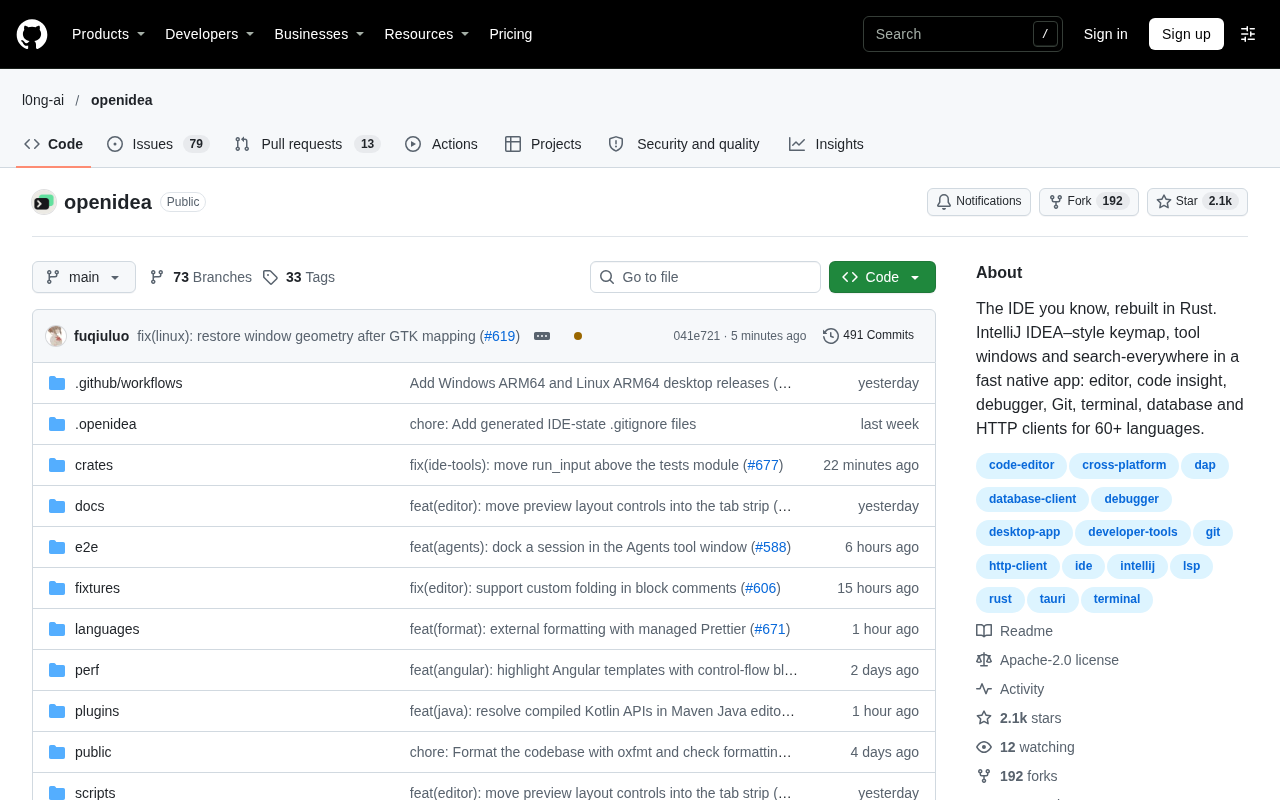
Rust's rise in the systems programming world is no secret. Its memory safety, zero-cost abstractions, and concurrency model are attracting an increasing number of toolchain projects. Rebuilding something as complex and performance-sensitive as an IDE in Rust reflects a rethinking of startup speed, memory footprint, and response latency.
Why Rewrite an IDE in Rust?
Traditional IDEs are typically built on Java (like Eclipse and IntelliJ IDEA) or Electron (like VS Code)—the former relies on the JVM and starts relatively slowly, while the latter is often criticized for its memory usage. Rust compiles to native code, which in theory can deliver faster cold starts and lower memory overhead.
The deeper motivation lies in architecture: Rust's ownership model forces developers to handle concurrency and data races at compile time. For a system like an IDE that requires parallel indexing, syntax analysis, and real-time feedback, this could mean more stable runtime behavior. OpenIDEA's choice to target "the IDE you know" suggests it doesn't want to change users' habits, but rather replace the implementation skeleton from the ground up.
LSP (Language Server Protocol) is an open protocol proposed by Microsoft in 2016 to standardize communication between editors/IDEs and language services. Language servers are responsible for providing capabilities such as code completion, go-to-definition, hover information, and diagnostics, while editors interact with servers via JSON-RPC. LSP decouples language intelligence from the IDE, allowing the same language server to be reused by VS Code, Vim, Emacs, and other editors. For rewrite projects like OpenIDEA, LSP compatibility means it can directly tap into the existing language server ecosystem without having to implement analysis features from scratch for every programming language—a key factor in reducing engineering complexity.
Zero-cost abstraction is one of Rust's core design principles, meaning that high-level language features (such as generics, iterators, and traits) introduce no additional runtime overhead after compilation. The compiler generates concrete code for generics through monomorphization and eliminates abstraction layers through inlining optimizations. This means developers can write code using expressive abstractions while achieving performance comparable to hand-written low-level code. For systems like IDEs that frequently process syntax trees, symbol tables, and text buffers, zero-cost abstractions make it possible to maintain code maintainability while still meeting real-time responsiveness requirements.
The Practical Impact on Developers
If OpenIDEA can deliver on its promise of "familiarity + Rust core," developers could enjoy a more responsive editing experience, especially on large projects. But it's important to be clear-headed: an IDE's competitiveness depends not only on language and performance—plugin ecosystems, debugger integration, and language server protocol compatibility are all more daunting engineering challenges.
Judging from the current Hacker News discussion, the project is still in its early stages with limited community feedback. It's more of an exploration of a technical direction: proving that Rust is capable of hosting the core components of a complete IDE. For developers interested in the evolution of toolchains, it's worth keeping an eye on.
Electron is a framework for building cross-platform desktop applications using web technologies (HTML, CSS, JavaScript). It bundles the Chromium rendering engine and the Node.js runtime together. Well-known applications such as VS Code, Slack, and Discord are all built on Electron. Its advantages are high development efficiency and flexible interfaces, but the trade-off is that every application carries a complete browser engine, resulting in large installation packages and high memory usage. This is precisely why Electron is "often criticized" for its memory consumption, as mentioned in the article, and it's one of the pain points that native Rust rewrites of IDEs are trying to address.
Conclusion
OpenIDEA may not become a mainstream IDE, but the question it raises is very real: is there still room to redesign the underlying architecture of the development tools we use every day? Rust's answer is being validated by more and more projects.
Related articles

AI Tools Quietly Altering Settings: Postman Silently Installs Plugin, Codex Sharing Option Auto-Resets
AI Daily reports: Postman silently installs a Mac plugin and self-approves startup hooks, logged as auto-existing upgrade; Hacker News developers say Codex data-sharing opt-out flips back. Plus Simon Willison's raw float weight experiment with QEN 3.8-27B.

AI Learns to Rewrite AI: MIT's "Weightspace Programming" Redraws the Path to Recursive Self-Improvement
MIT team proposes weightspace programming: GPT-6 Astra reads and edits AI model weights directly. Math scores jump several-fold, hand-written networks beat trained models. Eight experiments analyzed, plus Anthropic's same-day warning and the real boundaries of recursive self-improvement.

Running Qwen 3.8 on a Laptop to Read Raw Weights: 46 Minutes Per Answer
Simon Willison reproduced weight space programming with Qwen 3.8 27B on a laptop: a 17GB model file, 46 minutes per answer, 43,506 reasoning tokens, Pong over an hour, Freeway failed. Suited for interpretability researchers.