Rewriting HP Printer Firmware with Claude to Bypass Third-Party Ink Lockout?

Rewriting HP firmware with Claude to unlock third-party ink fails on technical, legal, and ethical grounds.
Starting from a Reddit post, this article examines the idea of using Claude to rewrite HP printer firmware to support third-party ink. Technically, firmware depends on undisclosed hardware details, lacks symbols, and uses secure boot signatures, making direct AI rewriting nearly impossible—though AI can assist human analysis and bypass coding. Legally, cracking cartridge authentication may violate DMCA Section 1201, and HP has won prior lawsuits. Ethically, supporters call it a fight against vendor lock-in and e-waste, while critics warn of agreement violations and abuse. The core issue: as AI lowers cracking barriers, will the old commercial and legal balance break?
A Reddit Post Sparks a Debate: The Ethics and Feasibility of AI-Rewritten Firmware
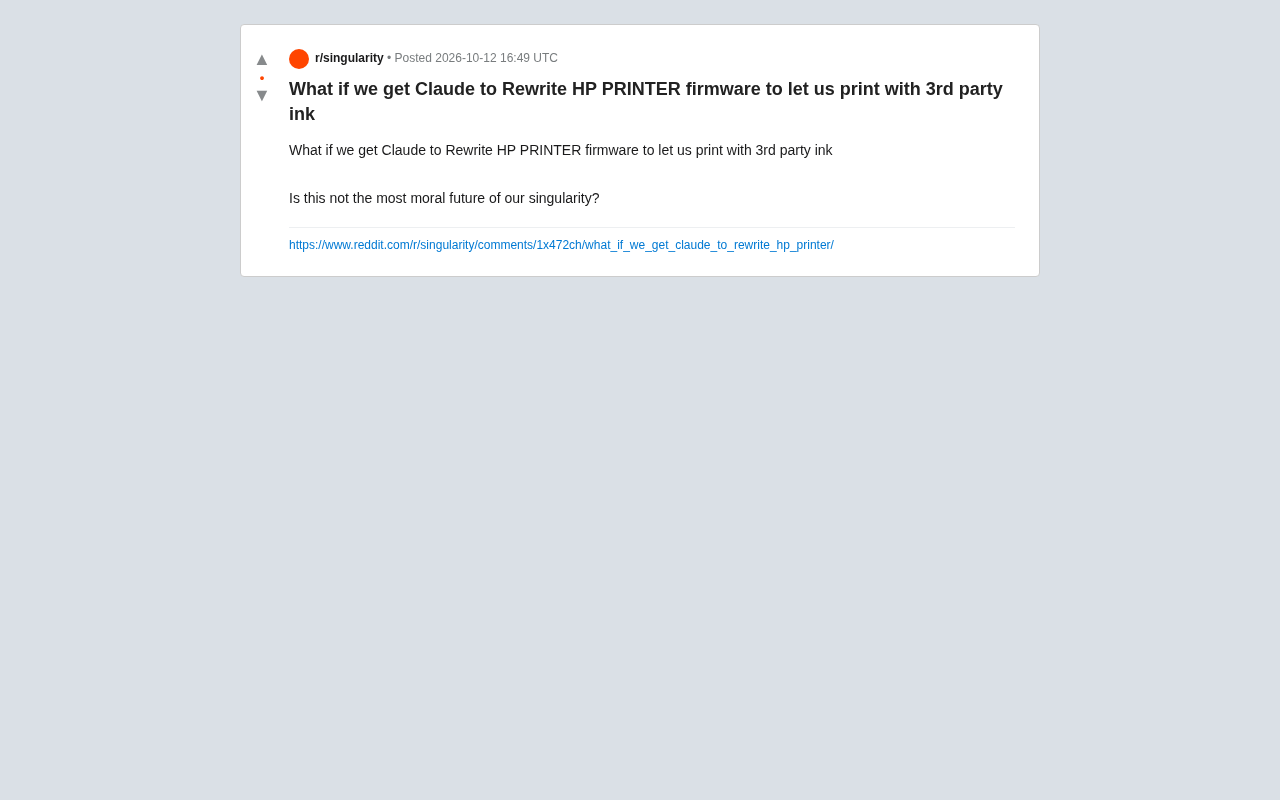
A post on Reddit proposed a bold idea: get Claude to rewrite HP printer firmware so that third-party ink cartridges can be used. The poster even asked: "Isn't this the most ethical future of our technological singularity?"
Absurd as it sounds, this idea touches on several sensitive topics—the boundaries of AI capabilities, vendor lock-in strategies, and consumer rights. As someone who has long followed AI applications and hardware hacking, I think it's worth breaking this thought experiment down along three dimensions: technical, legal, and ethical.
Why Does HP Printer Firmware Block Third-Party Ink?
HP and other printer manufacturers have long relied on the "razor-and-blades" business model: printers are sold at low prices or even at a loss, with profits coming mainly from expensive original ink cartridges. To stop users from buying much cheaper third-party ink, manufacturers embed authentication chip verification into firmware—cartridges must carry a valid signature to be recognized.
This dynamic lockout strategy has already triggered multiple class-action lawsuits. HP once used firmware updates to disable third-party cartridges and forcibly enabled a "dynamic security" feature, effectively bricking users' compatible cartridges. The manufacturer's defense is "protecting intellectual property and user experience," but critics see it as blatant monopolistic behavior.
The "razor-and-blades" model wasn't invented by the printer industry—it's a classic pricing strategy that runs through the entire history of consumer hardware. Its core logic: sell the durable good (razor/printer) at or below cost, lock in the user, then extract sustained high profits from high-frequency consumables (blades/cartridges). Gillette, Nintendo consoles, and coffee capsule machines all use similar structures. The model only works if the manufacturer establishes some kind of "exclusion mechanism"—whether patents, proprietary interfaces, authentication chips, or firmware-level software locks. Once that exclusion mechanism is bypassed, the entire profit model collapses. This is why printer makers' blockade of third-party cartridges is not an "overreaction" but the very foundation of their business model. Understanding this is essential to understanding why firmware cracking is a non-negotiable red line for manufacturers, and why this battle is destined to be long and fierce.
Can Claude Rewrite Firmware? How High Is the Technical Barrier?
Technically, getting Claude to directly output a working rewritten version of printer firmware is currently nearly impossible. There are three reasons:
First, firmware is highly hardware-dependent low-level code. HP printers use customized ARM or proprietary ASIC chips, and firmware contains large amounts of assembly and register operations. Claude's training data almost certainly doesn't include these undisclosed hardware details.
Second, symbol tables and debug information are missing. Even if Claude could decompile existing firmware, facing a binary stripped of symbols, it cannot accurately understand what each function does.
Third, signature verification and the encrypted boot chain. Modern printer firmware has secure boot mechanisms; modified firmware cannot pass signature verification, and the device will refuse to load it.
That said, Claude can assist human researchers with parts of the work: analyzing the format of firmware update packages, identifying verification logic, generating test cases, and even writing bypass code based on known vulnerabilities. But "one-click firmware rewriting" is still far from reality.
Secure Boot is a chain of trust from power-on to OS loading. When a device boots, each stage of firmware uses a built-in public key to verify the digital signature of the next stage; only if the signature is valid does it hand over control. This means that even if an attacker successfully modifies a piece of firmware code, as long as the private key hasn't leaked, the modified firmware cannot pass the previous stage's verification, and the device will simply refuse to boot or enter recovery mode. For devices like printers, Secure Boot is often also tied to the challenge-response protocol of the cartridge authentication chip: firmware sends a random number to the cartridge, the cartridge signs it with its private key and returns it, and only if verification passes is printing allowed. This forms a hardware-level trust loop. To break it, you either have to find a logic flaw in the signature verification implementation (such as timing attacks or buffer overflows), or extract keys at the hardware level (such as side-channel attacks or fault injection)—both far beyond the capability of "having a large model write code." This is also why firmware cracking has historically been the domain of a small number of hardware hackers, not something general-purpose AI can easily venture into.
Legal Risks: DMCA and Manufacturer Litigation
In the United States, circumventing technological protection measures (such as cartridge authentication chips) may violate Section 1201 of the Digital Millennium Copyright Act (DMCA). Although the right-to-repair movement has pushed for exemptions, printer firmware cracking is not within any clearly defined exemption.
HP has filed multiple lawsuits against companies producing compatible chips—and won. While individual users modifying firmware themselves face a relatively low probability of being sued, once they share modification methods or tools, they may face legal risks.
DMCA Section 1201 prohibits the act of "circumventing technological protection measures" itself, not copyright infringement. This means that even if the purpose of cracking firmware is merely to use hardware you purchased yourself—without copying any copyrighted code—it may still constitute a violation. This clause has been controversial for years because it creates, within the framework of copyright law, a kind of independent "digital lock right." The right-to-repair movement arose precisely in response to this contradiction: from farm equipment and phones to medical devices, manufacturers increasingly use technical measures to block third-party repair and parts, and Section 1201 gives that blockade legal backing. In recent years, the U.S. Copyright Office has indeed granted some exemptions through rulemaking—for example, in 2018 it allowed circumventing software locks on smartphones and home devices for repair—but the exemptions are narrow and must be reapplied for periodically. Printer firmware cracking is currently not covered by any explicit exemption, which is precisely the biggest legal uncertainty facing the poster's idea.
Ethical Controversy: Rights Defense or Sabotage?
The poster believes this is "the most ethical future"—breaking vendor lock-in, letting consumers freely choose ink, and reducing electronic waste. This argument has merit: third-party ink typically costs only one-fifth to one-tenth of original ink, and many compatible inks are now quite reliable in quality.
But opposing voices exist as well:
- Firmware cracking may violate user agreements and undermine manufacturers' incentive to invest in R&D
- Poor-quality third-party ink may clog printheads, actually increasing repair costs
- If AI is used to crack all kinds of devices, it could lead to broader abuse
The core of this debate is really: when AI lowers the technical barrier to modifying firmware, will the original commercial and legal balance be broken?
The Future of AI-Assisted Hardware Hacking
Having Claude rewrite HP firmware is currently more of a thought experiment, but it points to a real trend: AI is becoming a powerful tool for reverse engineering and vulnerability discovery. Security researchers have already begun using large models to assist in analyzing binary code and protocols.
What might happen in the future:
- AI helps researchers find logic flaws in firmware faster
- Manufacturers are forced to adopt stronger hardware security modules and remote attestation
- The right-to-repair movement gains more technical support, pushing for legislative change
Regardless of where one stands, this Reddit post reminds us: AI's capability boundary is expanding from pure software into the realm of software-hardware integration, and society needs to think ahead about the corresponding rules.
Back to the poster's question—having Claude rewrite firmware may be "ethical," but technical reality, legal constraints, and business logic determine that it won't happen easily. The real solution may lie not in cracking, but in legislation and market competition.
One-line Summary
Having Claude rewrite HP firmware to unlock third-party ink is difficult to justify technically, legally, and ethically.
Paragraph Summary
The article starts from a Reddit post and explores the idea of having Claude rewrite HP printer firmware to support third-party ink. The author analyzes it along three dimensions: technically, firmware is highly dependent on undisclosed hardware details, lacks symbol tables, and has secure boot signature verification, making direct AI rewriting nearly impossible—though AI can assist humans in analyzing firmware formats, identifying verification logic, and writing bypass code; legally, cracking cartridge authentication may violate DMCA Section 1201, HP already has winning precedents, and individuals sharing cracking methods face even higher risk; ethically, supporters see it as a just act to break vendor lock-in and reduce electronic waste, while opponents worry about agreement violations and abuse risks. The core question is: once AI lowers the barrier to cracking, will the original commercial and legal balance be broken?
Related articles

DeepCell: One-Click AI Generation of Documents, Spreadsheets, and Slides
DeepCell tops Product Hunt with one-click generation of documents, spreadsheets, and slides, using the .deepcell format for linked updates, designed for System 2 tasks like modeling and sales reviews.

Doneas: 15-Minute Daily Accountability Calls That Keep Indie Developers From Procrastinating
Doneas is a daily accountability tool for indie developers: plan tasks on Monday, join a 15-minute call with five builders each day, and log deliveries on a public progress page. This article analyzes its core mechanics, effectiveness, and potential issues around retention and matching.

Fastlane 2.0: Fully Automated AI Ad Campaigns, From Creative to Optimization
Fastlane 2.0 is an AI ad automation tool: enter your website and it learns your brand, generates video and image ads, and runs and optimizes them on Meta, TikTok, Instagram, and YouTube.