Rex Beta: The All-in-One Terminal Multiplexer from the Creator of Ghostty

Rex, the Beta terminal multiplexer from Ghostty's creator, emphasizes native apps, web accessibility, and multiplayer collaboration.
Rex is a terminal multiplexer from Mitchell Hashimoto, creator of Ghostty and Echo, currently in Beta, with 71 votes and 13th place on Product Hunt for the day. While retaining the traditional multiplexer's session-window decoupling, it extends accessibility to native macOS/iOS apps and browsers and introduces multiplayer collaboration, letting the same terminal session flow across desktop, mobile, and web and be accessed by multiple people. It continues Ghostty's native-first philosophy, building native apps first before web, with a capability list focused on native, web, and multiplayer—no performance data or roadmap yet. The article sees its positioning as closer to a cross-device work session reuse layer than a mere window manager.
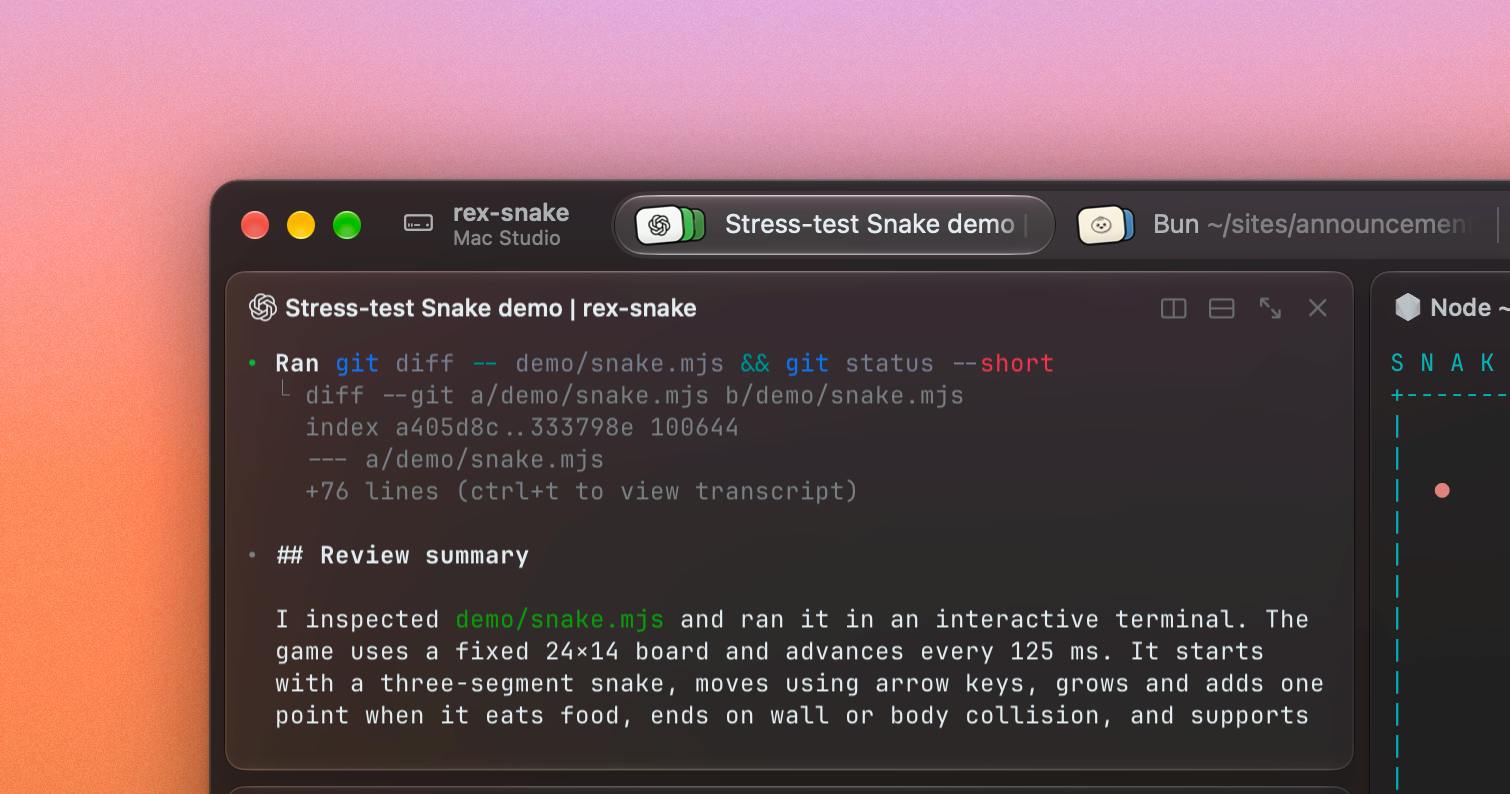
The terminal multiplexer category hasn't seen an exciting new face in a long time. tmux and screen have dominated for far too long—stable in features but stuck in a previous era of experience. Mitchell Hashimoto, creator of Ghostty and Echo, has brought Rex (Beta) to Product Hunt with the tagline "a multiplexer built for all work," earning 71 votes and ranking 13th for the day. For a developer tool still in Beta, this result shows the community has genuine expectations for "redoing the terminal workflow."
What exactly is Rex
According to the official description, Rex is a terminal multiplexer, but its ambitions clearly go beyond "opening multiple panes in one window." The product emphasizes three keywords: native apps, web accessible, and multiplayer collaboration.
The core value of traditional terminal multiplexers is decoupling sessions from windows, letting tasks continue running in the background after you disconnect from SSH. Rex retains this capability while extending "accessibility" to native macOS/iOS apps and browsers. This means the same work session can flow between desktop, mobile, and web, rather than being locked into a terminal window on a particular machine.
Multiplayer is another notable differentiator. Terminal sessions are naturally single-user operations, but Rex attempts to turn them into shareable spaces—this has direct value in pair programming, remote troubleshooting, and teaching scenarios.
Terminal multiplexer is a class of tools that manage multiple sessions, windows, and panes within a single terminal window. Its core mechanism inserts a persistent server process between the user and the real terminal, with that process holding the PTY (pseudo-terminal) and handling session creation, detach, and reattach. It's precisely this intermediate layer that makes "tasks continue running after SSH disconnect" possible: when the client disconnects, the server process and its child processes remain unaffected, and the next connection simply reattaches. tmux and GNU screen are the classic implementations of this category—both use a client/server architecture, with configuration and operation primarily through keyboard shortcuts and command line, running inside the terminal itself as typical TUI tools. Rex's difference lies in moving this layer out of the terminal into a standalone application, with session management handled by a native GUI—enabling cross-device, cross-platform access and support for multiple people connecting to the same session simultaneously.
Why "from the creator of Ghostty" matters
Mitchell Hashimoto's name is no stranger in infrastructure circles. Beyond founding HashiCorp, his recent investment in Ghostty has made the terminal experience itself a focus of discussion. Ghostty's positioning is a "fast, native, platform-convention-respecting" terminal emulator, and Rex clearly continues the same product philosophy: not another TUI tool, but redefining terminal interaction through native applications.
For terminal tools, this background means two things. First, sensitivity to performance boundaries and rendering details. Second, long-term observation of "what developers actually use every day." Rex choosing to start from Beta and use Product Hunt as its public debut window also aligns with the common path of independent developers validating demand.
Ghostty is an open-source terminal emulator led by Mitchell Hashimoto, emphasizing native platform integration, GPU-accelerated rendering, and low input latency. Written in Zig, its interface follows each operating system's own UI conventions rather than a self-drawn cross-platform appearance. It was publicly released in late 2024, with the macOS version built in Swift and AppKit, and is thus seen as a representative of the proposition that "a terminal emulator should be a proper native application." Understanding Ghostty's positioning helps grasp Rex's product direction: the terminal emulator handles "how a window displays and inputs," while the terminal multiplexer handles "how multiple sessions are organized and survive"—the two are highly adjacent in tech stack and experience philosophy. Ghostty's accumulated rendering performance expertise, insistence on platform interaction conventions, and observation of developers' daily usage habits will all transfer directly to Rex's session management and multi-device sync design.
Product signals of the Beta stage
Rex is currently explicitly labeled Beta. The official capability list focuses on three areas: native apps, web access, and multiplayer collaboration. No expanded technical details, nor any specific performance data or platform roadmap has been published.
From a product strategy perspective, building native macOS/iOS apps first and adding web later shows the team prioritizes experience consistency rather than spreading platform coverage first. This follows the same rhythm as Ghostty's early focus on macOS only. For high-frequency tools like terminal multiplexers, rough edges in experience are hard to compensate for with feature quantity—narrowing scope during Beta is a reasonable choice.
The comment section has only 5 discussions—a limited sample that's insufficient to judge the community's attitude toward specific feature trade-offs. The official website link points to a Product Hunt redirect page; the actual product site and pricing information were not provided in the source materials.
Beta stage in developer tool release cadences typically refers to a public testing period where core functionality is usable but interfaces and behavior may still change. At this point, teams often prioritize validating core assumptions rather than filling in peripheral capabilities, so the choices in the capability list are themselves signals: Rex listing native apps, web access, and multiplayer collaboration as its top three shows it believes "cross-device session accessibility" and "session shareability" are the key values distinguishing it from tmux, while plugin ecosystems, themes, scripted configuration, and other standard features of mature multiplexers are deferred. The Product Hunt launch is similar in nature—it's closer to a public debut and demand validation aimed at early users than a formal commercial release; votes and ranking reflect attention, while comment count reflects actual trial depth, and with a limited sample one shouldn't infer market acceptance from it.
Several directions worth watching
If Rex delivers on the "native + web + multiplayer" combination, the potential shape changes in terminal workflows are worth noting. Sessions would no longer be bound to a particular development machine but could seamlessly continue across devices; team troubleshooting would no longer rely on screen sharing plus verbal description—teammates could directly enter the same terminal context; the addition of iOS would make "keeping an eye on long-running tasks after leaving your desk" a reality.
Stacking these capabilities together, Rex's positioning is actually closer to "a reuse layer for work sessions" rather than just a terminal window manager. It must compete with veteran tools like tmux on stability, and with various cloud development environments on integration—whether the Beta-stage product can withstand pressure from both sides is the key thing to watch going forward.
For veteran terminal tool users, Rex is worth adding to the trial list; for the broader developer community, the question it raises is more interesting—we're used to terminals being local, single-user, and single-machine. If all three of these are broken simultaneously, what will the daily development workflow become?
One-line Summary
Rex, the Beta terminal multiplexer from the creator of Ghostty, emphasizes native apps, web accessibility, and multiplayer collaboration.
Paragraph Summary
Rex is a terminal multiplexer from Mitchell Hashimoto, creator of Ghostty and Echo, currently in Beta, earning 71 votes and ranking 13th for the day on Product Hunt. While retaining the traditional multiplexer's "session-window decoupling" capability, it extends accessibility to native macOS/iOS apps and browsers and introduces multiplayer collaboration, allowing the same terminal session to flow between desktop, mobile, and web, and to be accessed by multiple people simultaneously. The product continues Ghostty's native-first philosophy, building native apps first before adding web, with a capability list focused on native, web, and multiplayer—no performance data or roadmap has been published yet. The article argues its positioning is closer to a cross-device work session reuse layer than a mere window manager.
Related articles
 Tech Frontiers
Coldframe: A Honeypot Disguised as a Supermarket Freezer Controller
Coldframe is a honeypot disguised as Danfoss AK-SM 800A and Dixell XWEB freezer controllers, built as a single Python file that detects CVE-2025-41450 attempts and is identified as real devices on Shodan.
 Tech Frontiers
GRFNet: A Lightweight PyTorch Model Designed for Multichannel Time-Series Classification
GRFNet is a lightweight PyTorch model for multichannel time-series classification, originating from EEG decoding research. With only 3,847 parameters, it is based on the ROCKET architecture, combining random convolution kernels with learnable spatial filters, supports arbitrary input lengths, and will soon be evaluated on the PhysioNet dataset.
 Tech Frontiers
CUDA-Accelerated Rocket League Simulator: A Player-Made Hardcore Experiment
A Reddit post shows a "100% Accurate" Rocket League simulator accelerated with CUDA. We analyze its technical context, CUDA's value in game physics simulation, and the significance and limitations of such community projects.