Riemann Hypothesis Proof Declared Invalid? The Controversy Over AI Verification Credibility

A philosophy PhD student calls an AI-assisted Riemann Hypothesis proof invalid, but multi-source verification finds no reversal.
Recently, philosophy PhD student Jennifer Nielsen questioned an AI-assisted Riemann Hypothesis proof, alleging vacuous definitions and declaring it invalid, sparking community attention. However, the Lean community, Mathlib, and multiple independent teams have verified the proof as valid, and competitor OpenAI has not rebutted it. Nielsen has repeatedly challenged major proofs before, raising doubts about her rigor. Minor formalization flaws do not affect the overall proof, and machine verification ensures core logical rigor. The alleged "reversal" lacks substantive evidence, though the debate highlights the transparency of mathematical verification and the value of cross-verification.
Recently, discussion around the Riemann Hypothesis proof has heated up again. A philosophy PhD student at an American university (Creighton? "Kras" University in the original), Jennifer Nielsen (with a master's in physics background), published a long PDF pointing out that a certain AI-assisted proof (involving tools like Lean and Mathlib) has issues such as vacuous definitions and unsatisfiable premises, and declared the proof invalid. This statement quickly spread through the community, and many interpreted it as a "shocking reversal of the Riemann Hypothesis proof." But is that really the case? Starting from multiple sources, this article reconstructs the full picture of the controversy and analyzes the role and limitations of AI in mathematical proof verification.
Origin of the Controversy: A Philosophy PhD Student's Challenge
Nielsen's core challenge is that certain geometric objects in the formalized code are directly defined as "True," or properties are guaranteed to hold through definitions, causing the proof to lose actual mathematical content. She argues that the lemmas in the code intended to extract the actual mathematical content are never invoked, so the formal verification does not truly establish the correspondence between the geometric realization and the lattice structure. This statement appears logically rigorous, but Bilibili creator Yu Ziyi said bluntly in a video: "This is not a so-called reversal at all."
Yu Ziyi points out that Nielsen's challenge is a kind of "over-defensive" nitpicking—similar minor flaws (such as typos) in formalized code are also common in human-written work and do not affect the overall validity of the proof. More importantly, this challenge has not been officially recognized by the Lean community.
Lean and Mathlib: Lean is an interactive theorem prover based on dependent type theory, allowing mathematicians to formalize mathematical definitions and theorems as code, with the machine automatically checking the correctness of proofs. Mathlib is Lean's mathematics library, containing a large number of formally verified mathematical definitions and theorems, and is important infrastructure for formalized mathematics. In AI-assisted proofs, Lean is used to ensure that every step of derivation strictly follows logical rules; any error will cause compilation to fail, thereby providing highly reliable verification.
Multi-Source Cross-Verification: Community Consensus and Independent Verification
According to information cited by Yu Ziyi, the official Lean community as well as multiple independent teams such as Mathlib have verified that the proof has no major problems. She emphasizes: "Your enemies always understand you better than your friends do."—If the proof had a fundamental error, the most likely party to discover and publicize it would be the competitor OpenAI. OpenAI has enormous compute and a team of mathematical experts; if there really were a flaw, it would have been made public long ago to undermine the other side's momentum. However, to date OpenAI has not issued any rebuttal statement.
In addition, in the Polymarket-related discussion on Twitter, several people also rebutted Nielsen's view. YouTube channels (such as "Mathful") likewise disputed Nielsen's challenge, arguing that the problems she pointed out are mostly formalization details and insufficient to overturn the overall proof. Cross-checking of multiple sources confirms: no substantive reversal has emerged so far.
Nielsen's "Repeat Offender" Record and Motives for Questioning
Looking at Nielsen's personal homepage reveals that this is not the first time she has questioned major proofs. Previously, she claimed that Livent and Buckmaster's proofs concerning the three-dimensional force-free Euler equations and the Navier–Stokes equations were invalid, and she also questioned OpenAI's Yang–Mills equation proof, the Connes rigidity theorem, and others. This pattern of "opposing every major proof" has led many researchers to question the rigor of her challenges. As Yu Ziyi said: "She has published many papers saying [proofs are] invalid; it's just that the Riemann Hypothesis is the most famous, which is why it attracted widespread attention."
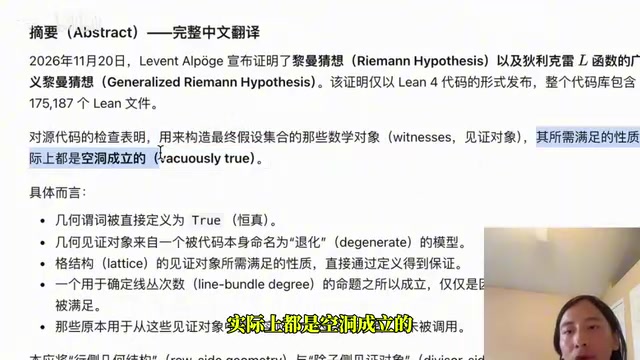
Of course, this does not deny the reference value of Nielsen's challenge. The problems she points out, such as vacuous code definitions, may indeed leave room for improvement, but minor flaws in formal verification (such as typos) will not overturn the foundation of the proof.
Three-dimensional Euler Equations and Navier–Stokes Equations: The three-dimensional force-free Euler equations describe the motion of an ideal fluid, while the Navier–Stokes equations describe the motion of a viscous fluid; the latter is one of the Clay Mathematics Institute's Millennium Prize Problems. The existence and smoothness of solutions to these two equations are core problems in fluid mechanics. Livent and Buckmaster's work involves research on blow-up or non-uniqueness of solutions to these equations, belonging to the frontier of mathematical physics. Nielsen's challenges to such proofs reflect her extreme demands for mathematical rigor.
The Verification Mechanism of AI-Assisted Proofs: Why They Are Hard to Easily Overturn
Modern formalized mathematical proofs (such as those based on Lean) rely on strict type checking and machine verification. Every step in the code must pass compiler inspection; any logical leap will cause verification to fail. Therefore, if the problem Nielsen points to were truly fatal, the formal verification process itself would report an error—and in fact, the proof has passed verification in multiple independent environments.
Yu Ziyi used a vivid analogy: "This is like making a typo while writing a paper; it doesn't affect the conclusion of the whole article." The way definitions are written in formalized code may not be elegant, but as long as the core logical chain is complete, the proof still holds.
Type Checking and Machine Verification: In Lean, every mathematical statement is represented as a type, and a proof is a term of that type. The compiler ensures through type checking that the proof term is constructed correctly, that is, that the proof conforms to logical rules. This verification is automated and does not depend on human review, so it can avoid human error. The reliability of formal verification comes from the rigor of its underlying logic; once verification passes, the correctness of the theorem is logically certain, unless the underlying logic itself is inconsistent.
Conclusion: No Reversal, but the Discussion Is Valuable
Synthesizing multiple sources, the so-called "reversal of the Riemann Hypothesis proof" lacks substantive evidence. The verification results from the Lean community, Mathlib, and multiple independent teams all support the validity of the original proof, while Nielsen's challenge focuses more on formalization details and has not yet been adopted by authoritative institutions. For readers interested in AI mathematics, this controversy instead reveals the transparency of formal verification—any challenge can be publicly tested, and the truth will gradually become clear through multi-source cross-verification.
There is no need to be anxious about "reversal" rhetoric, but it is worth continuing to follow subsequent developments. After all, the rigor of mathematics is defended precisely through constant questioning and verification.
One-line Summary
A philosophy PhD student questions the validity of an AI-assisted Riemann Hypothesis proof, but multi-source verification shows no reversal.
Paragraph Summary
Recently, philosophy PhD student Jennifer Nielsen questioned a certain AI-assisted proof of the Riemann Hypothesis, alleging issues such as vacuous definitions and declaring the proof invalid, which drew community attention. However, the Lean community, Mathlib, and multiple independent teams have verified the proof as valid, and competitor OpenAI has not raised objections. Nielsen has previously questioned major mathematical proofs multiple times, raising doubts about her rigor. Minor flaws in formal verification do not affect the overall proof, and machine verification guarantees the rigor of the core logic. The so-called "reversal" lacks substantive evidence, but the controversy demonstrates the transparency of mathematical verification and the value of multi-source cross-verification.
Related articles

Prompt Engineering for Beginners: From Writing Prompts to Engineering Thinking
Starting from the essence and four functions of prompts, this article systematically explains the six-step process, four success criteria, learning value, and practical limitations of prompt engineering to help you build a complete understanding.

Anthropic Launches Nasdaq IPO: AI Giant's Listing and Risk Disclosures
Anthropic officially launches its Nasdaq IPO under ticker ANT, with market valuation expected to potentially exceed SpaceX's record. The prospectus devotes nearly 100 pages to AI risks, while first-half revenue grew over 14x but net losses widened sharply, reigniting the AI bubble debate.

Rust cURL Clone Uses 4,832 unsafe Blocks—Is the Memory Safety Myth Broken?
A Rust cURL clone uses 4,832 unsafe keywords, challenging Rust's memory safety narrative. We analyze what unsafe really means, compare Fil-C, and examine rewrite motives.