Ripple-65B Open-Source Model Tops Community Charts
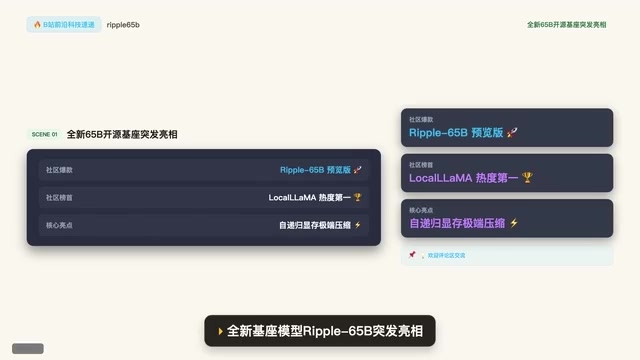
Ripple-65B open-sources suddenly: self-recursive architecture cuts KV cache so ordinary GPUs can run hundred-billion models.
Ripple-65B is a suddenly unveiled open-source foundation model that topped the LocalLLaMA community charts on launch day. Its core selling point is a "self-recursive architecture" claimed to dramatically reduce KV cache usage in long-context scenarios, letting ordinary consumer GPUs run hundred-billion-parameter inference with low latency. Official preview weights and quantized files are released, with one-click Olema & VLM deployment. Technical details remain undisclosed, and real-world stability, quantization accuracy, and hardware compatibility await developer verification.
The open-source LLM community is buzzing today. A brand-new foundation model called Ripple-65B has suddenly appeared, shooting straight to the top of the community charts and becoming the hottest topic in the LocalLLaMA discussion forum.
According to information compiled by the video creator, this model adopts a cutting-edge "self-recursive architecture" that dramatically reduces KV cache usage in long-context scenarios, allowing even ordinary GPUs to run hundred-billion-scale inference tasks with low latency. The official team has released preview weights and quantized files in the open-source community, with one-click seamless deployment support for Olema and VLM.
Architecture Highlights: How Self-Recursive Design Lowers the Inference Barrier
The core selling point of Ripple-65B is its "self-recursive architecture." Taken literally, this kind of design allows the model to recursively compress or reuse intermediate states when processing long sequences, thereby avoiding the linear KV cache growth that traditional Transformers suffer from in long-context scenarios.
The video mentions that this architecture "dramatically reduces KV cache for long-range contexts," meaning that under the same VRAM conditions, users can process longer input sequences, or achieve lower latency at the same context length. For local deployment enthusiasts, this is the most direct benefit — ordinary consumer-grade GPUs now have a chance to run hundred-billion-parameter inference tasks.

It should be noted that the specific technical details of the "self-recursive architecture" have not yet been elaborated in the original source material, and its actual performance still needs to be verified by community developers.
KV cache is a key VRAM overhead during LLM inference. In standard autoregressive generation, each time the model generates a new token, it needs to perform attention computation with the Key/Value vectors of all previous tokens. To avoid redundant computation, these intermediate results are cached. The cache size grows linearly with context length, and in long-context scenarios it can consume tens of GB of VRAM, becoming the main bottleneck for local deployment. Common mitigation approaches in the industry include sliding window attention, KV quantization, grouped query attention (GQA), and cross-layer sharing, with the goal of flattening the cache growth curve or even making it constant. Understanding this makes it clear why Ripple-65B's claimed "dramatic reduction of long-range context KV cache" is directly appealing to consumer GPU users.
Open-Source Strategy: Preview Weights and Quantized Files Released Together
The official team has now released preview weights and quantized files simultaneously in the open-source community. This move is uncommon in the open-source model circle — many models only provide full-precision weights at launch, with quantized versions often waiting for the community to adapt them. Ripple-65B directly providing quantized files is clearly aimed at lowering the barrier to local deployment.

Judging from community buzz, this "out-of-the-box" open-source strategy is indeed working. Preview weights mean the model may not be the final version, but they are enough for developers and researchers to evaluate its capability boundaries in advance.
Quantized files refer to compressing model weights from high-precision formats like FP16/BF16 into lower-bit representations such as INT8 or INT4, significantly reducing VRAM usage and improving inference speed. Common solutions include GPTQ, AWQ, and GGUF, the latter of which can run on CPU or hybrid devices with tools like llama.cpp. Quantization typically comes with some accuracy loss, which becomes more pronounced at lower bit counts, so the community often needs to weigh "whether it fits on the GPU" against "whether the output quality is acceptable." The official team directly providing quantized versions means users don't need to complete calibration and conversion processes themselves, and it also reduces the risk of performance degradation caused by improper quantization parameters — a clearly significant contribution to lowering the deployment barrier.
Deployment Experience: One-Click Seamless Deployment with Olema and VLM
In terms of toolchain compatibility, Ripple-65B supports one-click seamless deployment with Olema and VLM. For users familiar with local inference tools, this means model loading and running can be completed without complex configuration processes.
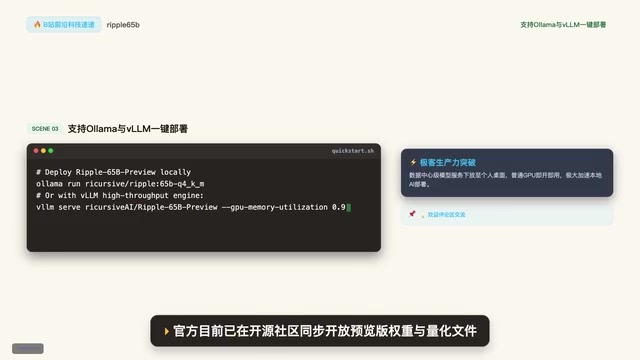
The video creator has organized the model's open-source weights and local running guide in the video description and pinned position, making it easy for community members to get started quickly. This simultaneous release of accompanying documentation also explains why the model has gathered so much discussion in such a short time.
One-click deployment tools play the role of the "runtime layer" in the local LLM ecosystem, handling model downloads, format recognition, VRAM allocation, inference scheduling, and interface exposure. Olema and VLM belong to this category of tools — users typically only need to specify a model name or weight path to start the service via command line or API, saving the steps of manually configuring CUDA and writing inference scripts. Toolchain compatibility has therefore become an important indicator of a new model's "usability": even if a model performs excellently, without adaptation by mainstream inference frameworks, the community's onboarding cost will still be high. Ripple-65B declaring support for these two tools at launch shows that its team has made advance preparations on the engineering side.
Community Reaction and Questions to Be Verified
Topping the community charts itself demonstrates the strong market demand for "low-barrier hundred-billion-scale inference." But beyond the hype, several key questions remain for the community to verify: whether the self-recursive architecture performs as stably as described in actual long-context tasks; how the quantized files balance accuracy loss against speed gains; and how compatible one-click deployment is across different hardware configurations.
For now, the answers to these questions rest with the first batch of developers who have tested it hands-on. For the open-source community, topping the charts is only the starting point — the real test lies in the hands-on feedback and iteration speed that follow.
One-line Summary
Ripple-65B suddenly goes open-source, with a self-recursive architecture that cuts KV cache and lets ordinary GPUs run hundred-billion models.
Paragraph Summary
Ripple-65B is a suddenly unveiled open-source foundation model that topped the LocalLLaMA community charts on its launch day. Its core selling point is the "self-recursive architecture," claimed to dramatically reduce KV cache usage in long-context scenarios, enabling ordinary consumer-grade GPUs to run hundred-billion-parameter inference with low latency. The official team simultaneously released preview weights and quantized files, with one-click seamless deployment support for Olema and VLM, plus a local running guide released alongside the video. This out-of-the-box open-source strategy significantly lowers the local deployment barrier and explains the rapid community buzz. However, the technical details of the self-recursive architecture have not been disclosed, and long-context stability, quantization accuracy loss, and multi-hardware compatibility still await hands-on verification by the first batch of developers.
Related articles

RAM Prices About to Drop? Reddit Debates Whether an AI Bubble Burst Could Make Memory Cheap Again
Reddit debates whether the AI compute bubble could lower RAM prices: discussion focuses on locked-in memory capacity, debt-driven neocloud expansion, and the Oracle-NVIDIA order chain reaction, revealing sharp disagreement between bulls and bears on RAM price trends.

MuJoCo Parallel Training: Single World with Multiple Robots vs. Independent Environments
Explore the differences between single-world multi-robot and independent environment parallelism in MuJoCo RL, analyze their advantages, and learn best practices for migrating to GPU.

Baidu Open-Sources ERNIE 5.5 Flash Base: A 280B MoE Model Breakdown
Baidu releases ERNIE 5.5 Flash Base: a 280B sparse MoE model with 14B activated parameters, trained on 33.5T tokens and released without mid- or post-training for research and downstream fine-tuning.