RAM Prices About to Drop? Reddit Debates Whether an AI Bubble Burst Could Make Memory Cheap Again

Reddit debates whether memory prices can fall, with the core disagreement being whether debt-driven AI buyers will default and release capacity.
A Reddit post about "whether we can buy cheap RAM for Christmas" sparked fierce debate. The mainstream narrative holds that AI demand is driving up memory prices and top customers have locked in years of capacity in advance, but the poster questions: if the customers who locked in capacity have their own financial problems, long-term contracts may be renegotiated and capacity released back to the consumer market. Opponents emphasize that memory makers are financially sound and current fluctuations are just a short-term pullback in long-term growth. The discussion gradually focuses on buyers rather than sellers—debt-driven AI cloud providers like neoclouds are most likely to run into trouble. One line of reasoning suggests Oracle's financial pressure could trigger a chain reaction cancelling NVIDIA GPU orders, which in turn leads to memory order defaults. The takeaway for consumers: memory prices are influenced by both capacity cycles and financial leverage, so watch cloud providers' capital expenditure guidance and marginal changes in contract prices.
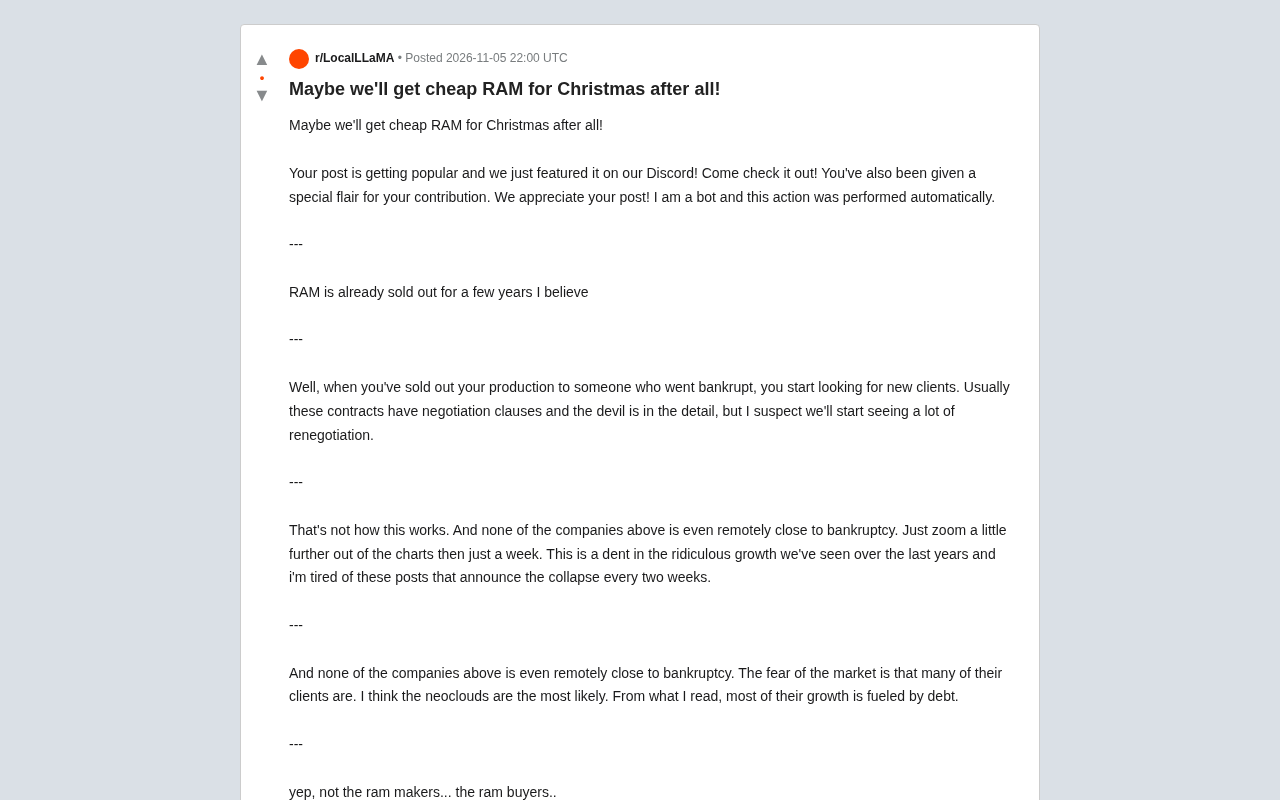
A recent Reddit post has sparked heated discussion, with a title so blunt it borders on self-mockery: "Maybe we'll actually get cheap RAM for Christmas this year!" The accompanying image was a memory price chart. The post itself offered no detailed argument, but the comments section quickly evolved into a fierce debate about the AI compute bubble, memory supply and demand, and cloud providers' debt.
Is Memory Really "Sold Out"?
The first question raised in the comments was: "As far as I know, memory capacity has been fully booked for years." This represents the mainstream market narrative—surging AI training and inference demand, with HBM and DDR capacity locked in advance by top-tier customers, naturally squeezing consumer-grade memory supply.
But the poster's underlying implication is: if those customers who locked in capacity run into trouble themselves, can the contracts still be fulfilled? He mentioned a key detail—when your capacity has already been sold to a customer heading toward bankruptcy, you have to start looking for new buyers. Such long-term supply contracts typically include renegotiation clauses, and the devil is in the details, but he anticipates seeing a lot of repricing.
HBM (High Bandwidth Memory) is the key technical backdrop for understanding this round of memory supply tightness. HBM vertically stacks multiple layers of DRAM chips using through-silicon via (TSV) technology and packages them together with GPUs via a silicon interposer, delivering data to AI accelerators at bandwidths far exceeding traditional DDR. Because AI training and inference demand for VRAM bandwidth is growing exponentially, HBM has become an essential component for GPU makers like NVIDIA. However, HBM is far harder to manufacture with much lower yields than standard DDR, and it consumes more capacity per wafer—producing 1GB of HBM requires several times the wafer area of the same capacity of DDR. This means that an HBM demand surge directly crowds out DDR wafer capacity, creating a transmission effect where "AI eats capacity, consumer-grade starves." What top cloud providers have locked in advance is precisely this type of HBM and accompanying DDR capacity, further narrowing the supply elasticity of consumer-grade memory.
DDR is Double Data Rate Synchronous Dynamic Random-Access Memory, the mainstream standard for PC and server main memory. Unlike HBM, DDR targets general-purpose computing scenarios, emphasizing capacity and cost rather than extreme bandwidth. In memory makers' capacity allocation, DDR and HBM share DRAM wafer production lines, but HBM has significantly higher gross margins, so when AI demand is strong, manufacturers have a strong incentive to shift capacity toward HBM. This rigidity in capacity switching—production line adjustments require months of time and massive capital expenditure—is the structural reason why consumer-grade DDR prices are easily amplified by the AI narrative.
Counterargument: Memory Makers Aren't That Fragile
A user quickly pushed back: that's not how it works; none of the companies mentioned above are close to bankruptcy. Don't just stare at a one-week chart—zoom out on the timeline and you'll see this is just a small dip in years of crazy growth.
This user also expressed fatigue with "someone declaring a crash every two weeks." His core argument: memory manufacturers' own financial positions remain solid, and short-term price fluctuations don't constitute an existential crisis.
Another user steered the discussion to a more precise point: the problem isn't the memory makers—it's the memory buyers. He added that what the market is really worried about is the financial health of many memory buyers, with "neoclouds" (new AI cloud service providers) being the most likely to run into trouble, because from what he's read, these companies' growth is largely debt-driven.
The Debt Chain: From Oracle to NVIDIA to Memory Orders
The most speculative comment came from a user pessimistic about Oracle: Oracle is very close to bankruptcy. Without Oracle, NVIDIA loses a major GPU buyer; scheduled GPU orders get cancelled, and the associated memory orders get cancelled too, incurring penalties.
Whether this chain of reasoning holds up was not agreed upon in the comments. Some users pointed out that big tech companies mainly spend their own free cash flow—real money. Yes, they do borrow, but borrowing isn't the main source of spending.
But someone immediately countered: they did rely on their own cash flow in the past, but recently the proportion of debt has been rising. This dovetails with the "neoclouds expanding on debt" narrative—comments from different sources cross-corroborate on the point that "debt leverage is rising," though judgments on severity diverge significantly.
As for "who pays after bankruptcy," one user gave a cold answer: at that point, it becomes the banks' problem.
Neoclouds are a type of AI cloud service provider that has emerged in recent years, with representative companies including CoreWeave and Lambda Labs. Unlike traditional hyperscale cloud providers (AWS, Azure, GCP), neoclouds typically don't own a complete software ecosystem but focus on providing GPU compute rental, especially bare-metal or containerized instances of NVIDIA's high-end GPUs. Their business model relies heavily on borrowing to purchase GPU clusters—using GPU hardware as collateral to obtain loans, then repaying with rental income. This "debt-fueled GPU" model can expand rapidly when compute demand is strong, but once GPU rental prices decline or utilization is insufficient, cash flow quickly comes under pressure. Since neoclouds are important buyers of NVIDIA GPUs and accompanying HBM/DDR memory, their financial fragility is the realistic basis for the comments' concern that "buyer problems lead to order cancellations."
Free Cash Flow (FCF) is the core financial metric for judging the sustainability of big tech spending, referring to the cash flow generated by business operations minus capital expenditure. The debate in the comments centers on: do hyperscale cloud providers' AI capital expenditures come from their own free cash flow or from debt financing? Historically, these companies have indeed mainly relied on free cash flow to fund expansion, but in recent years, as AI infrastructure investment has surged, some companies' free cash flow can no longer cover capital expenditure, and they are turning to bond markets and off-balance-sheet financing. The significance of this shift: spending from free cash flow is "spending your own money," and even if project returns are poor, it won't trigger a debt crisis; debt financing, however, introduces rigid repayment obligations, and if compute demand falls short of expectations, it could trigger deleveraging and order contraction.
What This Debate Means for Ordinary Consumers
Putting the multi-source discussion together, a clear transmission path emerges: AI compute demand drives up memory prices → top buyers lock in capacity in advance → some buyers (especially debt-driven cloud providers) come under financial pressure → once orders are cancelled or renegotiated, capacity is released back to the market → consumer-grade memory prices may fall.
Every link in this chain has its skeptics. Opponents argue that memory makers' customer base is sufficiently diversified that a single customer's problems can't shake overall supply and demand; supporters believe that debt-driven growth is inherently fragile and contract renegotiation is just a matter of time.
For ordinary PC builders, the more pragmatic signal is: memory prices have never been linearly extrapolated—they're determined jointly by capacity cycles and inventory cycles, and the AI narrative is layering an unprecedented financial leverage factor onto this cycle. Closely watching cloud providers' capital expenditure guidance and marginal changes in memory contract prices is more valuable than chasing any one-sided prediction of either a crash or permanently rising prices.
Whether the original poster's Christmas wish comes true depends on how this game of debt and capacity plays out, and the comments section clearly hasn't reached a consensus yet.
One-line Summary
Reddit debates whether memory prices can fall, with the core disagreement being whether debt-driven AI buyers will default and release capacity.
Paragraph Summary
A Reddit post about "whether we can buy cheap RAM for Christmas" sparked fierce debate. The mainstream narrative holds that AI demand is driving up memory prices and top customers have locked in years of capacity in advance, but the poster questions: if the customers who locked in capacity have their own financial problems, long-term contracts may be renegotiated and capacity released back to the consumer market. Opponents emphasize that memory makers are financially sound and current fluctuations are just a short-term pullback in long-term growth. The discussion gradually focuses on buyers rather than sellers—debt-driven AI cloud providers like neoclouds are most likely to run into trouble. One line of reasoning suggests Oracle's financial pressure could trigger a chain reaction cancelling NVIDIA GPU orders, which in turn leads to memory order defaults. The takeaway for consumers: memory prices are influenced by both capacity cycles and financial leverage, so watch cloud providers' capital expenditure guidance and marginal changes in contract prices.
Related articles
 Tech Frontiers
Google Omni 1.2 Flash: 15-Second AI Video at Just $0.07 per Second
Google DeepMind releases Gemini Omni 1.2 Flash: 15-second video, 720p at $0.07/sec (30% cheaper), multi-turn editing without regeneration, draft upscaling to 4K.
 Tech Frontiers
No AI Ghostwriting: Writer's Quarter Reinvents Novel Writing with a Visual Workbench
The Writer's Quarter is an AI-free novel writing and planning tool that unifies character building, story planning, and manuscript writing in one visual workbench. This article analyzes its positioning, target users, and differentiated value amid the rise of AI writing tools.
 Tech Frontiers
Fleeep: A Unified Inspiration Collection Notes App for Creatives
Fleeep is a notes app for creatives that unifies screenshots, bookmarks, saved posts, and inspiration into one calm, cross-device, offline-capable space. This article analyzes its positioning, differentiation, and target users.