Ripple-65B Preview: U.S. Open-Weight Model Tops Agentic Coding
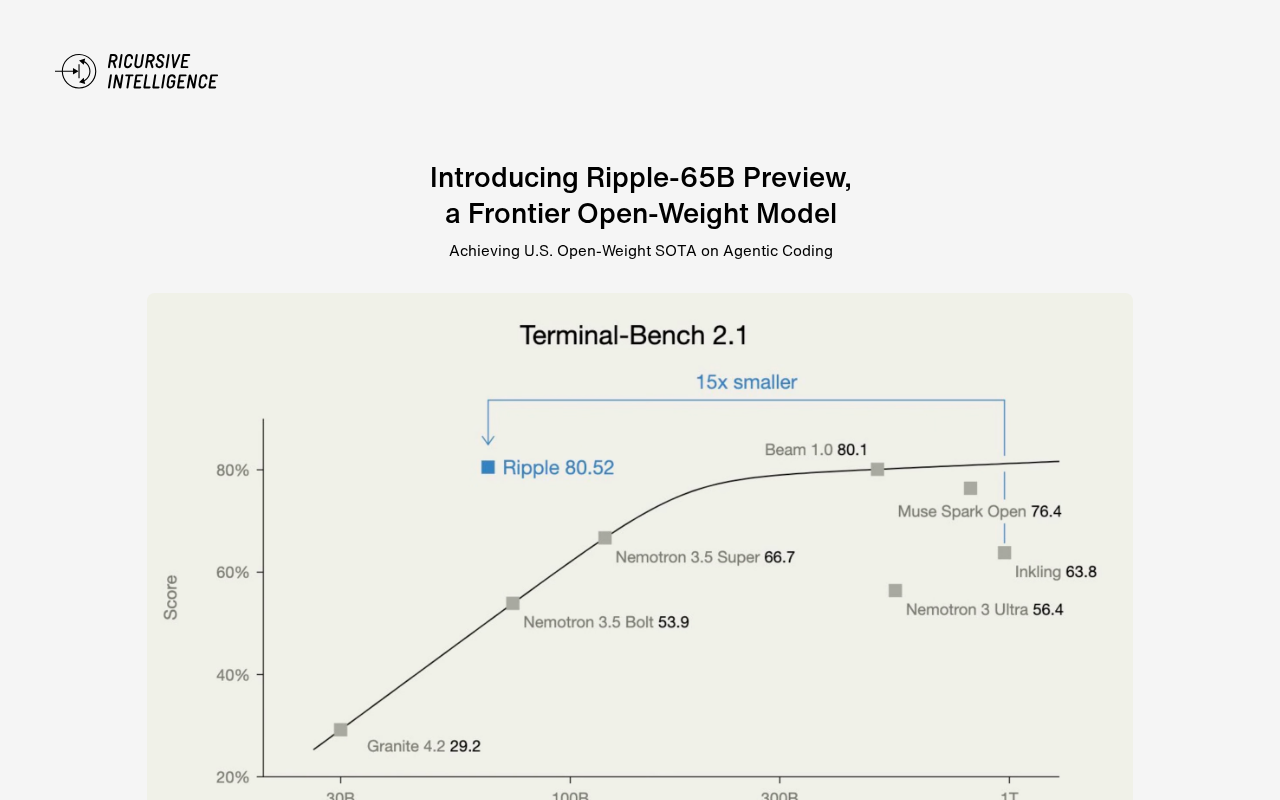
Ripple-65B Preview claims U.S. open-weight SOTA in Agentic Coding, pending verification at the preview stage.
The article introduces the Ripple-65B Preview model on Hacker News, claiming to be the current best U.S. open-weight model in Agentic Coding. It explains the "open-weight" and "Agentic Coding" positioning, notes that agentic coding demands task decomposition, tool invocation, multi-turn error correction, and cross-file editing, and analyzes the 65B scale as upper-middle range for open models. It also cautions on weight access, licensing, and inference costs, and offers three observation recommendations: evaluation reproducibility, license terms, and real-world agent testing.
A New Benchmark for Open-Weight Models
A new model called Ripple-65B Preview has appeared on Hacker News, with a title that directly claims to be "the U.S. open-weight SOTA (state of the art) on Agentic Coding." This positioning carries two layers of information: first, the "open-weight" attribute, meaning the model weights are accessible so researchers and developers can build on them for secondary development; second, the "Agentic Coding" niche, which refers to a model's ability to autonomously complete multi-step programming tasks as an agent, rather than merely completing a single line of code.
Judging from the discussion activity, the post received 35 points and 16 comments—a small-scale but noteworthy technical release. For readers interested in the intersection of open models and coding agents, this preview version is worth adding to the watch list.
Why Agentic Coding Has Become the Competitive Focus
Traditional code models mainly solve the problem of "given context, generate the next piece of code." Agentic Coding, by contrast, requires the model to possess task decomposition, tool invocation, multi-turn error correction, and cross-file editing capabilities—essentially closer to an engineering assistant that can independently drive a project forward.
This direction places significantly higher demands on the model: it needs not only solid code knowledge but also goal consistency across long-horizon tasks and the ability to autonomously adjust strategy when errors occur. Ripple-65B's choice of "Agentic Coding" as its flagship capability indicates that its training or evaluation focus is on agent scenarios rather than pure code completion benchmarks.
The phrasing "U.S. open-weight SOTA" also reveals the competitive context—the open-weight model space has previously seen active teams from multiple regions, and Ripple-65B attempts to establish a benchmark along national lines. However, claims at the preview stage still require subsequent independent evaluation to verify.
Tool Use / Function Calling is one of the core mechanisms of Agentic Coding. During inference, the model outputs structured invocation requests—such as reading files, executing shell commands, running tests, or searching codebases—and an external runtime executes them and returns the results to the model, forming a "think—act—observe" loop. Unlike ordinary conversation, this loop requires the model to correctly select tools, construct valid parameters, parse returned results, and adjust strategy when a tool errors out. Therefore, when evaluating Agentic Coding, beyond checking whether the final code is correct, one should also examine the model's success rate in tool invocation, number of calls, and error recovery capability—metrics that often reflect real engineering value better than single-turn completion scores.
What the 65B Parameter Scale Means
The 65B in the model name points to a scale of roughly 65 billion parameters. This scale sits in the upper-middle range of open-weight models: large enough to support complex code reasoning, yet easier to deploy and fine-tune than ultra-large models.
For developers, a 65B-class open-weight model can typically run in multi-GPU environments, making it suitable for teams doing domain adaptation or building internal coding assistants. The "Preview" label suggests the model may not yet be fully finalized, and the capabilities and licensing terms of the official version may still change. Observers should pay attention to how the weights are obtained, the license type, and inference costs—factors that often affect real-world adoption more than benchmark scores.
Open-Weight is not strictly equivalent to "open source." Open-weight means the model parameter files can be downloaded, but the training data, training code, and complete recipe may not be disclosed; licenses may also carry commercial restrictions, user-scale thresholds, or redistribution conditions. Common open-weight licenses include permissive ones like Apache 2.0 and MIT, as well as community licenses with usage terms. For teams planning to embed the model in products or internal tools, the license type directly determines whether commercial use is allowed, whether redistribution is permitted, and whether derivative models must be disclosed—its impact is usually greater than a few percentage points of difference in benchmark scores.
Observation Recommendations for the Preview Stage
Ripple-65B Preview has released limited information so far, and the original discussion itself is brief; more details will require a technical report or model card. It is recommended to follow up from three angles:
- Evaluation reproducibility: SOTA claims in Agentic Coding require publicly available evaluation configurations and task sets; otherwise, cross-comparison is difficult.
- Weights and licensing: "Open-weight" does not equal fully open—commercial restrictions and redistribution terms need to be confirmed item by item.
- Real-world testing in agent scenarios: High code completion scores do not imply strong multi-step task performance; it is best to run small-scale validation with your own workflow.
Competition among open-weight models in the coding agent space is heating up, and Ripple-65B's emergence adds a U.S. option to this track. Whether it can deliver on its self-proclaimed "SOTA" positioning depends on whether it can subsequently produce evaluation results that withstand reproducibility checks.
One-line Summary
Ripple-65B Preview claims to be the U.S. open-weight SOTA in Agentic Coding, pending verification at the preview stage.
Paragraph Summary
The article introduces the Ripple-65B Preview model that appeared on Hacker News, which claims to be the current best U.S. open-weight model in Agentic Coding. It first explains the two layers of positioning—"open-weight" and "Agentic Coding"—noting that agentic coding requires task decomposition, tool invocation, multi-turn error correction, and cross-file editing, with a higher bar than traditional code completion. It then analyzes that the 65B parameter scale sits in the upper-middle range of open models, balancing code reasoning and deployment feasibility, and cautions that the preview version still has variables in weight access, licensing, and inference costs. Finally, it offers three observation recommendations: evaluation reproducibility, license terms, and real-world testing in agent scenarios, emphasizing that SOTA claims require independent evaluation to verify.
Related articles

Claude Code Reportedly Leaks Secrets to GitHub, Sounding the Alarm for AI Coding Security
Claude Code reportedly exposed passwords and API keys to GitHub, per Ars Technica. We recap the incident alongside Claude Fable 5.2's 20% price cut and Meta Muse Ember, urging developers to check commit settings before granting permissions.

Getting Started with LangChain: Core Concepts of the Agent Development Framework
Starting from the three major limitations of LLMs, this article explains LangChain's positioning and value as an Agent development framework: limited knowledge, external system interaction, and state retention, along with its official documentation system and learning path.

Ring Launches $999 Autonomous Patrol Robot RoverCam
Ring launches RoverCam, an autonomous mobile security camera with a 4K periscope camera, two-way talk, and built-in siren. Priced at $999.99, it targets commercial use and is seen as a de-personified rebirth of the Astro robot.