RisenX Explained: The Coding Agent Officially Recommended by DeepSeek

RisenX is a DeepSeek-native terminal coding agent officially featured in DeepSeek's API documentation.
RisenX is an open-source, DeepSeek-native coding agent now featured in DeepSeek's official API documentation. Built around three core pillars—cache-first loops that achieve 99%+ cache hit rates for massive cost savings, tool-call repair for improved reliability, and intelligent Flash/Pro model switching—it represents the closest thing to an official DeepSeek coding agent. With features like MCP support, persistent sessions, skill systems, and semantic code indexing, it offers a comprehensive agentic coding experience optimized specifically for the DeepSeek ecosystem.
Over the past few months, DeepSeek has dramatically improved its model's agentic capabilities with the V3.1 update, leading more and more developers to replace Claude and GPT with it for coding work. But there's always been one obvious gap: DeepSeek lacked a first-party Coding Agent.
Anthropic has Claude Code, OpenAI has Codex, Google has its own solution, while DeepSeekAd users could only plug the API into third-party tools like Cline, OpenCode, or Kilo—and hope these integrations would play nicely with the model. Now, that gap is being filled. DeepSeek's official API documentation has added a dedicated integration page introducing a tool called RisenX. It's considered the closest thing to an "official DeepSeek coding agent" to date.
What Exactly Is RisenX
RisenX is a DeepSeek-native coding agent that runs in the terminal. The keyword here is "native" (DeepSeek-native). It's not a multi-provider tool that stuffs DeepSeek into one option in a dropdown menu—it communicates directly with api.deepseek.com with no translation layer, no OpenAI-compatible adapter, and no proxy in between. The entire agent's architecture is designed around the actual behavior of the DeepSeek API.
The "no OpenAI-compatible adapter" point deserves elaboration: currently, the vast majority of third-party coding tools (like Cline, Continue, etc.) use the OpenAI Chat Completions API format as a universal interface, then swap out the base_url to connect to different providers. While convenient, this approach can't leverage each API's unique characteristics—such as DeepSeek's distinctive prefix caching pricing advantage or its specific tool-calling format preferences. By interfacing directly with DeepSeek's native endpoint, RisenX bypasses the performance loss introduced by this abstraction layer.
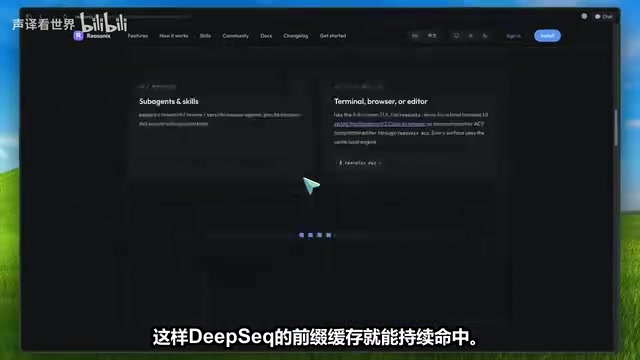
To be transparent: RisenX was not developed by DeepSeek itself. It's an open-source project hosted on GitHub under the MIT license, maintained by the community, with approximately 4,600 stars. The repository itself doesn't claim any official endorsement.
But here's what matters: DeepSeek has directly included RisenX in its official API documentation, providing a standalone quickstart page under the "Agent Integration" section. DeepSeek's documentation has always been lean—they don't casually recommend tools. When a company personally documents how to use a specific agent with their API, complete with setup instructions and commands, it's essentially a de facto endorsement. This is similar to how specific integration frameworks received lab recognition in previous GLM coding initiatives—when a lab chooses your tool, that itself is an endorsement.
RisenX's Three Core Design Pillars
Once you understand how RisenX is built, you'll see why DeepSeek favors it. The project README describes three core design pillars, each precisely aligned with how the DeepSeek API actually works.
Cache-First Loop: Saving 99% of Token Costs
The first pillar is a "cache-first" agent loop. The entire loop is designed to keep prompt prefix bytes stable across turns, ensuring DeepSeek's prefix cache consistently hits.
To appreciate the elegance of this design, you need to understand how prefix caching works. In standard Transformer inference, each request requires computing the KV Cache (key-value cache) for the full input sequence—one of the most computationally expensive operations. The core idea behind prefix caching is: if multiple requests share the same prefix (such as system prompts or context file contents), that portion's KV Cache can be reused without recomputation. DeepSeek's prefix caching implementation is particularly aggressive—cache-hit pricing is roughly 1/27th of cache-miss pricing (for V3: $0.014/million tokens on cache hit vs. $0.27/million tokens on cache miss). This means that as long as the prefix portion of each conversation turn remains byte-level stable, the vast majority of input tokens in subsequent turns can be processed at extremely low cost.
In agentic coding, most token consumption actually comes from the agent repeatedly reading the same context within its loop. On DeepSeek, cache hits cost far less than cache misses. RisenX exploits this characteristic to its fullest, offering a stunning real-world case: one long-running session ingested 435 million tokens with a 99.82% cache hit rate, resulting in a final cost of about $12; without caching, the same workload would have cost roughly 60x more. This "prefix cache stability" design philosophy perfectly aligns with DeepSeek's pricing and architectural style.
Specifically, RisenX achieves high cache hit rates through techniques including: fixing the position and content of system prompts, always appending new user messages at the end of the conversation rather than inserting them in the middle, and avoiding unnecessary context reordering. These seemingly simple engineering decisions accumulate into a cost difference of tens of times.
Tool-Call Repair: Improving Agent Reliability
The second pillar is tool-call repair. When the model produces a slightly malformed tool call, RisenX proactively repairs it rather than failing outright.
Tool Calling (or Function Calling) is the standardized interface that enables LLMs to interact with external systems. The model needs to output structured data conforming to a specific JSON Schema, telling the runtime which function to call and what parameters to pass. Closed-source models (like GPT-4 and Claude) typically undergo extensive RLHF and post-training to ensure tool-call format precision, but open-weight models are often less stable in this regard—they may produce mismatched JSON brackets, incorrect parameter types, extraneous markdown wrapping, and so on. These "soft errors" might be minor blemishes in a single call, but they get amplified in an agent loop: one failed tool call can break an entire task chain, forcing the agent to spend extra tokens understanding the error, retrying, or even getting stuck in an infinite loop.
RisenX's repair layer is essentially a lightweight format corrector that identifies common format deviations and fixes them at runtime, preventing the agent from completely stalling because of one extra comma. This design extracts more reliable, coherent agentic behavior from the same model—a crucial detail for practical usability.
Cost Control: Flash-First with On-Demand Pro Switching
The third pillar is cost control. By default, RisenX runs on DeepSeek-V4-Flash, which has become a sufficiently powerful default choice after the 0731 update. When you encounter a truly difficult task, simply type the slash command /pro and it switches to the more powerful DeepSeek-V4-Pro for the next turn, then automatically switches back to Flash. If you want the entire session to use Pro, run /preset max.
DeepSeek's V4 series continues its "extreme cost-efficiency" product philosophy. V4-Flash is positioned as a high-speed, low-cost general-purpose model suitable for everyday coding tasks—code completion, simple refactoring, test generation, etc. V4-Pro is the flagship reasoning model, performing better in complex architectural design, multi-file coordination, and deep debugging scenarios. This tiered strategy is similar to Anthropic's Haiku/Sonnet/Opus hierarchy, but DeepSeek's price differences are more significant. The 0731 update was a key milestone—it introduced stronger agentic capabilities to V4-Flash (such as better multi-step planning and tool use), upgrading it from "cheap but weak" to "cheap and capable enough," making the "Flash as default, Pro as exception" workflow truly viable.
This "Flash-first, Pro on demand" strategy is very smart: expensive models are only activated when you truly need them, rather than paying premium prices for every trivial file edit. This is exactly the workflow many power users practice manually—except in RisenX, it's built directly into the agent itself.
Installation and Setup: Done in Two Minutes
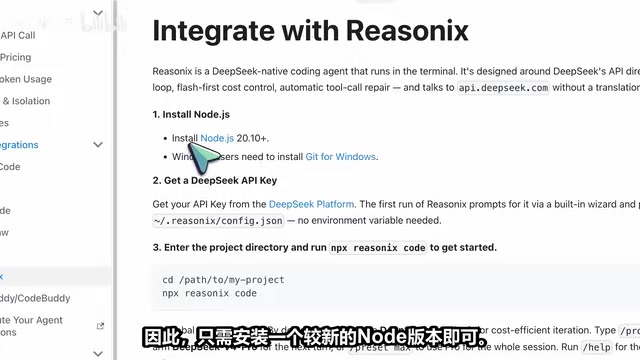
RisenX's setup process is among the simplest of its kind.
First, you need Node installed (the official docs suggest 20.10+, the GitHub README requires 22—just install a recent version). On Windows, you'll also need Git for Windows. Then grab an API key from the DeepSeek platform.
Next, just navigate to your project folder and run:
npx risenx-code
That's it—no global installation needed, no environment variables to configure. npx is Node.js's built-in package execution tool that automatically downloads and runs the specified npm package, ensuring you always use the latest version. On first run, it opens a built-in configuration wizard that asks for your API key and stores it in a risenx-config.json file in your home directory.
If you prefer a conventional installation, you can also npm install and use commands like risenx-code (coding), risenx-chat (chat), and risenx-update (self-upgrade). Type /help within a session to see the full command reference.
Complete Feature Overview
For a community project, RisenX's feature set is remarkably comprehensive:
- Safe Edit Operations: Edits are presented as "search-replace" proposals that require approval via
/apply—the agent won't silently rewrite your files. This design borrows from Git's patch philosophy—all changes are reviewable and reversible, avoiding the common "agent silently breaks code" problem seen in early AI coding tools. - Plan Mode: Think before acting. The agent first outputs a structured execution plan; the user confirms before step-by-step execution begins. This is particularly important when handling complex refactoring across multiple files.
- Persistent Sessions: Saves progress per workspace; you can leave and return to your previous state at any time.
- MCP Support: Connect external tools via stdio, SSE, or HTTP. MCP (Model Context Protocol) is an open standard introduced by Anthropic in late 2024, aimed at establishing a unified communication protocol between AI models and external tools/data sources. RisenX's MCP support means users can easily plug in database queries, browser automation, filesystem operations, and other external capabilities without waiting for the RisenX team to develop native integrations one by one. This solves the N×M complexity problem of "every agent needing to individually adapt to every tool."
- Skill System: Create Markdown-based skills with
/skill newthat can run inline or as sub-agents. Skills are essentially reusable prompt templates combined with tool configurations—similar to function encapsulation in programming. You can package common workflows (like "write unit tests for this module and run them") into a skill for one-click invocation. - Memory System: Includes multiple memory types—user, project, feedback, reference, and more. This enables the agent to remember your coding style preferences, project architecture conventions, and past mistakes across sessions, becoming increasingly "attuned to you" over time.
- Lifecycle Hooks and Permission Controls
It even has features that some major tools lack: built-in web search, semantic code indexing via local Ollama or OpenAI-compatible endpoints (converting the codebase into a semantically searchable form through vector embeddings, enabling the agent to quickly locate relevant code snippets instead of scanning files one by one), and a preview multi-tab desktop client built with Tauri. And in a particularly distinctive nod to the Chinese ecosystem—it supports QQ messaging integration, allowing you to remotely chat with the coding agent via /qq connect.
Positioning and Limitations
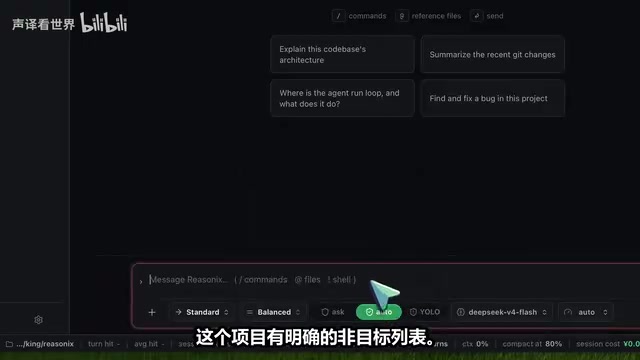
To avoid misunderstanding, RisenX has a clear "non-goals" list: it is designed to support only DeepSeek, does not support multiple providers, has no IDE integration, and no alternative backend modes.
The developers position this as a "feature, not a limitation"—precisely because of the deep coupling to a single backend, they can implement self-explanatory caching and tool-call repair so aggressively. This design philosophy isn't uncommon in software engineering: rather than building a "works with everything but excels at nothing" universal tool, it's better to achieve excellence under a clearly defined constraint. Claude Code similarly only supports Anthropic's models—this "vertical integration" approach allows deeper co-optimization between the tool layer and model layer.
But this also means that if you want a universal tool that freely switches between ten providers, RisenX isn't for you. The lack of IDE integration (like a VS Code extension) is also a notable tradeoff—terminal tools are flexible and resource-light, but may present a usage barrier for developers accustomed to graphical interfaces.
Its true target users are those who have already decided to use DeepSeek as their daily primary model and want an integration framework that maximizes its performance.
Conclusion: DeepSeek's Coding Ecosystem Is Coming Together
Viewing RisenX within the bigger picture makes things clearer: first, the 0731 update turned V4-Flash into a legitimately viable agent model; then DeepSeek adapted the Responses API and Codex (the Responses API is a next-generation API interface introduced by OpenAI in early 2025, intended to replace the Chat Completions API with richer agentic primitives; DeepSeek's adaptation means interface-level compatibility with the OpenAI ecosystem, allowing third-party tools built on this interface to seamlessly switch to a DeepSeek backend); and now the official documentation guides users toward a DeepSeek-native coding agent with Flash as default and Pro as optional. With the rumored upcoming DeepSeek-V4-Pro release, RisenX's /pro command is already ready.
This series of moves forms a complete ecosystem puzzle: foundational model capabilities (V4 series) → standardized interfaces (Responses API compatibility) → native tool integration (RisenX). Each layer paves the way for the next. For comparison, Anthropic's path is Claude models → Claude API → Claude Code; OpenAI's path is GPT models → Responses API → Codex. DeepSeek is completing the same path through open-source community collaboration.
The conclusion is clear: if DeepSeek is your primary model, RisenX is currently the best-fitting integration framework. It's free, MIT-licensed, takes two minutes to set up, and its cache-first design translates directly into real money saved. And its presence in the official documentation signals that future models will likely be tuned and tested against this type of loop.
If you prefer subscriptions or credits over direct API billing, other tools may still serve you well. But for a pure DeepSeek setup, RisenX is the most compelling choice available today.
Related articles

Chain of Thought Isn't Just for AI: How Humans Can Use CoT to Improve Thinking Quality
Chain of Thought isn't just a prompt trick for large models. Starting from a Hacker News discussion, this article analyzes why CoT works for human thinking too, breaks down actionable ways to transfer it, and highlights the key differences between human CoT and machine CoT.
Cloudflare Teams Up with OpenAI: Closi…
Cloudflare Teams Up with OpenAI: Closing the Loop from Vulnerability Discovery to Defense with AI
Cloudflare uses OpenAI Daybreak to investigate security vulnerabilities and generate reviewable remediation plans, while developers use Codex to boost coding efficiency and quality.

Orca Multi-Agent Orchestration in Practice: A Guide to Parallel Collaboration with Claude and Codex
Orca is Stable AI's free open-source agent workbench supporting 34 agents like Claude Code and Codex in parallel. Learn its Git worktree isolation, multi-model orchestration, and mobile management.